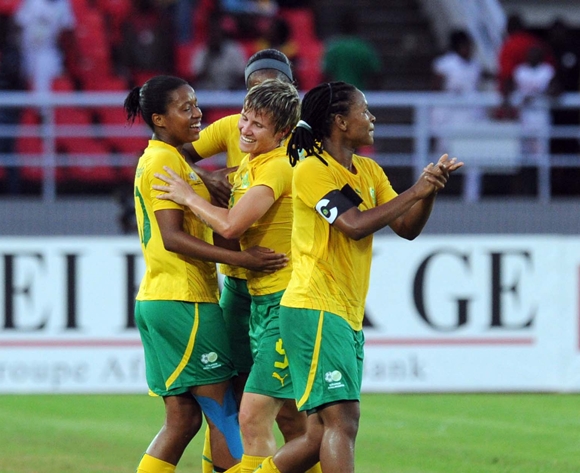
South Africa’s women’s national team recorded its most important victory ever on November 7 by defeating Nigeria 1-0 in the semifinal of the 8th African Women’s Football Championship in Bata, Equatorial Guinea. Defender Janine Van Wyk long-range blast gave Banyana Banyana (The Girls) their first-ever win against the six-time champion Super Falcons. South Africa will face Equatorial Guinea in the final on Sunday, November 11, a team that beat them 1-0 in the first group stage match.
“I have been in the Banyana Banyana side since 2004 and we have tried for so long to beat the Nigerians but luck has never been on our side, but now we have proved that we can compete and beat of the best on the continent,” said Van Wyk. “At the CAF African Championship held in South Africa in 2010 I scored with a free kick from 35 metres out against Nigeria, and my teammates always remind me that I normally reserve my best for matches against Nigeria,” she laughed.
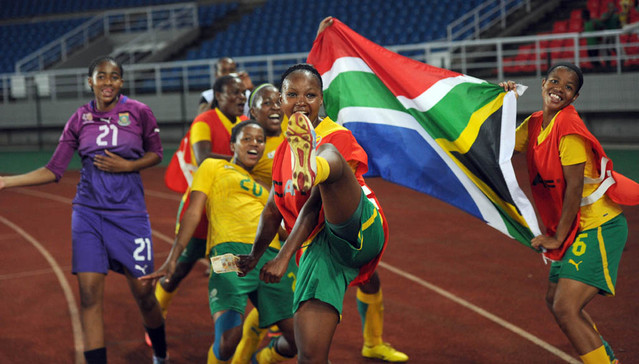
With the men’s team — Bafana Bafana — struggling, it is perhaps not surprising that South African fans and the football establishment are leaping onto the Banyana bandwagon. Following the win against Nigeria, SAFA President Kirsten Nematandani announced he would be flying out to attend the final. “The victory should open doors for the growth of women’s soccer,” he said. “Well done to the girls for making the country proud.”
“We are in a very positive frame of mind going into the final game against the hosts,” said Joseph Mkhonza, the Banyana head coach. “But we are still focused on attaining our mission of taking gold in this tournament. We came here with a mission and that mission is still on track,” he said. “We have some homework to do before Sunday’s final, knowing we will play in front of a large red-clad crowd in what is certain to be a packed Malabo stadium, but we will be ready for the challenge.”
Fútbologia: Talking Football in Bologna

I caught the football virus early on in life. Growing up in Rome, some of my earliest memories of pure freedom and unadulterated joy had to do with playing football with my brothers, friends, and school mates in courtyards, playgrounds, streets and on the dirt and gravel pitches of Villa Ada and Villa Borghese. Eventually, I made it into the CONI Acqua Acetosa football academy, which in the 1970s was a bountiful feeder program for youth development programs across the city, including Roma and Lazio.
This was around the time of the Iranian Revolution and the U.S. Embassy hostage crisis (go see Argo if you haven’t yet). When our creative writing teacher demanded an essay on a global topic, I cheekily produced a (handwritten) lengthy fiction piece about an Iran vs. U.S. “peace match” in Tehran. I coreographed it tightly. President Carter and Ayatollah Khomeini sat next to each other in the VIP seats (!) and at the end of the match the unifying power of sport resolved the diplomatic crisis. Nothing like a young boy’s idealism and imagination!
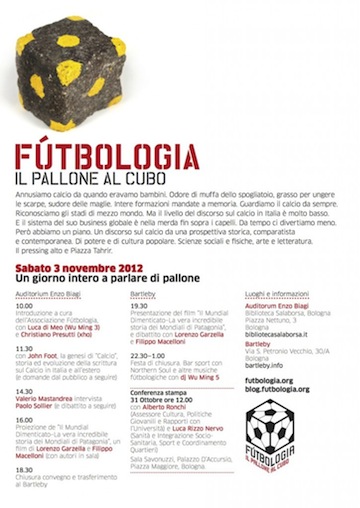
These childhood memories were suddenly stirred up when I learned about “Fútbologia 2012” — a day-long gathering to be held in Bologna on Saturday, November 3. John Foot, lecturer in Italian history at the University of London and author of Calcio: A History of Italian Football will give a keynote address (follow him on Twitter @footymac) based on his book and the evolution of football writing in Italy and abroad.
I liked the emotional, unpretentious prose of the event’s official description, as well as its philosophical thrust. “We sniff football from when we are kids. The smell of mold in the dressing room, shoe polish, sweaty uniforms,” write the Fútbologia organizers. “Entire lineups memorized. We watch football since forever. We recognize stadiums from around the world. And yet the level of discourse on football in Italy is very modest. And its global business system is in deep shit. We’ve been having less fun for quite some time. But now we have a plan. A conversation about football from a historical perspective, comparative and contemporary. About power and popular culture. Social sciences and physical sciences, art and literature. High pressing and Tahrir Square.”
Now that’s what I call a Saturday well spent. Buon divertimento!
For more information visit the futbologia.org blog.
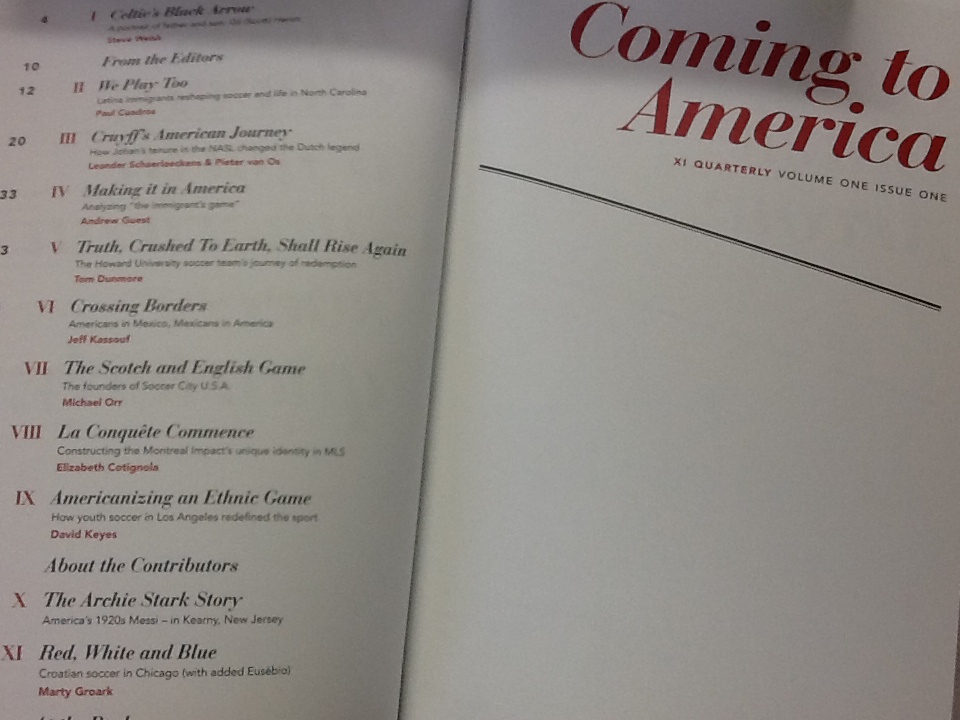
“Neither magazine nor book, but somewhere in between,” is how journalist and author Jonathan Wilson describes the genre of long-form football writing currently gaining popularity in the United States and Britain. I call this genre the bookzine, a hybrid form that lies at the intersection of academia and popular journalism.
In an insightful article at Forbes.com, Zach Slaton notes how in September 2012 “three English-language print publications – XI Quarterly, The Blizzard, and Howler – either debuted or had their latest issue released all within a month of each other.” Each of the three magazines has a distinct style, edge, form, and funding model. Published in both print and digital editions, XI Quarterly and The Blizzard are more narrative and non-commercial than Howler, which emphasizes visual graphics and has a deal with Nike. “We’re embarking on a golden age for such writing,” Slaton writes, one “that may just be sustainable given the niches each one fills.”
The main triggers powering this new trend, according to Slaton, are “the globalization of the game and the tearing down of historical publishing structures.” He’s right, of course, as satellite and cable television, Web publishing, video and audio streaming online, Facebook, and Twitter expanded access for soccer junkies almost everywhere.
Having spent almost twenty years as a sort of football academic, I wonder why this supposed “golden era” is happening right now. Are there some deeper, longer-term factors fueling this sudden explosion of bookzines?
Come on Michael! The American De Rossi

Guest Post by “Er Prof”
Dear friends, unfortunately last week I could not post my comment on the match in Turin, but I can confirm that there are still clouds over the capital. It looks like there are few players who cannot accept Zeman’s ideas and on Sunday the great majority of us at the Stadio Olimpico were speechless when De Rossi and Osvaldo were both left on the bench. We are talking about two Italian internationals, one the top goal scorer and the other “Capitan Futuro,” who will inherit the captaincy when Totti retires. If you need a comparison it is like leaving Pirlo and Vucinic out of Juve’s starting eleven.
The first 20 minutes of the match with Atalanta were horrible for the giallorossi with plenty of chances for the black and blue from Bergamo, one of the Northern cities where the hate against Rome is more visceral. We luckily survived, thanks to the crossbar and three great saves by Stekelenburg. AS Roma finally started playing better and by the end of the first half we were in front thanks to a great pass from Totti (a little spoon pass) to Erik Lamela, the Argentinian striker who softly pushed the ball into Atalanta’s goal. Destro nearly scored a second, but he smashed the cross bar. Then Lamela was fouled inside the box, but the referee had his eyes closed so the first half ended 1-0.
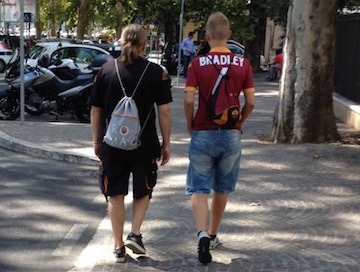
During the second half AS Roma played calmly and without giving space to the opponents. Michael Bradley, back from injury, grew in confidence until he scored the second on an easy ball after a shot from outside the penalty area. Atalanta then seemed to have drawn level, but the referee (wrongly) disallowed it for offside. I ran away from the Olimpico before the end of the match, fearful of watching another victory be senselessly squandered.
I am proud and happy for Bradley who celebrated his first league goal for the wolves right in front of our seats. He played poorly at the beginning of the match, losing possession several times in midfield, but the entire team started with fear in their hearts. Bradley’s performance improved dramatically over the course of the match and I hope he will be on the pitch in Genoa in two weeks time. I remember him from last season’s match in Verona against us; he was one of Chievo’s best players, always fighting and stealing dozens of balls from our midfielders. Now Bradley needs to develop the ability to make the vertical passes crucial for Zeman’s 4-3-3 system to work.
Of course, in Italy soccer is like a religion and so Bradley’s chances of replacing a healthy, in-form De Rossi are almost nil. But Zeman clearly thought Osvaldo and De Rossi were not working hard enough during training, while Bradley showed greater effort and convinced the Bohemian Master. After Sunday’s game, I am confident the American will be a regular choice as one of the three midfielders.
Come on Michael, this is your time!

Guest Post by Chris Bolsmann (@ChrisBolsmann)
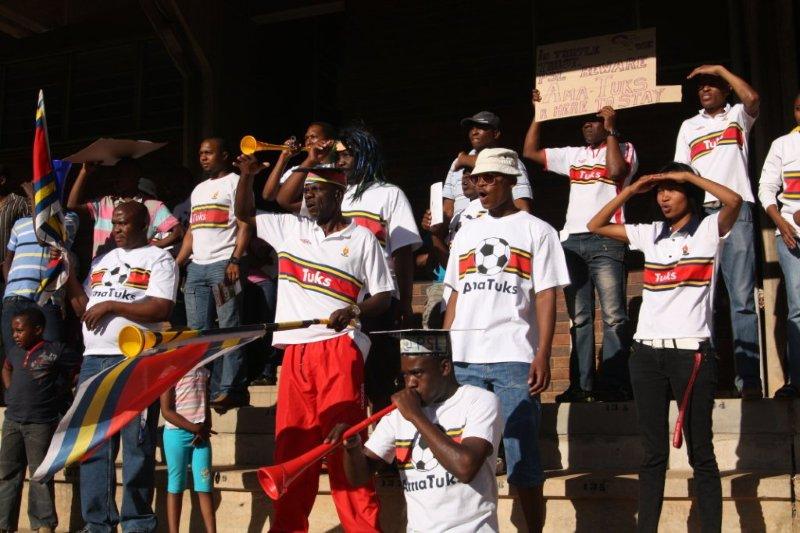
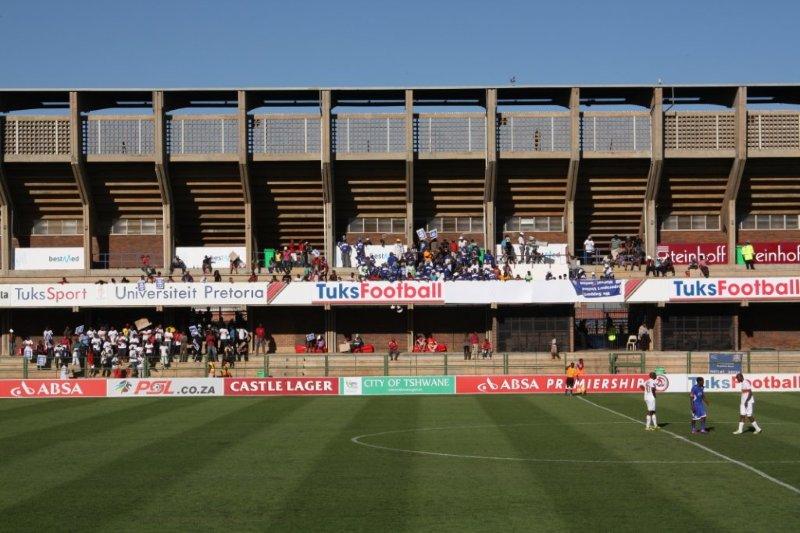
Four matches into the Premier Soccer League season and newly promoted University of Pretoria remain unbeaten. Even more surprisingly, Tuks, as the university side are known, are second on the table behind South African football giants Kaizer Chiefs. The name Tuks is derived from the institution’s original name: Transvaal University College, established in 1908. During a recent visit back to my hometown of Pretoria I watched Tuks play against city rivals Supersport United at the intimate L. C. de Villers Stadium. The uninspiring derby ended in goalless stalemate. Former national team goalkeeper, Rowan Fernandez pulled off a world-class save in the dying minutes of the game to earn Supersport United a point. This moment of brilliance was his only significant contribution but was enough to earn him the man of the match award.
I was an undergraduate student at the University of Pretoria during the volatile early 1990s. The University of Pretoria was an overwhelmingly white campus during this period with a substantial number of visible and active extreme right-wing students. It was a sign of the troubled times that the fascist Afrikaner Weerstandsbeweging (AWB) essentially barred Nelson Mandela from speaking on campus. My politics classes were attended by students who left leave their 9mm pistols on their desks to either intimidate progressive lecturers or students or both.
Between 1993 and 1998 I also played football for Tukkies in the local amateur leagues. We fielded two teams and were relatively successful during this period. Our home ground was one of two fields in the enormous L. C. de Villers sports complex. Training was on Tuesday and Thursday evenings after lectures and matches on Saturday afternoons. Sunday football was deemed to violate the Sabbath and thus prohibited. The university sporting authorities were passionate about rugby but not particularly interested in football. Rugby was played on many pitches and, of course, in an impressive rugby stadium that could seat 10,000 spectators. Soccer teams weren’t issued the university regulation kit nor were we acknowledged at the end of the year sports functions.

With this history in mind, it was great to watch Tuks play PSL football at the former rugby stadium in front of a small crowd that included many black students. How things have changed at the University of Pretoria! Many of the previously sacred rugby pitches are now football fields; the football club now has teams from under 6 all the way up to the professional team. Moreover, women’s teams and university residential hall teams also play competitively.
Why the university authorities have invested substantial resources into football is perplexing. Tuks football is not a money-making venture since it attracts few paying spectators. My sense is that the University of Pretoria sees a professional football team as a marketing opportunity that helps strategically reposition itself as a premier university for all South Africans. The university has changed from its heyday as the elite training ground for Afrikaner nationalists, but as with many of South Africa’s symbols, what do we make of Tuks’s badge featuring an ox-wagon on their white shirts? Will this powerful symbol of the Boer Voortrekkers of the 1830s be reappropriated and adapted for a new era much like the Springbok survived apartheid to remain the symbol of South African rugby?
Guest Post by Elliot Ross (@africasacountry)
1. This high-stakes knockout format might not be so bad after all. Qualifying groups are long, turgid affairs, especially the European ones, international football’s equivalent of the snoozetastic-but-moneyspinning UEFA Champions League group stages. Knockout football puts the big names at risk, as they should be. This past weekend was joyous.
2. Look out for the central African sides. I reckon DR Congo look a good early outside bet (remember current champions Zambia were 50-1 behind Burkina Faso and Libya before the 2012 tournament) and nobody will want to play Central African Republic — Egypt’s conquerors featured in this video — if Les Fauves manage to hold onto their slender 1-0 lead over Burkina Faso.
3. The Sudanese really know how to celebrate a goal. Watching big Sudan-Ethiopia games feels like being back in the 1950s. All we need is Ad-Diba to turn up with his whistle to referee the second leg.
4. Home advantage is everything. Just ask the Moroccans, the Angolans or the Cameroonians. On the flip side, it means all three of those teams will hold out hope of turning their ties around in October. It also means that despite their recent struggles Bafana Bafana can’t be discounted as serious contenders when South Africa host the tournament early next year.
5. Cabo Verde could have a big future in the African game, especially if they can prevent their top players from representing Portugal and other nations.
6. As Jonathan Wilson (@JonaWils) points out, Cote d’Ivoire’s defence looks a bit dodgy. Kolo Toure is seriously slowing down these days and former Dunfermline Athletic stalwart Sol Bamba might be a favourite of Sven Goran Eriksson, but he’s not the most positionally sound. Thankfully, Eboué has been restored by Sabri Lamouchi at the expense of the clunking Gosso. Hopefully, Seydou Doumbia will be next.
7. Papiss Demba Cissé is a genius. As the video above shows, the Senegalese striker scores goals most players wouldn’t dream of attempting.
8. Zambia have to be very careful in their second leg in Kampala. That encounter is going to be tense, and I’ve got a hunch Uganda will do a number on the African champs.
9. I miss Samuel Eto’o. What’s the price for his dramatic return in the second leg? If Eto’o does not show, then Cameroon look doomed. Whatever the internal drama behind this years-long row, it’s a dispute between a handful of soon-to-be-forgotten officials and one of Africa’s greatest footballers ever, and the result is to that a huge chunk of international matches is missing from his career and Cameroon are absolutely hopeless.
10. Remember the name: Christian Atsu. Is he the Ghanaian Messi? We don’t know but he looked tasty against Malawi and Porto’s scouts really know talent when they see it.
South Africa’s Premier Soccer League is back in action. For the next nine months, we are assured of the thrills, spills, and glossy mediocrity of Africa’s richest domestic championship. Things are already getting interesting. Newly promoted Chippa United fired their coach just two games into their maiden PSL campaign and Mamelodi Sundowns walloped crowd favourites Kaizer Chiefs 4-1 in the MTN 8 quarter-finals before crashing to a 2-1 home defeat against lowly Maritzburg United.
Off the pitch, the heir-apparent to the Chiefs’ throne and incumbent team manager, Bobby Motaung (whose father, Kaizer Motaung, is the founder-owner of the club) was arrested and then released on bail in relation to allegations of fraud and corruption around the construction of the Mbombela Stadium used in the 2010 World Cup. It says a lot about the state of South Africa that the son of a multi-millionaire — and a wealthy man in his own right — is one of the people under scrutiny for illegal self-enrichment from an expensive tournament that was punted to economically uplift so-called ordinary men and women on the street.
The prelude to any forthcoming football season is typified by the movement of players, coaches and even administrators to new teams. While the top clubs made the obligatory headline-grabbing plunges into the transfer market, Bidvest Wits made the boldest acquisitions. (Formerly known as Wits University, “The Clever Boys” were bought by one of the country’s biggest financial companies a few years back.) Their long-serving coach departed, a new CEO was appointed, and a number of high-profile players signed. Could these moves mark the dawn of a new era for the Johannesburg club? Or will they remain little more than a mid-table team capable of an upset or two and an occasional run in a knockout tournament?
Probably the most notable new Wits recruit is former Bafana Bafana captain, Aaron “Mbazo” (“The Axe”) Mokoena. The player most likely to partner Mbazo in the centre of the defence is the man he replaced as national captain: Mbulelo “OJ” Mabizela. The progression of the two centre-backs’ careers could not be more divergent. Yet they seem to capture the different experiences and trajectories of players who emerged in the PSL, made it the Promised Land of the English Premier League, and then returned home to play out their days.
Both men were born in 1980. Mbazo was the first to make it to the professional ranks. After being discovered by the iconic manager Jomo Sono at the age of 15, he made his professional debut two years later, and soon he was in the national team. His ascension to Bafana Bafana, however, was shrouded in controversy. Caretaker coach Jomo Sono selected the unknown and unproven Mokoena for the 1998 African Nations Cup in Burkina Faso where Bafana Bafana were to defend their continental title. Jomo Sono is not only a club owner and manager, but also a player agent of note, and there were rumblings that his selection of Mbazo was largely influenced by his personal interests in the young defender. The rumblings proved to be accurate.