Categories
Fútbology

World Cup: The Syllabus

The Global Sport Lab at the University of Washington’s Jackson School of International Studies just released World Cup: The Syllabus, a free online resource “intended for anyone interested in learning more about the history and politics of the World Cup, curious about some of the current and past controversies, or just wants to understand a little more about why people care so very much about these global events that take place every four years.”

The syllabus features seven thematic sections — FIFA, Migrations, Protest and Resistance, Arts and Culture, Human Rights, Stadiums,Technology — each featuring concise intro essays, curated reading lists, and 4-6 discussion questions to guide reading and exploration.

I am proud to have been part of the project’s editorial team, which worked together flawlessly, almost like Cruyff’s Ajax or Pep Guardiola’s Barça. We hope you enjoy this intellectual journey through the world of global football!

Categories
Fútbology

2023 Women’s World Cup: Roundtable

FSF_round_logo

The upcoming FIFA Women’s World Cup in Australia and New Zealand/Aotearoa will make history: the first co-hosted WWC; first in the southern hemisphere; first with 32 teams; and first with guaranteed prize money for all players.

Historians Jean Williams and Brenda Elsey, and anthropologist Hillary Haldane led a wonderful session on the Football Scholars Forum focused on the politics, economics, culture, and history of the most popular event in women’s football.

Click on the link below to listen to the June 13, 2023, discussion.

Categories
Fútbology

Professors of Fútbology

Dr. Philipp Gollner invited Brenda Elsey (Hofstra University), Pablo M. Sierra (University of Rochester) and me on to The Assistant Professor of Football podcast to talk about what it’s like to “regularly teach, in American university classrooms, about football — its culture, its meaning, its history.”

As the show notes for the episode released on June 1, 2023, put it: “We talked about how that teaching is going, what would it be like to take a class with them, what do they assign, and how did they get into this subject in academia in the first place, and what good books are being written about the beautiful game beyond the well-known popular ones. And then we went on to opine more broadly, about the future of the game globally as well as here in the US, the next World Cup, why awful people run clubs, and what makes the beautiful game such a unique angle to understand the world.” 

Click on the link below to listen to the episode:

https://theassistantprofessoroffootball.buzzsprout.com/2052670/12964341-teaching-soccer-three-actual-professors-of-football-on-their-college-classes-and-soccer-literacy-in-the-u-s

Categories
Fútbology

FSF Summer Series: The Age of Football

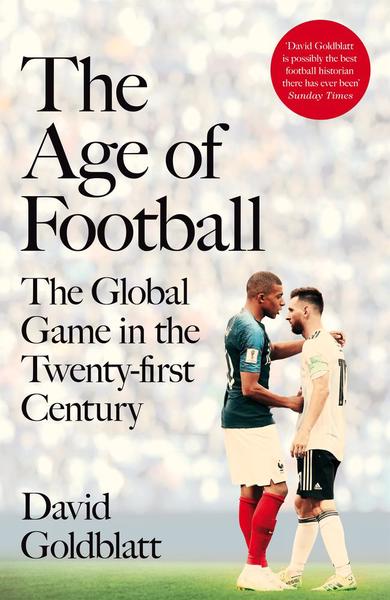
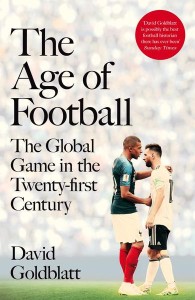
Age_of_Football_UK_coverWith Euros 2020 postponed until 2021 due to the COVID-19 pandemic, the Football Scholars Forum organized a five-part summer series with academic, journalist, and broadcaster David Goldblatt on his new book, The Age of Football: The Global Game in the Twenty-first Century [UK edition here / US edition here].


A longtime FSF member, Goldblatt is the award-winning author of several football books, including the highly acclaimed The Ball is Round: A Global History of Football, which FSF discussed here and here.


A record-setting 56 participants from five continents registered for the series. Each Tuesday 90-minute Zoom session focused on a different chapter (or chapters) in the 551-page book. Discussants opened each intellectual pick up game with a number of comments and questions. Given the book’s length and depth, this approach broke the conversation down into more digestible chunks and made it easier for individuals to contribute on topics of particular interest or expertise.


As the convenor of the series, I served as the first discussant on June 9 in the session on Africa. Danyel Reiche and Alex Galarza collaborated the following week on the Middle East and South America; then on June 23 Lindsay Krasnoff led on the 119-page chapter on Europe (read her comments here); on June 30 Andrew Guest was the discussant for the chapters on East Asia and North America/Central America/Caribbean; finally, on July 14, Simon Rofe and Matthew Pauly spearheaded the fifth and final session devoted to FIFA, Russia, and the 2018 World Cup.
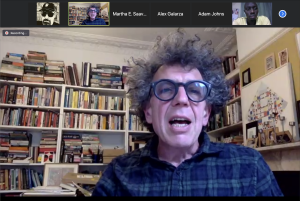
 

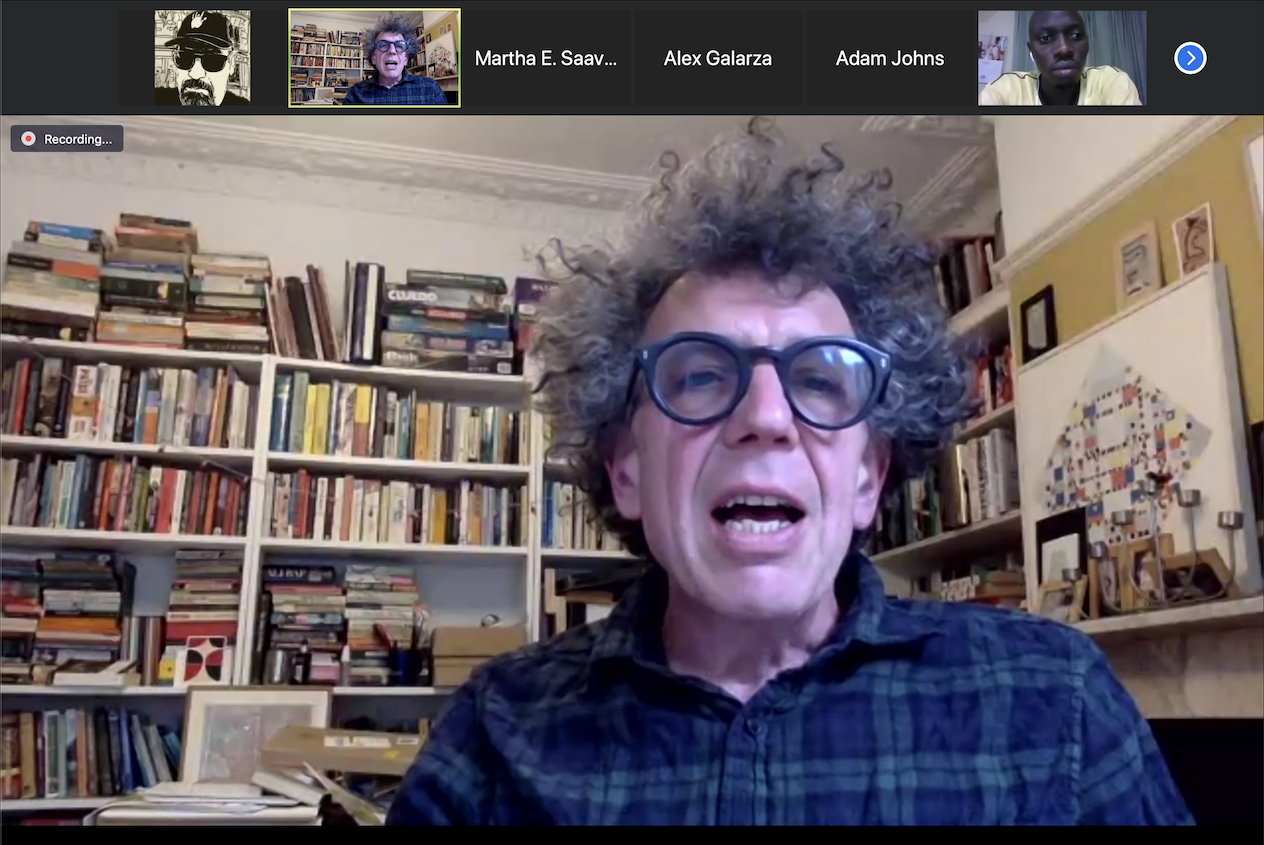
Screenshot of conference call“It’s the hardest book I’ve ever written,” Goldblatt revealed. “A combination of Brexit and COVID kind of ate its public reception alive. That was quite hard to process,” he said. “This [series] has been a fabulous corrective to that. It means a lot to have you read it, to know that it held your attention, entertained you and maybe enlightened you along the way.”


David Goldblatt’s extraordinary endurance, encyclopedic mind, grace and humor, com bined with the vital and sustained contributions of discussants and dozens of participants, made this series a truly extraordinary experience.


Listen to the audio recordings of each session below (personal/educational use only).

The Age of Football, Part 1

The Age of Football, Part 2

The Age of Football, Part 3

The Age of Football, Part 4

The Age of Football, Part 5
Categories
Fútbology

Beyond Master Narratives: Local Sources and Global Perspectives on Sport, Apartheid, and Liberation

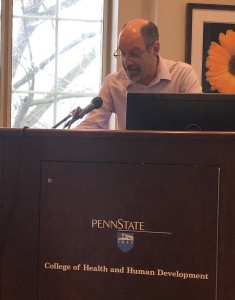
Alegi speaking at Penn StateMy article “Beyond Master Narratives: Local Sources and Global Perspectives on Sport, Apartheid, and Liberation” has just been published in The International Journal of the History of Sport (2020).


This article is a revised and peer-reviewed version of a 2019 keynote address I delivered at the “Global Histories: Sport and Apartheid South Africa” symposium at Penn State University.


Abstract


Drawing mainly on a set of oral and written primary sources situated in their proper historical and geographical context, this article explores how multiple forms of agency and memory shaped the history of sport, apartheid and liberation in South Africa. In doing so, it argues that a new revisionist history is needed in order to problematize the entrenched ‘master narrative’ of South African sport history, which privileges national redemption and patriotic heroism at the expense of more complex individual, local and global dynamics. The article concludes with suggestions for future research directions in order to assist a process of decolonizing sport history in South Africa.


To link to this article: https://doi.org/10.1080/09523367.2020.1773434

Categories
Fútbology Video

“Outside Write” Podcast Interview

Outside Write logoI was recently interviewed by Outside Write, the UK podcast about football (soccer) travel, history and culture.


In just 45 minutes we covered a lot of ground in the  history of football in Africa: the arrival and spread of the sport during the colonial era, and stories about race, class, politics, and international migration. We even had time to highlight some watershed World Cup moments.


Click here to listen. Enjoy!

 
Categories
Fútbology

Football Scholars Forum 2019-20 Schedule

FSF_round_logoThe Football Scholars Forum, based in the History Department at Michigan State University, is set to celebrate its tenth anniversary!


Originally conceived as an online academic book club, FSF has evolved into a vibrant international soccer studies community. Professors, graduate students, journalists, fans, and practitioners take part in 90-minute sessions. A distinguishing feature of FSF is the participation of authors willing to engage with an audience of knowledgeable fútbologists. Out of these conversations have sprung new sources and ideas, scholarly collaborations, publications, conference papers, and grants.


The 2019-20 schedule features a terrific lineup of books and authors. The season opens on September 24 (3pm US ET) with Futbolera: A History of Women and Sports in Latin America by Brenda Elsey and Joshua Nadel. Futbolera is “beautifully written, meticulously researched, incredibly thoughtful,” writes author and historian Amy Bass. “A must read,” says Laurent Dubois of Duke University.


On October 30 (3pm US ET), it’s time for Football and Colonialism: Body and Popular Culture in Urban Mozambique by Nuno Domingos. One reviewer of the book notes how “as Domingos effortlessly oscillates between colonial policy and indigenous response, he brings the city [of Maputo] alive, and at the heart of the text are the African players themselves.”


The following session is planned for December but is not centered around a book. Instead it focuses on the six-part documentary film This Is Football. Released on the Amazon Prime platform and boosted by endorsements from major companies, this series is likely to elicit a range of critiques from the experts. [Watch the trailer here.]


After the holiday break, FSF rekindles the excitement of the 2019 Women’s World Cup with a session on Caitlin Murray’s National Team: The Inside Story of the Women Who Changed Soccer. Sports Illustrated‘s Grant Wahl praises the book for “shedding new light on all the major tournaments while revealing fascinating details on [the USWNT’s] decades-long fight for better treatment from the men who run soccer.”


The last two sessions will grapple with David Goldblatt’s new 700-page book The Age of Football: The Global Game in the 21st Century. In all seriousness a British journalist called him “not merely the best football historian writing today, he is possibly the best there has ever been.” The dates for both the Murray and Goldblatt events are yet to be determined so stay tuned for updates.


A friendly reminder that all FSF events are free and open to the public. Anyone interested in participating should contact Dr. Alex Galarza (now at the University of Delaware) or me.