 Alex Galarza, a PhD student in history at Michigan State University and co-founder of the Football Scholars Forum, has been awarded the João Havelange Research Scholarship. This prestigious award is administered jointly by FIFA and CIES (Centre International d’Etude du Sport), an independent research center created in 1995 by the governing body in collaboration with the University of Neuchâtel, and the City and State of Neuchatel, Switzerland.
Galarza’s project is titled “Between Civic Association and Mass Consumption: The Soccer Clubs of Buenos Aires.” It explores how clubs developed as both centers of mass spectacle and sites of everyday urban sociability. Club members and officials used political connections to secure city space and public subsidies for stadiums and the overall success of their professional teams. While clubs became centers of patronage and spectacle, they were also non-profit civic associations central to social and cultural activities in the city. Clubs provided educational facilities, libraries, leisure space, and political forums for their members.
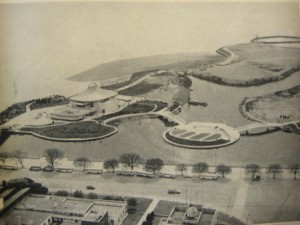
Galarza’s research examines the tensions within football clubs during the mid-twentieth century, an era when Argentine society entered a period of deep economic and political changes following the ouster of Juan Domingo Perón in 1955. Perón’s project aimed at developing a new kind of citizen and civic culture in which the popular classes would have a greater political voice and heightened access to new forms of mass consumption. Mass political participation and consumption remained critical and unresolved tensions during the democratic and military governments that followed. One powerful example of how soccer clubs gave shape and meaning to civic engagement, popular spectacle, and mass consumption is Boca Juniors’ Ciudad Deportiva (in photo above). This failed project was a mix between a stadium complex and amusement park, built over seven artificial islands on sixty hectares of land filled in the Rio de la Plata.
Click here to read a digital version of Galarza’s preliminary work on the fascinating history of the Ciudad Deportiva.
Check back with us for an interview with Galarza in the coming days.
Categories
A “Hallmark Holiday” for American Soccer
Guest Post by Tom McCabe
I’ve been invited to not one, but three Boxing Day parties this year, which got me thinking that the day after Christmas should become a soccer holiday in the United States. Like other manufactured holidays such as Grandparent’s Day, Secretary’s Day, and Boss’s Day, Boxing Day can become American soccer’s Hallmark Holiday.
This country has no real tradition for December 26th, unlike England and some other Commonwealth countries, so two Englishmen and one American I know have co-opted the day and made it an “unofficial” soccer holiday.
My friend Jimmie’s son was born seven years ago on Boxing Day, and ever since he has an open house for his soccer-loving friends and family. He wants his son’s birthday to always be filled with soccer. His house is just seven exits away on the Garden State Parkway (yes, the “Which exit?” New Jersey joke lives on) so my son and I watch a Premier League match as we eat an early morning English breakfast.
Phil, an Englishman, just started his Boxing Day party, but we’ll have to pass on it as one in our hometown gets top billing. Steve, a Scouser who supports Liverpool, has hosted a match and after-party for a number of years now.
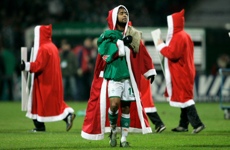
The event starts as an eleven-a-side “international” between England and the U.S.A., but disintegrates into a twenty-a-side melee when the kids join in. It ends with a party at the local Elks Lodge. Last year, the Stars and Stripes posted a convincing 4-1 victory over Mother England on a clear, cold day. One player dressed as a Victorian-era Englishman with a retro Three Lions jersey, long white shorts, and a faux mustache. After the match we warm ourselves with meat pies and beer.
It’s a festive day of food and football that others should partake in. Soccer clubs could use it as a get-together after the fall season. Professional clubs might use the opportunity to stage an exhibition match, advertise the coming season (Major League Soccer just announced its home openers for 2013 this past week), or just host fans for a holiday party.
Whatever the motivation, December 26 could become a day that gets you off the couch and back onto the field. With soccer as its focus, it would be better than any of those other Hallmark Holidays.
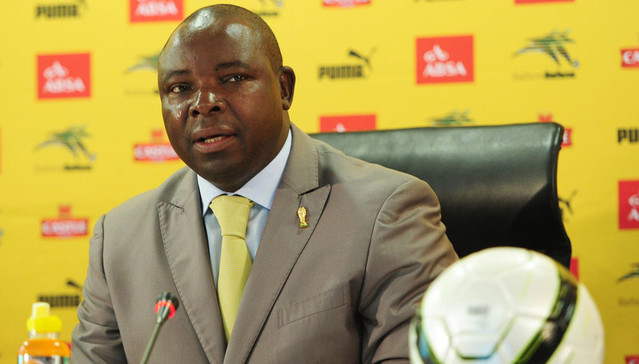 These are interesting times for politics and football in South Africa. The African National Congress is meeting this week in Bloemfontein/Mangaung to select the ruling party’s new leaders while 94-year-old Nelson Mandela is still hospitalized recovering from surgery and a lung infection. Domestic football has been rocked by a FIFA match fixing report alleging that a transnational match-fixing syndicate based in Singapore, assisted by South African Football Association (SAFA) officials, fixed Bafana Bafana’s friendlies against Thailand, Bulgaria, Colombia and Guatemala in the build up to the 2010 World Cup. Five SAFA men, including its president, Kirsten Nematandani (in photo above), have been suspended pending “further examination” of possible “criminal intent in collusion” with a front organization set up by the convicted match fixer Wilson Raj Perumal.
Consumed by the details of this latest sporting malfeasance as well as the tensions in ANC politics at a particularly difficult moment for South Africa, I was stunned to belatedly learn of the death of Sedick Isaacs at the age of 72. I had the extraordinary privilege to meet him in 2010 while a Fulbright Scholar at the University of KwaZulu-Natal (UKZN). I was humbled and honored to share the stage with Isaacs in a symposium on football history held on the UKZN Westville campus and sponsored by the German cultural exchange program, DAAD.
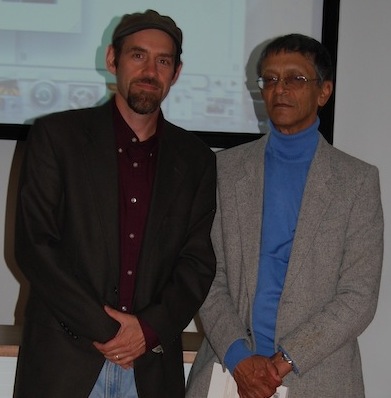
Isaacs spoke matter-of-factly about the cruelty and hardships endured during his 13 years on Robben Island. What had earned him a place in apartheid’s most notorious prison had been his role as saboteur in the armed struggle. Standing before us wearing a blue sweater in the humidity of sub-tropical Durban, Isaacs pointed out that his years on Robben Island had left him always feeling cold regardless of the temperature. A point he reiterated in Cape Town two weeks later when he spoke at my book launch for African Soccerscapes. (That’s us in the photo below.)
By studying and playing on Robben Island, Isaacs told us, prisoners formed and maintained communities of survival and resistance. He earned a university degree while behind bars and also helped to build and administer the prisoners’ Makana Football Association. (The story is admirably told by Chuck Korr and Marvin Close in More Than Just a Game: Football v Apartheid.) When the prisoners finally secured the warden’s approval for their league after three years of struggle, Isaacs ended up handling much of the day-to-day operations of the Makana FA.
 Dr. Isaacs explained that the weekly cycle of matches proved crucial in fighting “eventless time” — a debilitating condition for prisoners serving lengthy sentences. The cycle worked something like this: teams started the week by analyzing the previous match and then by midweek there was growing anticipation for upcoming matches. Conversations, banter, and meetings stoked the hype and created heroes and personalities. By the weekend, excitement surrounding the matches reached fever pitch. Football’s importance, Isaacs said, was enhanced by its force as a provider of human emotions in an emotionally neutral context.
Isaacs pointed out that the only positive effects of long prison sentences is that they can strengthen prisoners’ organizational skills and improve their understanding of human nature. The activities of the Makana FA reinforced this outcome. Intriguingly, both candidates for the ANC presidency in 2012, South African President Jacob Zuma and his challenger Kgalema Motlanthe, played football on Robben Island. “If it had not been for the beautiful game and these community building devices,” Isaacs concluded, “we could have become psychological and physical wrecks incapable of integration into a multicultural world, let alone be able to contribute positively to it.” May you rest in peace Sedick Isaacs. An exemplary South African who can teach folks in Mangaung and at SAFA a few lessons about doing the right thing in politics and football.
Categories
Motor City Celebrates US Women’s Team
Guest Post by Sophie Alegi
11-year-old soccer player and writer in Michigan. This is her first match report.
December 8, 2012
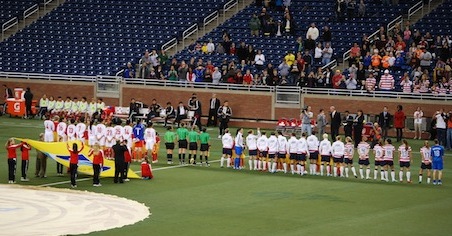
Detroit –17,371 people came to Ford Field to watch USA vs. China: an attendance record for a women’s soccer game in Michigan.
The US was not used to the artificial surface. Players struggled to control the ball. The surface was clearly not appropriate for soccer because when they passed the ball, it bounced up and down slightly, as if the carpet was ruffled.
China’s defense was shaky in the first five minutes, letting at least six shots be hammered at their goalkeeper, Zhang Yue. The best chance was for Amy Rodriguez who was playing in her 100th international match. China let the US pin them down in their own half. But the Chinese pulled together, playing tight defense.
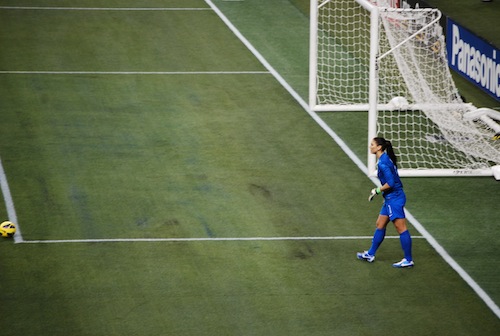
All of the players were extremely close together; making it very difficult for the US to connect their usual passes. The US started to look a little wobbly in the back, with Shannon Boxx giving up ball after ball in the defensive third. Hope Solo managed to keep out a powerful shot by the Chinese number ten with a spectacular aerial save.
In the midfield, the US gave up at least ten balls, giving China easy opportunities to go forward. But the US defense held up, and only a few shots were directed at Solo.
Unfortunately, the two times the ball went down the wing Megan Rapinoe failed to get the ball to Abby Wambach’s head. China started to get physical about eighteen minutes into the half. Every time an American player turned, she would get brutally fouled. It hurts to fall on that carpet surface!
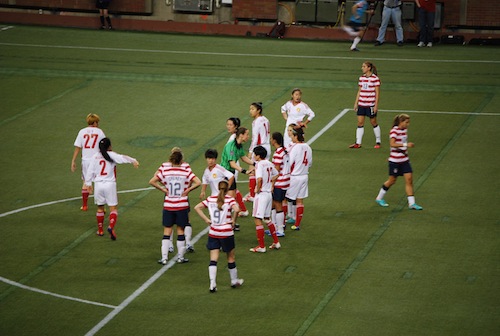
Twenty minutes in, a Chinese player got a yellow card. On the resulting play, Wambach received a cross. The ball glanced off her head and out. She probably wanted that one back. The young Chinese team did well to close up the gaps, but the US team was playing at the speed of molasses.
Thirty minutes in the US began to play in the Chinese penalty box. They would pass around on the outskirts, trying to find an opening. The referee was not very good. She botched a corner kick call and awarded a goal kick instead. A corner was awarded to the US thirty-one minutes in. Wambach got clattered on the back post by a giant Chinese defender.
The 90th Minute Trailer from Jun Stinson on Vimeo.
The Football Scholars Forum is holding its final session of the 2012 season on Wednesday, December 5, at 3:30pm EST, on Jun Stinson’s short film, The 90th Minute. The 20-minute documentary follows three members of FC Gold Pride, the 2010 Women’s Professional Soccer champions. The film sheds light on what it’s like to be a female pro player in the U.S. — a dream that has become more elusive after the demise of the WPS.
Why do Hope Solo, Alex Morgan, Megan Rapinoe, Abby Wambach and others struggle to play professionally in their country? Why have two pro women’s soccer leagues failed since the heady days of Mia Hamm, Brandi Chastain and the 1999 Women’s World Cup? What needs to happen for a new women’s league in the U.S. to be sustainable? How does the situation in the U.S. compare with international trends?
Jun Stinson recorded an interview with me ahead of the session in which I also asked a few questions on behalf of FSF members. To listen click here. Gwen Oxenham, former Duke and Santos player and one of the producers of the film Pelada will participate in what promises to be a terrific season finale!
For more information about this event please contact Alex Galarza: galarza1 [at] msu [dot] edu.
Update: On November 21, “U.S. Soccer president Sunil Gulati announced the launch of a women’s professional league which will start play in March.” Details here.
Théophile Abega, the heart and soul of Cameroon’s superb national team of the 1980s, has died at the age of 58. Thoughtful, elegant, and tough, Abega had an illustrious club career with Canon Yaoundé. He was a dominant force in the team that twice won the African Champions Cup (1978, 1980), the African Cup Winners’ Cup (1976, 1979), and three domestic league titles. Abega’s only World Cup participation was in 1982 in Spain, where Cameroon drew all three group stage matches against Peru, Poland, and Italy.
I remember watching him on TV against my beloved Azzurri in an extraordinarily tense contest with qualification to the next round on the line. Abega’s composure, strength, and technique were striking. As a result of the 1-1 draw, Cameroon was eliminated on goal difference (number of goals scored in fact) but nevertheless enhanced the image of African football on the global stage. Two years later, as the video above demonstrates, Abega was at his footballing peak as Cameroon defeated Nigeria 3-1 in the 1984 African Nations Cup final. The Indomitable Lions returned to international glory at the 1990 World Cup in Italy (Roger Milla!), but by that time Abega had closed out his career with Toulouse in France and no longer commanded Cameroon’s midfield with his consummate professionalism and style.
May his soul rest in peace.
Categories
Banyana Banyana Win Silver: What Next?
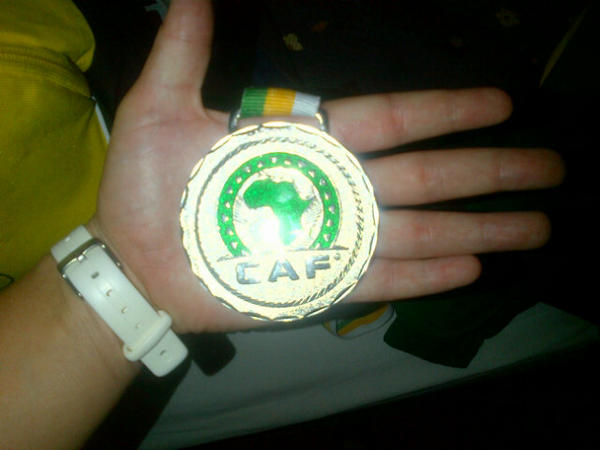
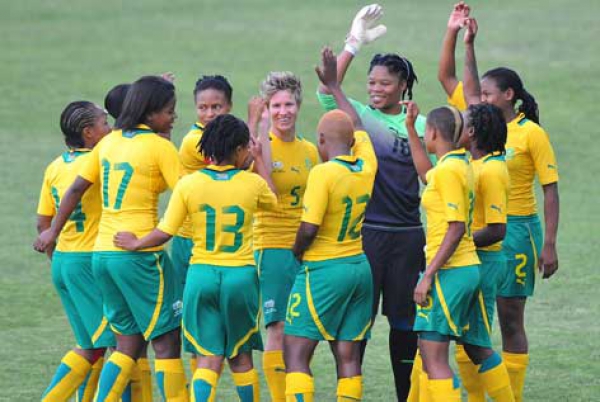 Boosted by a home crowd of 20,000 fans, including President Teodoro Obiang Mbasogo, Equatorial Guinea crushed South Africa 4-0 in the final of the 8th African Women’s Championship in Malabo on Sunday.
Banyana Banyana — as the team is affectionately known — held out until the 43rd minute when the home team took the lead through Chinasa’s header from a corner kick. The goal seemed to take the wind out of Banyana’s sails. After the break the qualitative difference between the two sides became evident. Midway through the second half Banyana lost their concentration, giving up three goals in six minutes to the Nzalang Nacional (Nation’s light): Costa (66′), Anonman (70′) and Tiga (72′).
“Falling at the final hurdle is a major disappointment to all involved with Banyana Banyana,” said head coach Joseph Mkhonza at the post-match press conference. In a year that saw South Africa’s women’s team reach two major milestones, competing in the Olympics for the first time and finally beating powerhouse Nigeria, Mkhonza looked ahead and said that “Banyana Banyana should be able to qualify for international tournaments, such as the World Cup and the Olympics, in the future.”
 It is always tough to play a final against the host nation, but the big game in hostile territory did appear to get the best of the South Africans. The night before the match, for example, Banyana captain Amanda Dlamini (@Amanda_Dlamini9) shared her state of mind on Twitter. “I don’t know how I’m going to sleep tonight. If I’m going to sleep at all,” she wrote. Then a few hours before the match, defender Janine Van Wyk (@Janinevanwyk5), whose marvelous goal beat Nigeria in Wednesday’s semifinal, tweeted: “Very IMPORTANT game today. I’m so nervous its [sic] insane but I know we will do well.” Perhaps adding to the pressure of the moment, the office of the Presidency (@PresidencyZA) followed by tweeting its support: “President Zuma wishes Banyana well.”
That Banyana could not field three overseas players partly explains Sunday’s result. Midfielder Kylie Ann Louw and reserve goalkeeper Roxanne Barker stayed in the United States due to study commitments, while midfielder Nompumelelo Nyandeni remained with her club in Russia. “Losing a player of Nyandeni’s talent and experience will always be a setback to any team,” said Mkhonza. Another factor to consider has to do with oil-rich Equatorial Guinea’s “willingness to hand out passports to players who agree to play for them without any period of residency,” as Ian Malcolm of goal.com put it. “Almost the entire squad selected for the African Women’s Championship were born outside Equatorial Guinea, most in Brazil, but also in other African states.” While not illegal according to FIFA rules, the ethics of this all-star team formation are questionable.
The buzz about Banyana from South Africans on social media was overwhelmingly positive. “You did South Africa proud, the whole team deserves a heroes welcome. You passed all expectation and showed your greatness,” @RhandzuOptimus wrote in a tweet that captured the general tenor of South Africans’ reactions. The government chimed in too. Sports Minister Fikile Mbalula said that “Although they did not win the (African) Championships, Banyana Banyana have proven that they are an ever improving team that has shown progress over the last year.”
Now that the tournament is over what will happen to the “Banyana Bandwagon”? Practitioners and fans know that women’s football in South Africa needs much more investment and support. Even at the elite level there is no season-long national league. And as Thabo Dladla, founding director of Izichwe Youth Football in Pietermaritzburg, explains in a comment to my previous Banyana post: “There are no competitions for girls junior teams. Our girls only start playing football at the university level. These issues have nothing to do with money. SAFA should play the role in terms of promoting the game.” The road ahead is long and tortuous. We’ll be following developments closely.
Suggested Reading
Prishani Naidoo and Zanele Muholi, “Women’s bodies and the world of football in South Africa,” in Ashwin Desai, ed., Race to Transform: Sport in Post-Apartheid South Africa (HSRC Press, 2010).
Cynthia Fabrizio Pelak, “Women and gender in South African soccer: a brief history,” Soccer and Society 11, 1/2 (2010); 63-78.
Martha Saavedra, “Football Feminine—Development of the African Game: Senegal, Nigeria, and South Africa,” Soccer and Society 4, 2/3 (2003): 225-253.