Categories
Fútbology

The Soccer Conclave

Hofstra_soccerconf_logoThere may not be any white smoke coming out of the soccer conclave this week at Hofstra University in New York, but little else will be missing from an unprecedented fútbological event featuring presentations by more than 100 scholars, journalists, authors, coaches, and the King of Soccer himself: Pelé.
Historians Brenda Elsey and Stanislao Pugliese are the presiding cardinals of Soccer as the Beautiful Game: Football’s Artistry, Identity and Politics , an international conference hosted by the Hofstra Cultural Center and the Hofstra Department of History. The gathering begins on Thursday, April 10, with concurrent panels, an opening ceremony, and two keynote addresses by David Goldblatt (“Brazil: The Curious Rise of the Futebol Nation”) and Jennifer Doyle (“Imagining a World Without a World Cup: An Abolitionist Perspective).

Friday’s menu serves up a plethora of panels on a dizzying range of topics and a ceremony honoring Pelé with the conferral of an honorary degree. Saturday’s focus is on journalists, coaches, philanthropy round-tables, followed by a concluding plenary session, and . . . a pickup game on the New York Cosmos home ground! (Note to self: remember to pack turf shoes.)

I’ll be presenting a paper comparing World Cup 2010 in South Africa to World Cup 2014 in Brazil (click here to listen to an earlier version of this talk) and also participating in the Football Scholars Forum on academic vs. journalistic writing about soccer (click here to watch my pre-conference video blog and here to read the other five posts by my fabulous co-panelists).

Categories
Fútbology

Football Scholars to Discuss Soccer and Politics in France

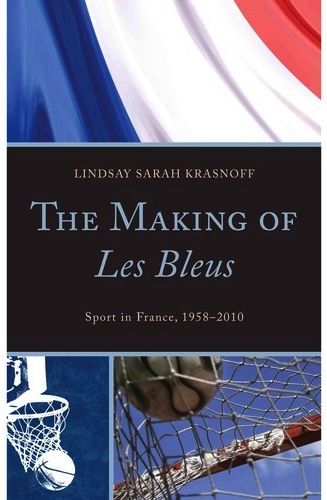
making_lesbleusThe Football Scholars Forum 2013-14 season resumes on February 12 with a discussion of Lindsay Krasnoff’s The Making of Les Bleus: Sport in France, 1958-2010.

The book “traces the Fifth Republic’s quest to create elite athletes, a compelling tale that serves as a prism through which to investigate the larger history of France, the evolution of society, the impacts of the media revolution, and the government’s mission of public health. It provides perspective on how France coped with and adapted to the post-1945 world and underscores just how much things have changed—yet still remained the same.” 

An active member of the Football Scholars Forum (FSF), Krasnoff is an historian of France and Modern Europe, with expertise in sports, media, and foreign policy. You can listen here to Lindsay discussing her book on the New Books in Sports podcast.

To participate in the online 90-minute session, which begins at 8pm Eastern Time, please email me (alegi.peter AT gmail.com) your Skype name (if I don’t already have it) so you can be added to the conference call.

FSF has two more public events scheduled in the lead up to the 2014 World Cup in Brazil.  In March (25/26, time TBD), the fútbol think tank is trying something new. Instead of members reading a common book, each participant will read a different fútbol book (or lengthy article) and give a 5-7 minute report about it to the rest of the group. The idea is to produce a sort of “state of the field” snapshot from various world regions and academic disciplines.

Then in April, I’ll be joining several FSF soccerati in attendance at the “Soccer as the Beautiful Game: Football’s Artistry, Identity & Politics” conference at Hofstra University (Long Island, NY). In addition to scholarly papers and presentations, the conference features a special FSF-sponsored roundtable on “Academics, Journalists, and the Changing Trends in Fútbol Writing.” I’ll be doing a post about the Hofstra roundtable in the coming weeks.

Categories
Fútbology

Football Writing Today with Jonathan Wilson

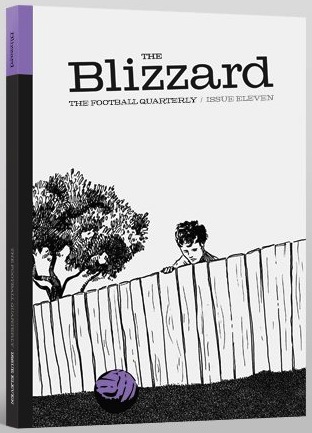
blizzard9_coverOn December 5, Jonathan Wilson, journalist, author, and founding editor of The Blizzard, and the Football Scholars Forum convened for an online session devoted to independent fútbol writing in a digital age.

Wilson fielded a range of questions from an international audience from five continents. The 90-minute conversation blended English pragmatism and fútbol romantico, and indirectly grappled with Simon Kuper’s critique that “Football just isn’t what it’s cracked up to be,” and “anyone who peeks behind football’s curtain discovers there is no magic there.”

The Forum with Wilson pivoted around the notion that there is a growing English-speaking audience for longer-form writing about the game that goes beyond mixed-zone clichès, diatribes about managers, questionable refereeing decisions, and other narrow, shallow concerns of so much contemporary sport journalism. The challenges and opportunities of publishing in print and digital formats sparked conversation and debate, as did the evolving relationship between the futbology work of reporters and academics.

The audio recording of the session is available here.

For a Storify Twitter timeline click here, with special thanks to Liz Timbs (@tizlimbs).

Learn more about the Football Scholars Forum here.

Categories
Fútbology Hosting

Forum on Football in the Middle East

20131123-194419.jpgThe Football Scholars Forum, an international online think tank, convened on November 14 to discuss Football in the Middle East. The conversation focused on a special issue of the academic journal Soccer and Society, edited by Alon Raab and Issam Khalidi. The group began by noting that while football has been a critical force in broader political and cultural developments in the region, there is little institutional support for studying the game in the Middle East.

The ensuing 90-minute discussion demonstrated the value of scholarly collaboration and research on the game.  The group explored a dizzying number of topics and territories, including football as a source of unity and hope and as a site of political and ideological conflict; the 2022 World Cup in Qatar; soccerpolitics in Turkey; sport and Islamism; Palestinian and Iraqi Kurdish women’s teams; and football films and poetry.

For a Storify Twitter timeline click here.

Download the mp3 of the session here.

Categories
Fútbology

Football and Independence in Zambia

Guest Post by *Hikabwa Chipande

LUSAKA—On a rainy Friday evening at the Pamodzi Hotel, Zambia Open University Professor Ackson Kanduza, president of the Southern African Historical Society, convened a forum based on my paper “Football and Independence in Zambia: A Political and Social History 1950s-1964.”

Part of my doctoral research on colonial and postcolonial Zambian football, the paper draws on archival, newspaper, and oral sources to argue that the changing culture of the African game influenced the anti-colonial nationalist struggle by fighting racial segregation and promoting African leaders to highly visible and prestigious administrative positions before independence.

In the early 1960s, colonial racism in then-Northern Rhodesia was still intense. Segregation kept Africans out of European-owned shops and forced black customers to shop through a window instead; Africans were not allowed to enter whites-only train carriages and buses; and jobs paying higher wages were reserved for whites.

But in 1961-62, black and liberal white businessmen founded the nonracial (racially mixed) National Football League. A black man, Tom Mtine, was named chairman of an otherwise white-dominated league executive. Two years prior to independence, the NFL permitted black players to be on the same teams as whites, and Africans were also allowed to represent the territory in international competitions. The emergence of black administrators like Tom Mtine and the game’s function as a “neutral” cultural form among people speaking 73 languages helped to assert black power as well as a sense of Zambian-ness that cannot be ignored in the history of Zambia.

An audience of both academics and members of the general public posed interesting questions and offered constructive comments. Most participants agreed with me that these sporting events signified an important step towards political freedom. Some noted that as Zambians celebrated their country’s 40th independence anniversary, my historical evidence about black leaders in football and the hosting of an international football tournament in 1964 to celebrate the nation’s birth would be highly appreciated by millions of Zambians. The discussion also grappled with the seemingly contradictory evidence that the British believed the game to be part of the “white man’s burden” while local people used it to fight colonial oppression.

“I did not know that our football has such a rich history,” said Pride Mwaanga; “I was wondering about the connection between football and independence, but now it makes sense!” Other participants asked why this rich history of Zambian football has not yet been explored. Echoing the conclusions of Marissa Moorman’s recent history of music and nationhood in the musseques (shantytowns) of colonial Luanda, Angola, audience members highlighted how, unlike anti-colonial political leaders, Zambian football administrators and players’ contributions to building the Zambian nation are not recognized in typical historical accounts.

Participants also stressed the need to publish biographies of past footballing greats such as “Ucar” Godfrey Chitalu, Dickson Makwaza, John “Ginger” Pensulo and many, many others. Professor Moses Musonda, Zambia Open University Deputy Vice Chancellor, pointed out that we need more scholars to research and write the history of football in Zambia, otherwise we are going to lose this valuable past.

Other interesting contributions came from Mrs. Kanduza and, again, from Prof. Musonda, who both gave testimonies of how they experienced leisure activities in welfare centers during the colonial era. These social centers played a critical role in the development of football. Prof. Musonda stated that Europeans enforced separate social institutions such as welfare halls to make sure that young Africans did not have the opportunity to challenge young Europeans in sport. Ironically, the same welfare centers and sporting facilities helped African men and women build their self-esteem and were later turned into avenues for political agitation.

Prof. Kanduza concluded the event by pointing out that a goal of the Zambia Open University is to organize forums that give opportunities to listen to unheard local voices. He highlighted how the research and discussion of “Football and Independence in Zambia” captures voices and conveys the historical experiences of African people through the prism of sport. The evening ended with a promise to organize more of these lively and insightful sessions in the near future.


*Hikabwa Chipande is a PhD candidate in the Department of History at Michigan State University. He is currently in Lusaka researching the social, cultural and political history of football in colonial and postcolonial Zambia. Follow him on Twitter at @hikabwachipande

Categories
Fútbology Hosting

*Africa’s World Cup* at the Football Scholars Forum


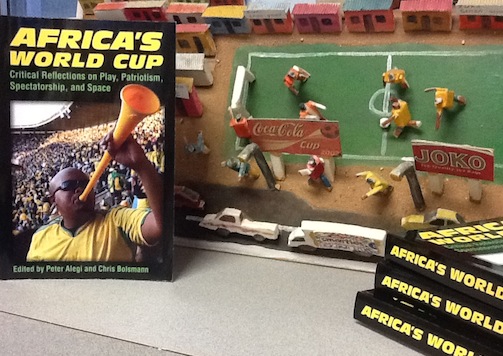
The Football Scholars Forum, an online fútbol think tank I co-founded at Michigan State University, recently launched its 2013-14 season. On October 24, FSF held a lively discussion of Africa’s World Cup: Critical Reflections on Play, Patriotism, Spectatorship, and Space, a newly published collection I edited with Dr. Chris Bolsmann, a South African sociologist based in the UK.

The 90-minute event opened with a consideration of the book’s attempt at blending scholarly and journalistic approaches to exploring the game and its broader implications. The editors and several chapter authors in attendance talked about the process of writing and editing, as well as their experience working with an academic press on a topic with potentially broad appeal.

The book, much of it written in the first person as a loving critique of the 2010 tournament, demonstrates how the FIFA World Cup story is entangled in a web of national and international politics, sporting culture, and global capitalism. Many interventions linked South Africa 2010 to Brazil 2014, particularly through the public financing of expensive and unsustainable new World Cup stadiums in countries with dysfunctional schools and hospitals and high rates of poverty and inequality. The online conversation also featured Luis Suarez’s handball against Ghana and the contradictory legacies of this “African” World Cup.

Participants logged in from half a dozen countries in North America, South America, Africa, and Europe. In attendance: Andrew Guest, Chris Bolsmann
, Christoph Wagner
, David Patrick Lane, 
David Roberts, 
Derek Catsam, 
Jacqueline Mubanga, 
Raj Raman, 
Orli Bass
, Rwany Sibaja, 
Laurent Dubois
, Achille Mbembe
, Jordan Pearson, Sean Jacobs, and Alex Galarza (all via Skype); and Liz Timbs, 
Dave Glovsky, 
Alejandro Gonzalez, and 
Peter Alegi (in East Lansing).

For a Storify Twitter timeline of the event click here.

The audio recording of the discussion is freely available here.

The next Football Scholars Forum event on November 14 will focus on Soccer in the Middle East, a special issue of the journal Soccer and Society (2012), edited by Alon Raab and Issam Khalidi.

Categories
Fútbology

Football 150: Conference Report


Guest Post by Dr. Matthew L. McDowell

The new home of the National Football Museum, the Urbis Building in Manchester, was the site of an international conference on September 2-4, 2013, celebrating the 150th anniversary of England’s Football Association. The event welcomed a group of around sixty speakers and an even larger group of delegates from different disciplines interested in the past, present, and future of football: its culture, its finances, its development, and its governance.

The varied affiliations of the participants made for some rather productive tension: critics of world football’s leaders and patrons rubbed shoulders with officials from the FA and UEFA, and no words were minced. Sir Trevor Brooking’s appearance at the outset of the conference, and Karen Espelund’s keynote address on the final day, were sandwiched around acclaimed author David Goldblatt’s second-day keynote: a brilliant, scathing, and often surreal account of FIFA in relation to the Brazilian riots of this past summer, which occurred while the Confederations Cup was staged in the country. (Those who were at the address will never think of AC/DC’s “Hell’s Bells” in the same way again.) All in all, it made for a highly enjoyable three days, and the National Football Museum (especially Dr. Jane Clayton and Dr. Alex Jackson) and the University of Central Lancashire’s International Football Institute pulled out all of the stops to ensure that all of us working within the broad continuum of “football studies” felt at home.

After Brooking’s interview with UCLan’s John Hughson – one of the driving forces behind the gathering – Tony Mason of De Montfort University, a renowned expert on English football’s history, introduced us to previous commemorations of the FA’s anniversary: some lavish, some passing barely noticed. I attended various sessions afterwards. Naturally, I leaned toward history: Tony Collins, Roy Hay, and Gavin Kitching formed an excellent panel advocating more research into what Collins called the “primordial soup” of football in the pre-Association era. The term “football,” as both Hay and Kitching stated, was representative of a very broad church prior to 1850, and was not confined to the “public school” sphere. Afterwards, I attended a session on the history of ‘soccer’ in the United States, with my native New Jersey finding its way into both Brian Bunk’s and David Kilpatrick’s papers: Bunk discussed the football-playing circle of the mid-nineteenth century Princeton University, while Kilpatrick discussed the colorful, controversial and recently-revived New York Cosmos, whose 1970s’ home was the NFL’s Giants Stadium. The “Nostalgia and Design” panel, which featured Jean Williams, Graham Deakin, Ffion Thomas and Chris Stride teased out the meanings in some of football’s most iconic (and, in the case of Shoot and Goal magazines, not-so-iconic) images through various media.

The second and third days featured their fair share of highlights. Notable among them was Gary James, who gave us a glimpse into late-nineteenth/early-twentieth century football in Manchester, a subject long neglected by academic historians. Matthew Klugman, Svenja Mintert, and Jessica Richards, meanwhile, discussed their own pioneering research, and their attempts to examine the emotions, desires and suspicions of “the fans” in a wide variety of time periods, places, and guises. (Richards, whose ethnographic research examines the match-day rituals and gender performance of Everton supporters, candidly discussed the risks associated with field work.) Meanwhile, “The Role of the Individual,” which featured Clayton, Jackson, and Dilwyn Porter, critically examined the mythology of some of football’s greatest characters, in relation to the archival material which actually exists regarding them. Referees, it seems, took great pains to present themselves in a heroic light against agents of chaos: Porter’s examination of 1930s referee Percy Harper stated that that Harper featured death threats from supporters in his own personal archive, perhaps as kinds of trophies. The ‘World Cup’ panel featured its own fair share of surprises. Though Peter Alegi could not make it to discuss his history of South Africa 2010 (the perils of transatlantic travel!), Marion Stell and Daniel Malanski examined FIFA’s global showcase in relation to Australian and Brazilian football history respectively, showing us that domestic politics inevitably colors how individual nations view participation in the tournament.

One wonders what Football 200 will look like. Will the ‘beautiful game’ continue to stress the paradoxes of being the world’s most popular sport, while at the same time being a focal point for fierce tribalism? Will we be bemoaning the “good old days” of the 2010s, a day before money, political correctness, and middle-class sanitisation took their toll on the viewing experience of the people? The thread of nostalgia has always run through popular perceptions of what the game should be; and, as Football 150 and its constituent presentations have shown, there is no one unified consensus on what the game has represented, or what it continues to demonstrate regarding our world. It is as confused as we are; and perhaps that, above all, is the appropriate message of the conference.

**

Dr. Matthew L. McDowell is a lecturer in sport and recreation management at the University of Edinburgh, Moray House School of Education. He was written on the early history of Scottish association football, and is currently researching Scotland’s history with the Empire and Commonwealth Games competitions, and early North Atlantic footballing cultural encounters. Follow him on Twitter: @MattLMcDowell