Categories
Video

Germany’s History of Failure vs. Italy: Part 2


July 11, 1982: the World Cup final at the Santiago Bernabeu in Madrid. Four years earlier, West Germany had drawn 0-0 against a young, enterprising Italian side in the second group stage of the 1978 World Cup — the Argentinean Generals’ Mundial. (Video highlights here.)

1978 was also the year of the assassination of Italian Prime Minister Aldo Moro (who was held for a month in an apartment building adjacent to my elementary school), and the inauguration of President Sandro Pertini, a dedicated socialist and former anti-Fascist resistance fighter. We didn’t know it back then, but “The Years of Lead” were about to come to an end. Football — or calcio as we call it — was about to show us that the road to the future went beyond Left and Right.

With the pipe-smoking Pertini enjoying the 1982 final next to King Juan Carlos in the VIP section of Real Madrid’s majestic stadium, the Azzurri demolished the (West) Germans 3-1. Not everything went perfectly that night. Graziani’s injury forced an early substitution and then Cabrini — my mother’s favorite player — missed a penalty: the only time I ever heard my uncle, a man of the cloth, swear audibly.


The second half was all Italy. Physically and mentally fatigued after their penalty shootout victory gainst Michel Platini’s France in an extraordinary semifinal (highlights here), Germany caved in. Paolo Rossi opened the score with his sixth goal of the tournament and then Tardelli made it 2-0, celebrating it with such emotional abandon that we imitated it for years on playgrounds and pitches around the land.

When Altobelli added a third late in the game Pertini leaped out of his seat, waving his arms, rejoicing, telling everyone around him that “adesso non ci prendono più!” (Now they’re not going to catch us anymore!). Breitner got a consolation goal, but it didn’t matter. When the Brazilian referee theatrically picked up the ball with his hands, raised it above his head and blew the final whistle, match announcer Nando Martellini pronounced to the masses that we were “Campioni del Mondo! Campioni del Mondo! Campioni del Mondo!”

Millions of Italians thundered in a massive impromptu street carnival the likes of which had not been seen, the elders told us, since Liberation. Giving in to pleas from me and my friend Fabio, my uncle, in his clerical collar, honked his rickety FIAT 127’s horn all the way from our parish in the Marche hills to coastal Pesaro so that we could experience these historic celebrations. A quarter of a century later, another generation would experience the intoxicating feeling of World Cup victory . . . and Germany, once again, would play a key role in Italy’s success story.

Come back tomorrow for the final installment of Germany’s history of failure against Italy.

Categories
Video

Germany’s History of Failure Against Italy


Germany is favored to win Thursday’s Euro 2012 semifinal against Italy. While Die Manschschaft has played the best and most consistent football in the tournament, the Azzurri have won just one game in regulation and reached the semifinal only after surviving a penalty shootout against England. History provides a counterpoint to soccernomics-style prognostications, however, because the Germans — or West Germans — have never defeated Italy in Euros or World Cup tournaments.

It started with a forgettable goalless draw at the 1962 World Cup in Santiago del Chile, but ignited in a globally televised World Cup semifinal played at the Azteca Stadium in Mexico City on June 17, 1970, which Italy won 4-3 in extra time. Outside the Azteca a plaque commemorates it as “The Match of the Century.” The video above combines footage of the original broadcast with Fabio Caressa’s 21st-century play-by-play commentary. Rumor has it that this clip is streaming on a loop in the Azzurri’s team hotel . . .

Come back tomorrow for part 2 of Germany’s history of football failure against Italy.

Categories
Hosting

Resuscitating Football on the Zambian Copperbelt


Guest Post by *Hikabwa Chipande

NDOLA — Zambia’s victory in the 2012 African Nations Cup has spawned a new fashion on the Copperbelt — the country’s industrial and football heartland — where people now wear Chipolopolo (Copper-bullets) replica jerseys as well as chitenge (women’s waist wraps) in the national colors. Selling Chipolopolo regalia has also become big business in street markets and makeshift stores. Clearly, the African champions have re-energized the mood of the nation and revitalized support for football among ordinary citizens, politicians, and business people.

The stability of copper prices, increases in copper production, an improving economy, and the pride of being African football champions, have led ZCCM Investments Holdings, formerly Zambian Consolidated Copper Mines, to reconsider supporting the sport. For instance, private companies such as Mopani Copper Mines and Copperbelt Energy have resumed their funding of Kitwe’s famous Nkana Red Devils and Power Dynamos.

“Winning the African Cup changed things,” says Red Devils head coach Linos Makwaza. “People have started coming back to football. At Nkana [Football Club] Mopani [Copper Mines] is now involved and has taken over which is good,” Makwaza says. The relationship between mining companies and football is not a new one. It has shaped the history of the game in Zambia. As far back as the 1920s, when copper mining started on the Copperbelt under British colonial rule, and into the independence era up to the privatization of the ZCCM mining company in 1991, government-controlled mining companies provided football grounds, financial resources, coaches, players, and stimulated a deeply rooted fan culture.

Zambia’s Nations Cup success has inspired politicians such as Sports Minister Chishimba Kambwili to encourage new owners of copper mining companies to sponsor Mighty Mufulira Wanderers, Nchanga Rangers, Nkonkola Blades, Roan United, Kalulushi Modern Stars and other important, but struggling, clubs in the mining province. Abraham Nkole, currently Mighty Mufulira Wanderers manager and a former player in the 1960s and 1970s, sees this shift as an opportunity to resuscitate the “lost glories” of Copperbelt football.

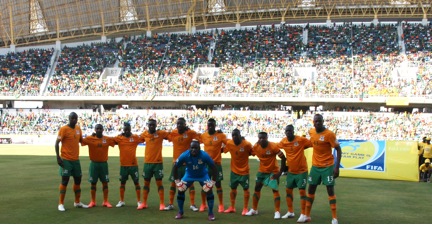
The opening of a modern stadium in the mining town of Ndola has also injected new life in Copperbelt football. I was in attendance on June 9, 2012, for the inauguration of the Chinese-built 40,000 capacity Levy Mwanawasa Stadium, which hosted a Zambia vs. Ghana 2014 World Cup group D qualifying match (see photo). Thousands of fans clad in green and orange Chipolopolo replica jerseys besieged Ndola. With Vice President Dr. Guy Scott in the stands, Chipolopolo beat the Black Stars 1-0 in the packed stadium, thus renewing their hopes for qualifying to Brazil 2014 after being thumped by Sudan 2-0 in Khartoum a week earlier.

Practitioners and fans I spoke to on the Copperbelt are encouraged by recent developments and hope the mining province will soon reclaim its dominant position in Zambian football after two decades of decline. The political and financial investment that is fueling the game’s resuscitation owes much to Chipolopolo’s international success. The question is whether such support will continue should the national team perform badly at next year’s African Nations Cup in South Africa.

*Hikabwa Chipande is a PhD candidate in African history at Michigan State University. His dissertation research is on the social and cultural history of football in 20th-century Zambia. He can be contacted at chipande [at] msu [dot] edu.

Categories
Hosting

Phambili! Izichwe Develops Footballers and Citizens


In the wake of Pitso Mosimane’s firing as Bafana Bafana head coach, there seems to be general agreement in South African football circles that a plan is needed to develop the local game constructively and sustainably.

On this blog, Mohlomi Maubane recently argued in favor of a German model that synchronizes the interests of the FA, the national team, and of professional clubs. “It is by virtue of young players being trained well that the German national team, and any other national team, can realise its full potential,” added Ted Dumitru and Sipho “King K” Kekana over at maximalfootball.com. “Lack of technical education in this vital aspect made many nations, including SA, compete without an identity and the results have been disastrous,” the two experts point out.

On June 9-10, 2012, the national finals of the under 15 boys’ Manchester United Premier Cup provided some clues about what lies ahead for South African football. At the Nike Football Training Centre in Klipspruit, Soweto, Ajax defeated SuperSport United in the final (2-1) to qualify for the global finals in China in July. The rest of the field featured Orlando Pirates, Izichwe FC, Bidvest Wits, School of Excellence, Diambars, and Mamelodi Sundowns.

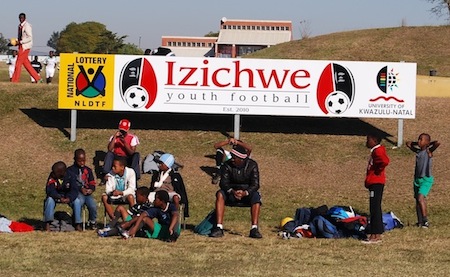
According to observers’ accounts, most teams at the Premier Cup fielded sides of tall, strong boys indulging in well-rehearsed kick-and-rush football. Two exceptions stood out: Izichwe FC and School of Excellence. The case of Izichwe, an extraordinary program based at the University of KwaZulu-Natal in Pietermaritzburg, illustrates how making highly technical footballers out of promising teenagers requires not only financial resources and qualified coaches, but also time and patience.

Izichwe distinguishes itself in a number of ways from the vast majority of youth programs in South Africa and elsewhere on the continent. Founded in 2010, when my family had the privilege of being welcomed into the Izichwe clan, the academy got its name from the regiment (ibutho) of Shaka kaSenzangakhona, the founder of the Zulu kingdom. It operates on a shoestring budget compared to the PSL youth teams in the Premier Cup. It is a not-for-profit organization in which the parents and sponsors — both local and international — actively participate in shaping the sporting and educational development of each youngster.

After intense daily training sessions, the Izichwe boys, many of whom come from humble backgrounds, remain on the University of KwaZulu-Natal campus for a meal and to complete their homework before returning home for the night. Developing responsible citizens is considered just as important as training future members of Bafana Bafana. From a football standpoint, Thabo Dladla, Izichwe’s technical director, points out that while Izichwe coaches understand the importance of the team their priority is individual development. The coaching staff works assiduously to develop the technical, tactical, psychological, physical and emotional aspects of the boys’ game. Another important aspect of the Izichwe approach is the lack of an overbearing, ambitious owner, the kind of person who regularly exerts pressure on coaches and players to deliver trophies and obey the dictatorship of results.

For Bafana Bafana to improve, the quality of play in the Premier Soccer League — the richest league in Africa — must improve; but this cannot happen if football development programs fail to provide players under the age of 16 with the multiple skills required for successful professional careers. Izichwe shows the way forward. As we say in isiZulu: “Phambili!”.

Categories
Hosting Players

Bafana Coach Fired, Now What?


Guest post by Mohlomi Maubane

The Germans regularly find a way to excel in tournaments and are among the favourites to win the Euros in Poland/Ukraine. The South African football fraternity would do well to take a page out of the playbook that produced the current incarnation of Die Manschschaft when appointing a new Bafana Bafana coach. SAFA fired Pitso Mosimane this week after Bafana Bafana could only muster a 1-1 draw against Ethiopia in a 2014 World Cup qualifier in Rustenburg.

Eight years ago, the German national team was in dire straits after failing to win a single match in the group stages of the 2004 Euros. A rebirth seemed inevitable, and the newly appointed technical team of Jürgen Klinsmann and Joachim Löw pursued it with typical German precision.

Their first step was to give Die Manschschaft a new identity. The duo settled on a style based on playing the ball on the ground and transitioning swiftly from defence to attack. This was the outcome of an extensive consultation process. Workshops were held with German coaches and players to inquire how they wanted to play and how they wanted to be seen to be playing by their fans (and international ones too). Members of the German public also enjoyed the opportunity to provide input on how they wanted the national side to play.

From this inclusive process, Klinsmann and Löw drafted a curriculum for German football that was presented to the Bundesliga and the German FA. The latter then pressured teams in the former to build academy programmes that adhered to the overall strategy. Bundesliga teams were also encouraged to adopt a fitness programme that enabled the philosophy to be implemented. The newly appointed Under-21 coach also had to abide by the new policy.

Categories
Fútbology

Football Scholars Miscellany: A First XI Summer Edition

The Football Scholars Forum is an online academic book club based in the History Department at Michigan State University. (I’m one of the founders.) The production and sharing of knowledge and ideas in an open-access platform drives this international community.

One of the Forum’s most valuable resources is a series of occasional posts by Andrew Guest entitled “A First Eleven” (not “The Best Eleven”). These brilliant posts provide an eclectic collection of links to and notes about work and events related to the beautiful game. Check out the summer 2012 installment here.

Previous “First Eleven” posts are here, here, and here.

Categories
Players

The Italian Job: Revisited


Police raid the Italian national team camp and an earthquake in Emilia-Romagna forces the cancellation of the Italy-Luxembourg Euro warm-up. It’s been a tough week for Italian tifosi, on and off the pitch.

Defender Domenico Criscito left the Euro squad after being implicated in the latest wave of prosecutorial investigations and charges. Meanwhile, Antonio Di Natale emerged as a pale as a ghost after riding out the 5.9 magnitude quake in an elevator.

The latest developments in calcio’s corruption and match fixing scandal have produced 19 arrests, including that of Lazio captain Stefano Mauri and ex-Genoa man Omar Milanetto. Prosecutors in Bari, Cremona, and Napoli have also implicated several dozen high profile players, managers, and club officials. That this mess is taking place only a few years after “calciopoli” — which famously landed Juve in serie B and penalized Milan, Lazio, and Fiorentina — is a potent indictment of the Italian football system and its willingness or ability to reform itself.

Italian authorities and prosecutors inspire confidence in some circles that the metastasizing problem will finally be addressed (read Declan Hill’s blog post here), but I find this optimistic view problematic on a number of levels. Here’s why:

First, the justice system in Italy is utterly dysfunctional. From civil to criminal cases, almost nothing works properly. The country has more than 10,000 laws on the books, that’s more than most, if not all, other countries in the world. Moreover, culprits of egregious crimes are often let off the hook with little more than a slap on the wrist while minor cases take years to resolve. And that’s just the tip of the iceberg.

Second, calcio works exactly like Italian politics. Family and “big man” cliques dominate and actively seek to expand their narrow interests against the common good. From serie A and B all the way to the lowest amateur ranks, this situation makes it almost impossible to develop a fair, equitable, and sustainable solution to the football rot.

Third, Italian sport and society struggle with a culture of cheating that pivots around what may be labeled “situational ethics” and a common sense rationalization that laws are made to be circumvented.

Given this dispiriting local situation and a worrisome rise in match fixing, corruption, and bribery on a global level, the Italian Prime Minister Mario Monti’s recent statement “that it would really benefit the maturity of us Italian citizens if this game was completely suspended” for a couple of years seems like a good idea. It might create the space needed for a soul-searching dialogue aimed at finding long-term solutions to calcio’s spiral of decline.