Categories
Video

My Curva Mundial Story

https://s3-us-west-2.amazonaws.com/anchor-generated-image-bank/production/podcast_uploaded400/20368923/20368923-1639938099089-762c8044583eb.jpg

Curva Mundial is a podcast about the fans of the “The Beautiful Game.” In each episode, Sal Bono sets out to ask why folks from all walks of life love the teams they do and how football represents who they are and where they are from.

In Episode 24, I got to tell my story: How my love for Juventus was not an arranged marriage; calcio culture; moving to the United States; South African soccer experiences; and becoming a fútbologist. Listen here.

Categories
Video

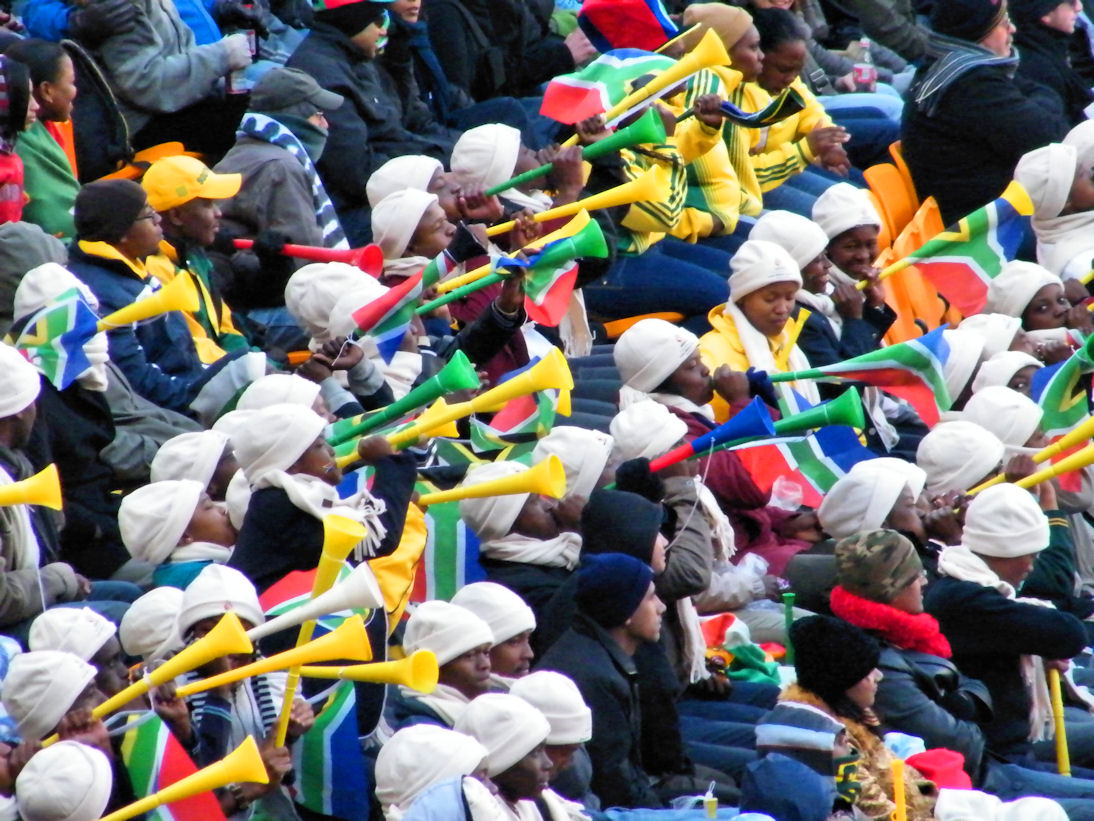
History of the Vuvuzela

Episode 511 of the 99% Invisible podcast reconstructs the history of the vuvuzela, its cultural power at the 2010 World Cup, and its gradual downsizing in the football soundscape.

It was an honor to be interviewed for the project alongside Freddie “Saddam” Maake, the “inventor” of the plastic horn, Mark Gleeson, the legendary football broadcaster, and Duane Jethro, the leading scholar on the topic.

The episode was produced by reporter James Parkinson (@JamesRParkinson).

Listen to the podcast here.

https://99percentinvisible.org/episode/vuvuzela/
Categories
Video

Detroit Youth Soccer, 1985

Poking around the Detroit Historical Society’s online archive for soccer material, I found intriguing footage of racially diverse young boys and girls playing a game in North Roseland Park. It’s from September 1985.

This Greens vs. Blues match between what appear to be 8-9 year olds is quintessential recreational soccer. They move in packs. The most daring among them dribble for dribbling sake. Technique is mostly an abstract concept. Goalkeeping resembles outfield play in Little League baseball. The ball ends up in the back of the net a few times, though the youngsters don’t seem to care about that as much as their parents do. The referee dad loves blowing his whistle. And just like today, coaches and parents shout “advice” and encouragement from the sidelines. It’s great to see gender integrated teams at play, though I did wonder why most players shunned shorts.

Categories
Video

Radio Interview: Soccer, Apartheid and Human Rights

On March 21, 2022, SAfm—South Africa’s national news and talk radio station—did a live interview with me on the “Sport On” show about the connections between soccer, apartheid, and human rights.

March 21 is Human Rights Day in South Africa, a national holiday honoring the victims of the Sharpeville Massacre of 1960. That Monday morning, South African police shot peaceful protestors, killing 69—many of them in the back—and wounding nearly 200 outside a police station in Sharpeville township, near Vereeniging, a 45-minute drive south of Johannesburg. The police killings brought international condemnation and triggered Pretoria’s banning of the African National Congress (Nelson Mandela’s organization) and the Pan Africanist Congress (which had organized the Sharpeville demonstration). With the country suddenly under martial law, the liberation movements turned to armed struggle.

As I say at the start of the interview with Thabiso Mosia (after a few technical difficulties), the 1960 massacre and its aftermath informed FIFA’s decision the following year to suspend South Africa. The world governing body’s sanctions marked an important early victory in the increasingly global fight against apartheid and instilled hope among South Africans at a grim time. Isolation from world soccer accelerated the campaign to transform South Africa into a pariah of global sport. In 1970, the country of apartheid was expelled from the Olympics and by the 1980s few sporting bodies or competitions allowed South Africans to participate.

My conversation with Mosia went on to discuss a few other things, too, such as the remarkable life of Darius Dhlomo—one of the first Black South African pros in Europe—racial integration in South African soccer, and the country’s hosting of the 2010 FIFA World Cup.

Feel free to listen to the interview below and share it, too!

Categories
Video

Maradona in Sun and Shadow

CGTN’s Mike Walter and Peter Alegi, Professor of history and global soccer studies at Michigan State University, discuss the legacy of Diego Maradona, both on and off the football pitch.


Categories
Fans Players

South African Football Returns in Empty Stadiums


This week I had the pleasure of speaking with Njabulo Ngidi, Sports Editor at New Frame, about the return of professional soccer in South Africa under COVID-19. “The beautiful game could give the depressed country some reprieve and an escape,” Ngidi says.

Read the full article here.

Categories
Fútbology

FSF Summer Series: The Age of Football

Age_of_Football_UK_coverWith Euros 2020 postponed until 2021 due to the COVID-19 pandemic, the Football Scholars Forum organized a five-part summer series with academic, journalist, and broadcaster David Goldblatt on his new book, The Age of Football: The Global Game in the Twenty-first Century [UK edition here / US edition here].


A longtime FSF member, Goldblatt is the award-winning author of several football books, including the highly acclaimed The Ball is Round: A Global History of Football, which FSF discussed here and here.


A record-setting 56 participants from five continents registered for the series. Each Tuesday 90-minute Zoom session focused on a different chapter (or chapters) in the 551-page book. Discussants opened each intellectual pick up game with a number of comments and questions. Given the book’s length and depth, this approach broke the conversation down into more digestible chunks and made it easier for individuals to contribute on topics of particular interest or expertise.


As the convenor of the series, I served as the first discussant on June 9 in the session on Africa. Danyel Reiche and Alex Galarza collaborated the following week on the Middle East and South America; then on June 23 Lindsay Krasnoff led on the 119-page chapter on Europe (read her comments here); on June 30 Andrew Guest was the discussant for the chapters on East Asia and North America/Central America/Caribbean; finally, on July 14, Simon Rofe and Matthew Pauly spearheaded the fifth and final session devoted to FIFA, Russia, and the 2018 World Cup.


Screenshot of conference call“It’s the hardest book I’ve ever written,” Goldblatt revealed. “A combination of Brexit and COVID kind of ate its public reception alive. That was quite hard to process,” he said. “This [series] has been a fabulous corrective to that. It means a lot to have you read it, to know that it held your attention, entertained you and maybe enlightened you along the way.”


David Goldblatt’s extraordinary endurance, encyclopedic mind, grace and humor, com bined with the vital and sustained contributions of discussants and dozens of participants, made this series a truly extraordinary experience.


Listen to the audio recordings of each session below (personal/educational use only).

The Age of Football, Part 1

The Age of Football, Part 2

The Age of Football, Part 3

The Age of Football, Part 4

The Age of Football, Part 5