Watch this great 20-minute documentary film on the tension and violence that accompanied the memorable Algeria-Egypt 2010 World Cup qualifiers.
Lots of rare footage captures the perspectives and experiences of the Algerian players and officials in both Cairo and Khartoum. Watch as the mainly France-based Les Fennecs players channel fear, insecurity, and rage into a memorable playoff victory and World Cup qualification. The scenes of joyous celebration among the traveling fans and players in Sudan, as well as the partying in the streets of Algiers are something to behold.
The film provides glimpses of both sides of the fútbol-nationalism coin. On the one hand, the Egyptian hooligans’ love of country expresses itself through hatred of the Algerian “other” and spills over into the vicious attacks on the visiting team’s bus depicted in the film. On the other hand, the Algerians’ patriotic unity propels them to victory against their rivals. Raw and riveting stuff.
Thanks to Mezahi Maher (@MezahiMaher) for the English subtitles!
Category: Video

[WATCH: http://vimeo.com/76755353]
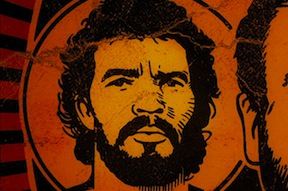
Doctor Socrates was futebol’s version of Che Guevara. The fifth and final episode of the superb “Football Rebels” film showcases the lanky, visionary midfielder’s role in the Corinthians Democracy movement that helped push for democratic change in Brazil under military rule in the early 1980s. “One person, one vote,” became the rallying cry of a campaign to elect a sociologist as chairman of Sao Paulo’s popular club. Contesting the election was a conservative businessman who came to embody the forces propping up the military dictatorship. Wearing a headband adorned with the words “Freedom and Justice” Socrates merged football with politics.
As his teammate Wladimir eloquently shows in the film, “Corinthians Democracy” transcended Socrates. The slogan was emblazoned on team jerseys and came to symbolize Brazilians’ dream of universal suffrage. On the final day of the 1983 season, Socrates and his teammates walked on to the pitch carrying a huge banner that read: “Win or lose, but always democracy.” Boosted by this remarkable movement started by courageous, idealistic athletes and embraced by thousands of ordinary men, women, and children, opponents of the dictatorship won provincial elections across the country and strengthened calls for direct presidential elections in Brazil. Watch. Listen. Learn.
Read my post on Socrates’s death here.
Before Pinochet’s rise to power in the September 11, 1973, coup, football clubs sustained a vigorously democratic culture, writes historian Brenda Elsey in her brilliant book Citizen and Sportsmen: Fútbol and Politics in 20th-Century Chile. Colo-Colo and Chile national team forward Carlos Caszely embodies this story. He is at the heart of episode 4 of the “Football Rebels” series on Al Jazeera (iOS users watch it here).
Brought up in a left-wing family in Santiago with its fair share of Communists, Caszely was not your typical professional footballer. He was active in the Players’ Union while many professionals saw themselves as “apolitical,” chiefly concerned with maintaining the status quo. Caszely was well known for his vocal support of Salvador Allende’s Popular Unity government: “Since I had use of my own reason,” he said, “I have liked the Left and I am not thinking of changing my ideals,” (Elsey, p. 217).
Interestingly, two months to the day after the coup, Caszely participated in what may well be the strangest match in football history. He took the field for Chile at the National Stadium in a World Cup qualifier against the Soviet Union. But the opponents were not there. Defying FIFA, the Soviets had refused to play in a stadium where more than 12,000 people had recently been imprisoned, tortured, raped, and brutalized by Pinochet’s goons. Caszely played that day because he was scared for his family’s safety. Sadly, this fear was borne out by the regime’s assault on his mother, whose direct testimony provides a dramatic highpoint in the film. As the footballer says: “I said no to dictatorship on every level: no to dictatorship, no to torture . . . So they made me pay for that with what they did to my mother.”
Caszely would go on to score 29 goals in 49 matches for Chile, taking part in both the 1974 and 1982 World Cup finals. He spent five years in Spain (1973-78) before returning to Colo-Colo. In the twilight of his career, Caszely also played for the New York Cosmos (1984) and for Ecuador’s most decorated club, Barcelona SC of Guayaquil. “Ever since I was a little boy and I started walking, holding my father’s hand, in the district where people play against a wall, against a tree, against a mound, against a big stone, against your opponent, with a football, a plastic ball, a rag ball, a paper ball, even a tin can, if there’s nothing else . . .” he always found a way to play. Despite the regime’s repression and intimidation, Caszely’s conscience and his passion for the game could not be silenced. El pueblo unido jamas serà vencido!
Drogba: The Peacemaker
Omdurman, Sudan, October 8, 2005: moments after Ivory Coast secured qualification to the World Cup finals for the first time, Didier Drogba extemporaneously transformed himself into a peacemaker. His country at the time was torn apart by a civil war between the Muslim-dominated rebel-held north and the mainly Christian south controlled by President Laurent Gbagbo’s government. Surrounded by joyous teammates in the dressing room, Drogba took the microphone and knelt in front of the television cameras. “We have proved that all Ivorians can live together,” he said, “and we can unite with the same objectives. Please, put down your weapons!”
The dressing room scene provides the emotional spark and narrative hook in “Didier Drogba and the Ivorian Civil War,” the riveting first episode of “Football Rebels,” a five-part documentary that began this week on Al Jazeera English. (Watch it here.) “It was just something I did instinctively,” the Ivorian striker would later tell Alex Hayes of The Telegraph in a 2007 interview. “All the players hated what was happening to our country, and reaching the World Cup was the perfect emotional wave on which to ride.”
The Al Jazeera documentary film reveals the little-known story of how Drogba played a key role in getting the national team, The Elephants, to play a 2008 African Nations Cup qualifier against Madagascar in Bouaké in the rebel heartland. Ivory Coast won 3-0, triggering a much needed sense of patriotic pride, national unity, and peace. (Highlights below.)
Presented by former Manchester United star Eric Cantona, “Football Rebels” focuses on players “whose social conscience led them to use their fame and influence to challenge unjust regimes, join opposition movements and lead the fight for democracy and human rights in their countries.” The next episode features another brilliant African player: Rachid Mekhloufi, who left the 1958 French World Cup team to join the FLN team aiding the cause of Algerian independence.
Orlando Pirates: The End of an Era?
Maluti FET College 4, Orlando Pirates 1. Dropped jaws and head-scratching abounded in South Africa last weekend after a third-tier side thumped the reigning league champions in the Nedbank Cup. Stunning results like this are what makes knockout competitions hugely attractive. It’s football’s David vs. Goliath narrative: a humble amateur side from an unknown backwater of the country upstaging their well-heeled city slicker brethren. Does Pirates’ stunning defeat against Maluti signal the end of an era for the fabled Soweto team?
The Buccaneers have been enjoying a purple patch for the past two seasons. An eight-year cup drought ended in 2010/11 when Dutch coach Ruud Krol guided Pirates to a three-cup haul as they annexed the MTN 8, Nedbank Cup and the league title. Krol’s success at Pirates came only after three years of perseverance. In his first season, Pirates lost the title to Supersport United on goal difference and then narrowly lost the Telkom Knockout Cup final to Ajax Cape Town. The following season the going got harder for Krol. Pirates fared badly in the knockout competitions and finished fifth in the league.
A classy defender in his heyday, Krol turned defence into a trademark of his years at Pirates. The side conceded a miserly 22, 18, and 23 goals, but also struggled up front with 37, 26, and 41 goals per campaign. Simply not good enough. The signing of Benni McCarthy (despite his advanced age and injury-prone body) dramatically improved Pirates’ attack. But at the end of a stellar season, the formerly underachieving club did not renew Krol’s contract.
In came Julio Leal. He won two trophies, but halfway through the campaign the Brazilian was booted out, his exit apparently engineered by players unhappy with his coaching methods. Head of Development, Augusto Palacios, took over the reins, steering the Bucs to a second consecutive PSL league title and treble. There would be no continuity in 2012/13, however, as Palacios made an early exit after Pirates got knocked out of the MTN 8 and then lost badly to rivals Moroka Swallows in a league match. Roger De Sa was put in charge.
Pirates’ shocking loss to the minnows of Maluti was by all accounts a major upset. The subsequent league loss to Moroka Swallows (again!) piled even more pressure on De Sa and the Bucs. Two losses in a row, however, do not constitute a crisis. It is a bad spell, a passage any team goes through in the course of a season. Pirates remain in contention for both the league title and the African Champions League. If Pirates were to win both competitions the foibles of the past few weeks would quickly be forgotten by their devoted fans, aka The Ghost. However, if such results don’t materialize, Roger De Sa will almost inevitably become the fall guy, accused of “destroying a great side.”
Truth be told, Pirates management should shoulder the blame for any such negative outcome. De Sa seems like an astute coach and for all the experience he has gained over the years, managing Pirates is his first stern challenge. But will he be given the time to build? After all, he answers to a management team that hired him as the 35th coach in 23 years. Pirates may live to rue dissembling the successful project Krol painstakingly built over the course of three years. If De Sa “fails” then an era will have ended. Humiliating losses like the one to Maluti FET College suggest that Pirates will probably continue to hire and fire many more coaches rather than repeat Krol’s recipe for success.
In this video, Alex Galarza and I discuss digital fútbol scholarship at Michigan State University. The conversation ranges from Galarza’s doctoral dissertation entitled “Between Civic Association and Mass Consumption: The Soccer Clubs of Buenos Aires,” to the Football Scholars Forum, the online football think tank.
For more information about Galarza’s research click here.
The 90th Minute Trailer from Jun Stinson on Vimeo.
The Football Scholars Forum is holding its final session of the 2012 season on Wednesday, December 5, at 3:30pm EST, on Jun Stinson’s short film, The 90th Minute. The 20-minute documentary follows three members of FC Gold Pride, the 2010 Women’s Professional Soccer champions. The film sheds light on what it’s like to be a female pro player in the U.S. — a dream that has become more elusive after the demise of the WPS.
Why do Hope Solo, Alex Morgan, Megan Rapinoe, Abby Wambach and others struggle to play professionally in their country? Why have two pro women’s soccer leagues failed since the heady days of Mia Hamm, Brandi Chastain and the 1999 Women’s World Cup? What needs to happen for a new women’s league in the U.S. to be sustainable? How does the situation in the U.S. compare with international trends?
Jun Stinson recorded an interview with me ahead of the session in which I also asked a few questions on behalf of FSF members. To listen click here. Gwen Oxenham, former Duke and Santos player and one of the producers of the film Pelada will participate in what promises to be a terrific season finale!
For more information about this event please contact Alex Galarza: galarza1 [at] msu [dot] edu.
Update: On November 21, “U.S. Soccer president Sunil Gulati announced the launch of a women’s professional league which will start play in March.” Details here.