The 90th Minute Trailer from Jun Stinson on Vimeo.
The Football Scholars Forum is holding its final session of the 2012 season on Wednesday, December 5, at 3:30pm EST, on Jun Stinson’s short film, The 90th Minute. The 20-minute documentary follows three members of FC Gold Pride, the 2010 Women’s Professional Soccer champions. The film sheds light on what it’s like to be a female pro player in the U.S. — a dream that has become more elusive after the demise of the WPS.
Why do Hope Solo, Alex Morgan, Megan Rapinoe, Abby Wambach and others struggle to play professionally in their country? Why have two pro women’s soccer leagues failed since the heady days of Mia Hamm, Brandi Chastain and the 1999 Women’s World Cup? What needs to happen for a new women’s league in the U.S. to be sustainable? How does the situation in the U.S. compare with international trends?
Jun Stinson recorded an interview with me ahead of the session in which I also asked a few questions on behalf of FSF members. To listen click here. Gwen Oxenham, former Duke and Santos player and one of the producers of the film Pelada will participate in what promises to be a terrific season finale!
For more information about this event please contact Alex Galarza: galarza1 [at] msu [dot] edu.
Update: On November 21, “U.S. Soccer president Sunil Gulati announced the launch of a women’s professional league which will start play in March.” Details here.
Category: Video
Théophile Abega, the heart and soul of Cameroon’s superb national team of the 1980s, has died at the age of 58. Thoughtful, elegant, and tough, Abega had an illustrious club career with Canon Yaoundé. He was a dominant force in the team that twice won the African Champions Cup (1978, 1980), the African Cup Winners’ Cup (1976, 1979), and three domestic league titles. Abega’s only World Cup participation was in 1982 in Spain, where Cameroon drew all three group stage matches against Peru, Poland, and Italy.
I remember watching him on TV against my beloved Azzurri in an extraordinarily tense contest with qualification to the next round on the line. Abega’s composure, strength, and technique were striking. As a result of the 1-1 draw, Cameroon was eliminated on goal difference (number of goals scored in fact) but nevertheless enhanced the image of African football on the global stage. Two years later, as the video above demonstrates, Abega was at his footballing peak as Cameroon defeated Nigeria 3-1 in the 1984 African Nations Cup final. The Indomitable Lions returned to international glory at the 1990 World Cup in Italy (Roger Milla!), but by that time Abega had closed out his career with Toulouse in France and no longer commanded Cameroon’s midfield with his consummate professionalism and style.
May his soul rest in peace.
Guest Post by Elliot Ross (@africasacountry)
1. This high-stakes knockout format might not be so bad after all. Qualifying groups are long, turgid affairs, especially the European ones, international football’s equivalent of the snoozetastic-but-moneyspinning UEFA Champions League group stages. Knockout football puts the big names at risk, as they should be. This past weekend was joyous.
2. Look out for the central African sides. I reckon DR Congo look a good early outside bet (remember current champions Zambia were 50-1 behind Burkina Faso and Libya before the 2012 tournament) and nobody will want to play Central African Republic — Egypt’s conquerors featured in this video — if Les Fauves manage to hold onto their slender 1-0 lead over Burkina Faso.
3. The Sudanese really know how to celebrate a goal. Watching big Sudan-Ethiopia games feels like being back in the 1950s. All we need is Ad-Diba to turn up with his whistle to referee the second leg.
4. Home advantage is everything. Just ask the Moroccans, the Angolans or the Cameroonians. On the flip side, it means all three of those teams will hold out hope of turning their ties around in October. It also means that despite their recent struggles Bafana Bafana can’t be discounted as serious contenders when South Africa host the tournament early next year.
5. Cabo Verde could have a big future in the African game, especially if they can prevent their top players from representing Portugal and other nations.
6. As Jonathan Wilson (@JonaWils) points out, Cote d’Ivoire’s defence looks a bit dodgy. Kolo Toure is seriously slowing down these days and former Dunfermline Athletic stalwart Sol Bamba might be a favourite of Sven Goran Eriksson, but he’s not the most positionally sound. Thankfully, Eboué has been restored by Sabri Lamouchi at the expense of the clunking Gosso. Hopefully, Seydou Doumbia will be next.
7. Papiss Demba Cissé is a genius. As the video above shows, the Senegalese striker scores goals most players wouldn’t dream of attempting.
8. Zambia have to be very careful in their second leg in Kampala. That encounter is going to be tense, and I’ve got a hunch Uganda will do a number on the African champs.
9. I miss Samuel Eto’o. What’s the price for his dramatic return in the second leg? If Eto’o does not show, then Cameroon look doomed. Whatever the internal drama behind this years-long row, it’s a dispute between a handful of soon-to-be-forgotten officials and one of Africa’s greatest footballers ever, and the result is to that a huge chunk of international matches is missing from his career and Cameroon are absolutely hopeless.
10. Remember the name: Christian Atsu. Is he the Ghanaian Messi? We don’t know but he looked tasty against Malawi and Porto’s scouts really know talent when they see it.
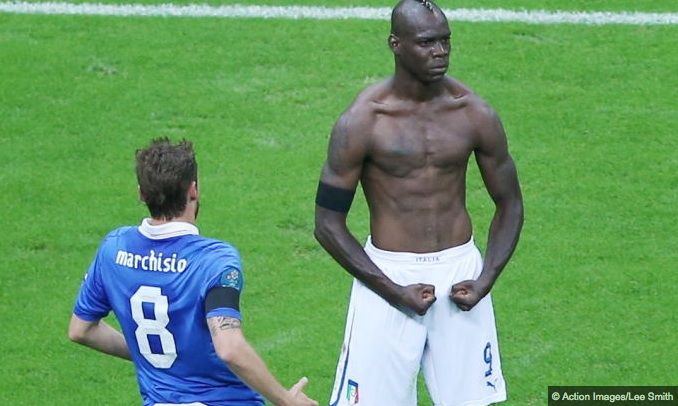
Super-Mario Balotelli wrote a new page in Germany’s History of Failure against Italy in Warsaw today. He scored two goals, the first a header off a delightful Cassano cross; the second a thunderous strike from outside the box, which he celebrated in inimitable style (photo above). He is Italy’s pride and joy.
Manager Cesare Prandelli did his part as well, completely outcoaching his German counterpart Jogi Loew. Italy now moves on the final against Spain on Sunday in Kiev.
Full Italy-Germany highlights courtesy of UEFA.com here.
After two more draws (1-1 and 0-0) at the 1988 and 1996 Euros, on July 4, 2006, Germany and Italy met again in the semifinals of the World Cup. The venue was the Westfalenstadion in Dortmund, an intimidating ground for any visiting team.
In a remarkable affair reminiscent of the 1970 World Cup semifinal at the Azteca (see my previous post here), extra time was needed. The climax defies description. So let’s leave it to Fabio Caressa and Giuseppe Bergomi (1982 World Cup winner at age 18) of Sky Italia to resurrect the memories — spine-tingling ones from an Italian point of view — of that cathartic evening.
Follow me on Twitter during the game tomorrow: @futbolprof
E daje Italiaaaaa!
July 11, 1982: the World Cup final at the Santiago Bernabeu in Madrid. Four years earlier, West Germany had drawn 0-0 against a young, enterprising Italian side in the second group stage of the 1978 World Cup — the Argentinean Generals’ Mundial. (Video highlights here.)
1978 was also the year of the assassination of Italian Prime Minister Aldo Moro (who was held for a month in an apartment building adjacent to my elementary school), and the inauguration of President Sandro Pertini, a dedicated socialist and former anti-Fascist resistance fighter. We didn’t know it back then, but “The Years of Lead” were about to come to an end. Football — or calcio as we call it — was about to show us that the road to the future went beyond Left and Right.
With the pipe-smoking Pertini enjoying the 1982 final next to King Juan Carlos in the VIP section of Real Madrid’s majestic stadium, the Azzurri demolished the (West) Germans 3-1. Not everything went perfectly that night. Graziani’s injury forced an early substitution and then Cabrini — my mother’s favorite player — missed a penalty: the only time I ever heard my uncle, a man of the cloth, swear audibly.
The second half was all Italy. Physically and mentally fatigued after their penalty shootout victory gainst Michel Platini’s France in an extraordinary semifinal (highlights here), Germany caved in. Paolo Rossi opened the score with his sixth goal of the tournament and then Tardelli made it 2-0, celebrating it with such emotional abandon that we imitated it for years on playgrounds and pitches around the land.
When Altobelli added a third late in the game Pertini leaped out of his seat, waving his arms, rejoicing, telling everyone around him that “adesso non ci prendono più!” (Now they’re not going to catch us anymore!). Breitner got a consolation goal, but it didn’t matter. When the Brazilian referee theatrically picked up the ball with his hands, raised it above his head and blew the final whistle, match announcer Nando Martellini pronounced to the masses that we were “Campioni del Mondo! Campioni del Mondo! Campioni del Mondo!”
Millions of Italians thundered in a massive impromptu street carnival the likes of which had not been seen, the elders told us, since Liberation. Giving in to pleas from me and my friend Fabio, my uncle, in his clerical collar, honked his rickety FIAT 127’s horn all the way from our parish in the Marche hills to coastal Pesaro so that we could experience these historic celebrations. A quarter of a century later, another generation would experience the intoxicating feeling of World Cup victory . . . and Germany, once again, would play a key role in Italy’s success story.
Come back tomorrow for the final installment of Germany’s history of failure against Italy.
Categories
Germany’s History of Failure Against Italy
Germany is favored to win Thursday’s Euro 2012 semifinal against Italy. While Die Manschschaft has played the best and most consistent football in the tournament, the Azzurri have won just one game in regulation and reached the semifinal only after surviving a penalty shootout against England. History provides a counterpoint to soccernomics-style prognostications, however, because the Germans — or West Germans — have never defeated Italy in Euros or World Cup tournaments.
It started with a forgettable goalless draw at the 1962 World Cup in Santiago del Chile, but ignited in a globally televised World Cup semifinal played at the Azteca Stadium in Mexico City on June 17, 1970, which Italy won 4-3 in extra time. Outside the Azteca a plaque commemorates it as “The Match of the Century.” The video above combines footage of the original broadcast with Fabio Caressa’s 21st-century play-by-play commentary. Rumor has it that this clip is streaming on a loop in the Azzurri’s team hotel . . .
Come back tomorrow for part 2 of Germany’s history of football failure against Italy.