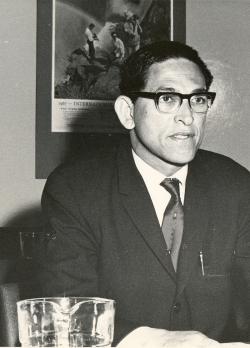
It is with immense sadness that we mourn the passing of Dennis Brutus, African activist and award-winning poet. The South African sport boycott owed much to his fierce commitment and relentless organizing, from his founding of the Coordinating Committee for International Recognition in Sport (1955) to the South African Sports Association (1958) and its successor, the South African Nonracial Olympic Committee. Dennis connected sport with the quest for human rights in powerful and probably unprecedented ways. Thanks largely to SANROC and its international allies, racist South Africa was expelled from the Olympics and world football. These global indictments of apartheid were huge and often undervalued milestones in the struggle against apartheid. Rest in peace Dennis. Hamba kahle.
Read Patrick Bond’s obituary here.
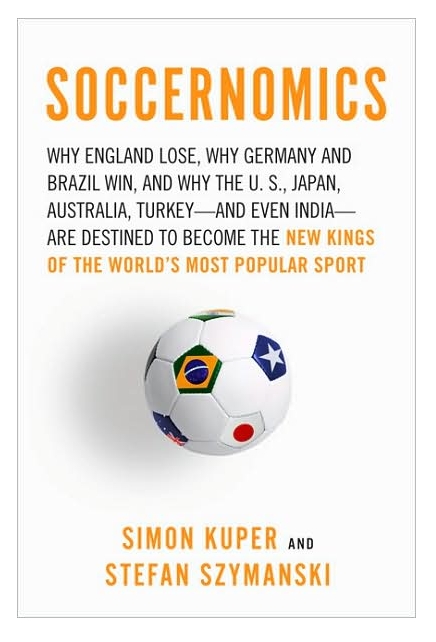
Stefan Szymanski, Director of the MBA program at Cass Business School in London and co-author of the new book Soccernomics, said on SAfm that the 2010 World Cup may turn out to be a ‘shocking waste of South Africa’s resources’ and not the economic ‘bonanza that government and Fifa would have us believe’. According to Szymanski, the only benefit that SA will reap from the tournament is a ‘feel-good factor’.
Read the full story here.
South African Sport, Hollywood-style

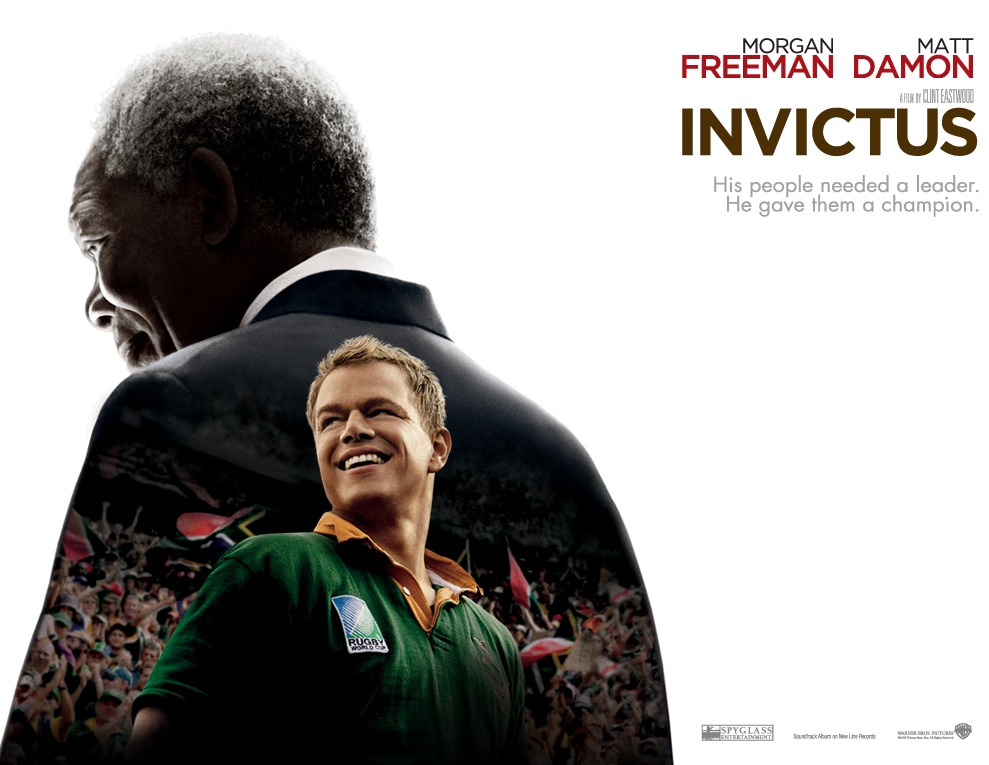
I just watched Clint Eastwood’s new film on South Africa’s victory in the 1995 rugby World Cup, one year after the country’s first democratic elections. Invictus (the title comes from an inspirational Victorian poem) stars Matt Damon as François Pienaar, captain of the Springboks, and Morgan Freeman as Nelson Mandela. Based on John Carlin’s book Playing the Enemy, it’s pretty good for a sports movie, a genre not usually associated with great cinematography.
The basics: thanks to Mandela’s stewardship, an all-white team (with one exception) goes from representing a sport synonymous with white supremacy to embodying the seemingly boundless potential of the postapartheid “rainbow nation.” There are some good moments. Like the team’s surprise visit to Robben Island prison, where the apartheid regime imprisoned Mandela and many other black activists during the country’s struggle for freedom. Props to Damon’s rugby moves, which are almost as good as his Afrikaans-inflected English, and to Freeman for closely matching Madiba’s physical movements and cadence. I enjoyed some of the sporting action as well, particularly the camera shots from inside the scrums.
Regrettably, sentimentality and cheesy music weaken the film. The lack of historical context and the refusal to develop any of the film’s characters (except Madiba) are also striking. We never get to know where the players come from, what their lives are like, and what happens to them after The Game. Same goes for the black and white bodyguards — a constituency usually at center stage only in movies such as In The Line of Fire and its ilk. While the final scenes project the fiction that 1995 transformed rugby from a white-dominated sport to a fully integrated one, the truth is much less uplifting. But then again, this is Hollywood history.

URUGUAY has 4 Stars on their shirts because…(“BUZZ…Jesus, Jones College, Cambridge”) because…Uruguay have been World Champions on 4 occasions: 1924, 1928, 1930 and 1950. The Gold Medalists of Paris and Amsterdam were recognized as World Champions by FIFA.
Uruguay has never played a fixture against 5 of the 2010 World Cup qualifiers. They are: Cameroon, Côte d’Ivoire, Democratic Peoples Republic of Korea, Greece, and Nigeria. It is possible for Uruguay to play against Greece and or North Korea in the 1st Round in South Africa for the first time. Los Charrúas will have to wait until the later rounds to get its claws into the Lions Indomptables, Les Éléphants and or the Super Eagles…Garra Charrúa!!!
Uruguay has beaten Argentina on 54 occasions, including the 1930 World Cup Final.
Uruguay has scored more goals against Argentina than any other qualifier. 213. Count them. Más goles! Menos culata tranplantes!
Uruguay has beaten Brazil on 20 occasions, including the final fixture of the 1950 World Cup Final. Uruguay’s victory ensured they lifted the World Cup in Brazil.
Uruguay is ranked 19th by FIFA, but is ranked 10th by Nate Silver, he of Soccer Power Index fame.
Uruguay has never beaten Algeria, Denmark, Germany, Honduras, Portugal, or Spain. Uruguay could face three of those nations in the first round.
Germany, Honduras, Uruguay and Portugal could be El Otro Grupo de la Muerte!
Slovenia is the smallest nation to qualify for a World Cup. Uruguay is the smallest to win a World Cup!
Silver Underestimates Slovakia
Nate Silver is a box score genius. Nate Silver can call states, counties and wards like no other. But can Nate predict the winner of the World Cup?

Some of our global readers may find Nate Silver’s statistical offerings on “soccer” other worldly. Who is this four eyed American running the numbers on our game, I hear some of you dismissively spit. But can it be true one can only understand football if one starts drinking about eleven in the morning in a backstreet pub or bar in the vicinity of some corrugated contraption called a football ground. There has to be a middle ground. Nate Silver deserves the utmost respect. But you know among the remnants of ale, chips, pies and gravy that your guts can tell you something Nate’s numbers cannot.
Nate has promised to delve into football realm for some time. His arrival is most welcome. FIFA has improved its ranking system. FIFA’s seeds were the deserving form teams (though Silver has a minor objection preferring Portugal over Italy.) Still, Silver’s Soccer Power Index is the Snow Leopard of upgrades. It is on paper at least, the best ranking of international football.
But can the running of fun football statistics really predict winners with such scientific certitude. How can it, for example, adjust for the emergence of a Uruguayan midfield prodigy, the determination African Disapora players from random places like Honduras to perform at that higher level, or the late call up of that left back capable of both the beautiful football and the most horrendous crimes ever witnessed on a football field, where one No.3’s mis-kick can find the back of the net or break Beckham’s leg in three places, not to mention all the other shenanigans?
Pot Observations
TEN POT OBSERVATIONS.

1. FIFA got the seedings right. Pot 1 seeds earned their ranking. France did not. France’s final appearance was four years ago.
2. Chile, Paraguay and Uruguay have come out of the pot alignment better than most. Each of the smaller South American nations will avoid the big five African qualifiers in the 1st Round.
3. Argentina and Brazil cannot avoid the African qualifiers from Pot 3. The seeds for two potential Groups of Death have now been sown. Has FIFA put Brazil at risk for an early bath?
4. The most frightening Group of Death would be: Brazil, Mexico, Côte d’Ivoire and Portugal.
5. The dark horse of Pot 2 is Honduras.
Organising Committee Comes Correct
Move over, Heidi. Johnny Clegg coming.

The FIFA Organising Committee came correct today. The decision to base the procedure for the Final Draw of the 2010 World Cup on the October 2009 World Ranking is a good one. The ranking system was raw at first, but now it is more refined and provides a rather useful way to measure the relative successes and failures of the world’s footballing nations.
South Africa will be joined by Brazil, Spain, the Netherlands, Italy, Germany, Argentina and England as the seeded teams in Pot 1.
The other 24 teams will be divided into the 3 pots, each with 8 teams.
Pot 2 will consist of teams from Asia (Australia, Japan, Korea DPR, Korea Republic), North, Central America and the Caribbean (Honduras, Mexico, USA) and Oceania (New Zealand)
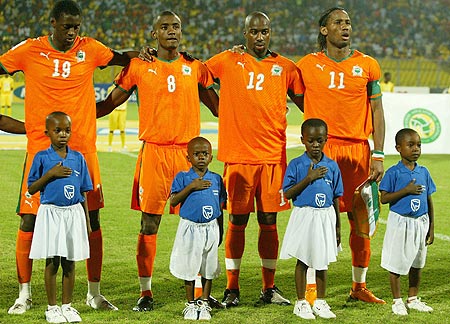
Pot 3 will include teams from Africa (Algeria, Cameroon, Côte d’Ivoire, Ghana, Nigeria) and South America (Chile, Paraguay, Uruguay)
Pot 4 will contain the remaining European teams (Denmark, France, Greece, Portugal, Serbia, Slovakia, Slovenia and Switzerland)