Guest Post by *Marc Fletcher
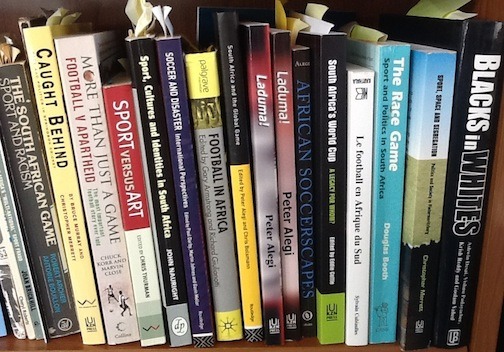
Gloomy skies and wet weather greeted the Research Forum on South African Football held at the University of Johannesburg (UJ) last month. The bleak conditions made for an intimate crowd, but the academics, journalists and sports practitioners in attendance were rewarded with three strikingly different presentations on varying aspects of the “beautiful game” in South Africa. The aim of the forum was to advance the specialized study of soccer in the country and beyond.
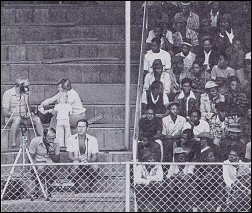 First up was Chris Bolsmann, a South African sociologist based at Aston University, Birmingham. His paper entitled “Professional Football in Apartheid South Africa: Leisure, Consumption and Identity in the National Football League, 1959-1977” provided a rich history of the whites-only National Football League (NFL) during apartheid. The common misconception of South African football is that it has historically been, and continues to be, an exclusively black, working-class game. Yet, Chris’s work challenges such a perception and begins to reconstruct a past that is often forgotten or even ignored. Matches in this white league were staged in front of segregated crowds. A successful corporate affair, the NFL attracted a host of world-renowned players, including George Best and Bobby Charlton. In concluding that the NFL became the leisure and sporting entertainment of choice for significant numbers of white and black (particularly Indian and Coloured) South Africans, this history emphasized how football in South Africa has had a more diverse support base than is often acknowledged.
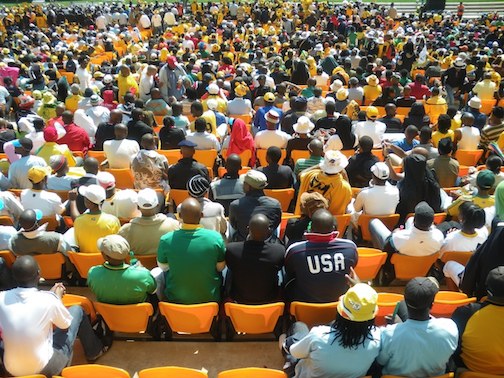 My paper on “Divisions, Difference and Encounters in Johannesburg Soccer Fandom,” explored contemporary cultures of fandom beset by race and class divisions, where domestic football is regularly constructed as an Africanized space without white supporters. However, through an ethnography of Kaizer Chiefs, Bidvest Wits, and Manchester United supporters’ clubs in Johannesburg, I began to explore the deeper complexities, where supporters on the margins of these groups began to engage with the other. In doing so, some fans challenged these social barriers in football and thus reinterpreted their understanding of soccer fandom and their wider experiences of everyday life in the city.
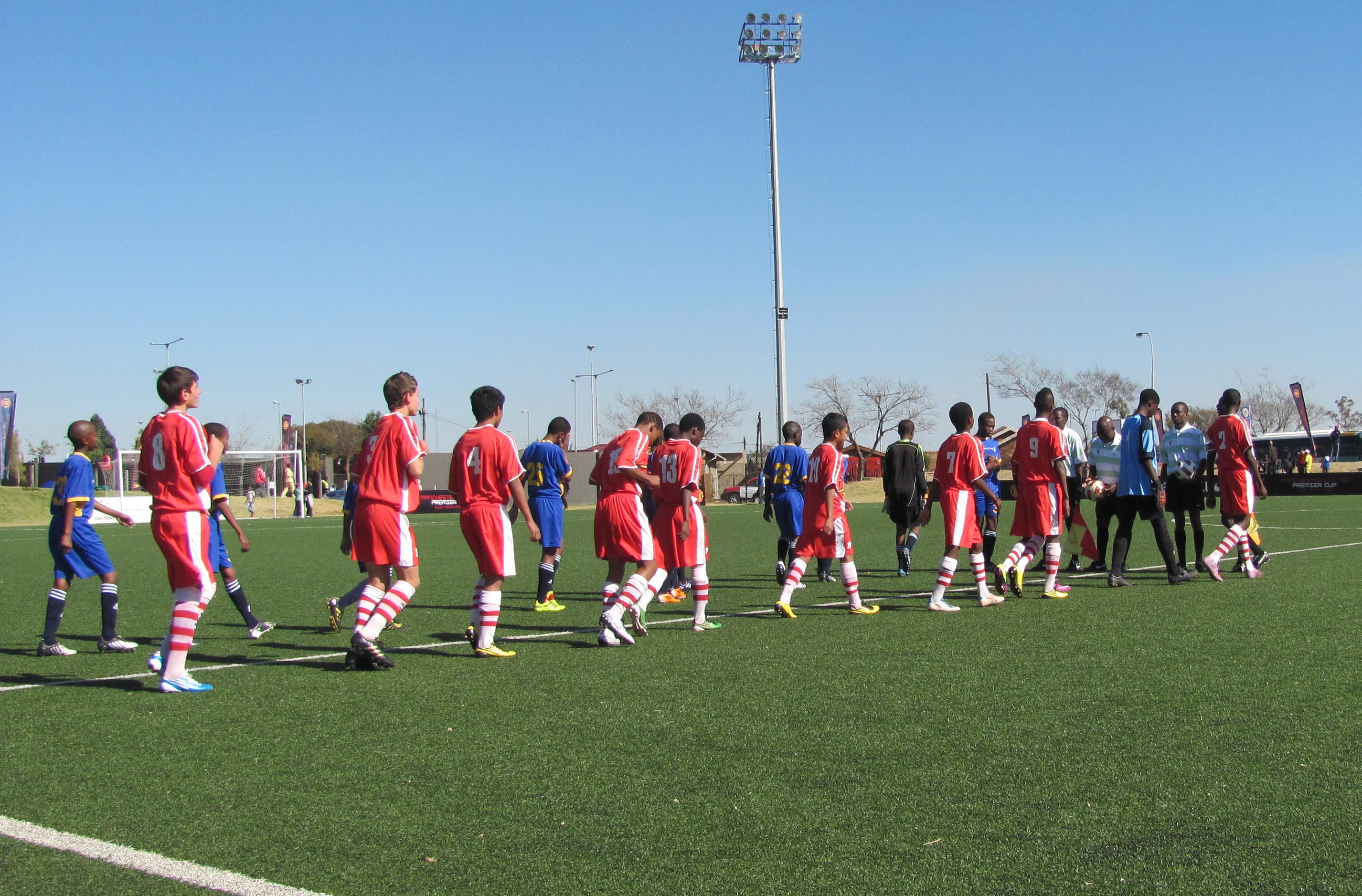 Chris Fortuin, based in the Department of Sport and Movement Studies at UJ, gave the third paper–an eye-opening account of the grim state of youth development in South African football. It was alarming to hear the inadequate ratio of qualified youth coaches to players in South Africa compared to some of the giants of international soccer, especially Spain. The shortage of such coaches, along with the absence of a coherent development plan at the national level, is harming the game at all levels and has contributed to the malaise of the men’s national team, Bafana Bafana.
The presentations encouraged members of the audience to think more seriously about football as an academic field of inquiry. During the second half of the forum panelists responded to numerous questions from the floor. One question stuck out, one that is often asked; why are black South Africans not writing about this subject? It is true that much of what is written on the subject is by foreigners like me. But a main goal of football scholars, regardless of origin, is to empower South African students in the humanities and social sciences (and other fields) with tools and desire to critically engage with football studies.
With questions on the presentations filling up the second half, the question of where does the academic study of South African football go from here was left unresolved. Events such as the UJ forum can play a vital role in motivating South African scholars to research and write about their game. Clearly, football is a legitimate and fascinating area of research. But many more events like the forum are needed to further develop the field and chart future directions.
To this end, readers of this blog who are in the Johannesburg area, are welcome to attend the UJ Wednesday Seminar Series on Wednesday, May 8, at 3:30pm, where I will be presenting a paper entitled “Reinforcing Divisions and Blurring Boundaries: Race, Identity and the Contradictions of Johannesburg Soccer Fandom.” For details about the event click here.
The journey continues.
*Marc Fletcher, a postdoctoral fellow at the University of Johannesburg, blogs at One Man and His Football: Tales of the Global Game. Follow him on Twitter: @MarcFletcher1
Police in riot gear battle protestors in the streets of Rio de Janeiro. Aggressive slum clearance threatens favelas. Gentrification at Maracanã Stadium. FIFA exclusion zones around World Cup venues. Sound familiar?
As readers of this blog know, South Africa staged a successful World Cup in 2010, marketing the country globally to tourists and foreign investors, and uniting, albeit temporarily, a nation divided along racial and economic fault lines. South Africa’s experience was part of a larger trend, that of BRICS countries enthusiastically embracing the global mega sporting events business: from Beijing (2008 Summer Olympics) and Delhi (2010 Commonwealth Games) to Brazil (2014 World Cup and 2016 Olympics) and Russia (2014 Winter Games [Sochi] and 2018 World Cup).
Recent media coverage of Brazil’s preparations reveals growing FIFA unease with delays in infrastructure construction projects and other hosting problems. Speaking at a FIFA academic symposium last week, FIFA General Secretary Jerome Valcke expressed frustration with Brazil’s government, saying that “less democracy is sometimes better for organizing a World Cup,” according to a Reuters wire story. Valcke’s extraordinary remark confirmed some experts’ suspicions about FIFA’s underlying rationale for choosing autocratic Russia and Qatar (2022) as World Cup hosts.
Another story about 2014 World Cup stadiums was published in the New York Times Goal blog. James Young’s “White Elephant Hunting in Brazil” highlighted the importance of staging matches across the country. It concluded that while there were some troubling questions about the preparations, “Nevertheless, amid talk of delays and spiraling costs, the 2014 World Cup will at least be an event for all Brazil. In a country where the north-south cultural and economic divide is so deeply engrained, that at least is something to celebrate.”
Young’s article elicited a sharp response from Chris Gaffney (@geostadia), Visiting Professor at the Graduate School of Architecture and Urbanism at Rio’s Federal University, on his blog “Hunting White Elephants.”
“The projects associated with the World Cup were poorly planned, hastily executed (if at all) and may not serve the long-term needs of the cities or the country,” Gaffney writes. “There is no redress (as the [NYT] author suggests) of historically-situated cultural or economic divides in World Cup investment, especially when we take into consideration the astronomical sums being invested in Rio de Janeiro for the 2016 Olympics.” Gaffney concludes emphatically by pointing out that Young’s piece “does not attempt to kill White Elephants, but to make them into bichos de estimação (pets).”
On Saturday, April 27, ABC radio in Australia picked up on Gaffney’s critical blogging. Listen to Geraldine Doogue’s interview with him here.
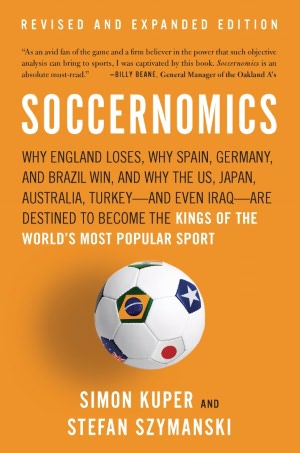
Soccernomics has been called “the Barcelona of football books” and the “Moneyball of soccer.” On Tuesday, April 16, the Football Scholars Forum discussed this influential book with the authors Stefan Szymanski (in East Lansing, Michigan) and Simon Kuper (via Skype). One of the most important questions asked was: How does the introduction of big data and “soccer analytics” change our understanding of fútbol clubs, fans, and nations? The forum also featured intriguing comparisons between Western Europe and the United States.
Joining the authors were: Andrew Guest, Brian Bunk, Christoph Wagner, Corry Cropper, David Kilpatrick, James Dorsey, Mark Siegel, Hikabwa Chipande, Christian Orlic, Benjamin Dettmar, Peter Demopoulos, Steven Apostolov, Tom McCabe, Alex Galarza, and me.
For Twitter timeline click here.
Listen to the audio from the session here (mp3).
[WATCH: http://vimeo.com/76755353]
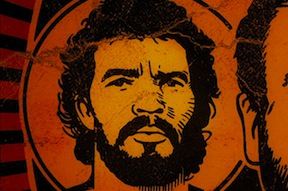
Doctor Socrates was futebol’s version of Che Guevara. The fifth and final episode of the superb “Football Rebels” film showcases the lanky, visionary midfielder’s role in the Corinthians Democracy movement that helped push for democratic change in Brazil under military rule in the early 1980s. “One person, one vote,” became the rallying cry of a campaign to elect a sociologist as chairman of Sao Paulo’s popular club. Contesting the election was a conservative businessman who came to embody the forces propping up the military dictatorship. Wearing a headband adorned with the words “Freedom and Justice” Socrates merged football with politics.
As his teammate Wladimir eloquently shows in the film, “Corinthians Democracy” transcended Socrates. The slogan was emblazoned on team jerseys and came to symbolize Brazilians’ dream of universal suffrage. On the final day of the 1983 season, Socrates and his teammates walked on to the pitch carrying a huge banner that read: “Win or lose, but always democracy.” Boosted by this remarkable movement started by courageous, idealistic athletes and embraced by thousands of ordinary men, women, and children, opponents of the dictatorship won provincial elections across the country and strengthened calls for direct presidential elections in Brazil. Watch. Listen. Learn.
Read my post on Socrates’s death here.
Before Pinochet’s rise to power in the September 11, 1973, coup, football clubs sustained a vigorously democratic culture, writes historian Brenda Elsey in her brilliant book Citizen and Sportsmen: Fútbol and Politics in 20th-Century Chile. Colo-Colo and Chile national team forward Carlos Caszely embodies this story. He is at the heart of episode 4 of the “Football Rebels” series on Al Jazeera (iOS users watch it here).
Brought up in a left-wing family in Santiago with its fair share of Communists, Caszely was not your typical professional footballer. He was active in the Players’ Union while many professionals saw themselves as “apolitical,” chiefly concerned with maintaining the status quo. Caszely was well known for his vocal support of Salvador Allende’s Popular Unity government: “Since I had use of my own reason,” he said, “I have liked the Left and I am not thinking of changing my ideals,” (Elsey, p. 217).
Interestingly, two months to the day after the coup, Caszely participated in what may well be the strangest match in football history. He took the field for Chile at the National Stadium in a World Cup qualifier against the Soviet Union. But the opponents were not there. Defying FIFA, the Soviets had refused to play in a stadium where more than 12,000 people had recently been imprisoned, tortured, raped, and brutalized by Pinochet’s goons. Caszely played that day because he was scared for his family’s safety. Sadly, this fear was borne out by the regime’s assault on his mother, whose direct testimony provides a dramatic highpoint in the film. As the footballer says: “I said no to dictatorship on every level: no to dictatorship, no to torture . . . So they made me pay for that with what they did to my mother.”
Caszely would go on to score 29 goals in 49 matches for Chile, taking part in both the 1974 and 1982 World Cup finals. He spent five years in Spain (1973-78) before returning to Colo-Colo. In the twilight of his career, Caszely also played for the New York Cosmos (1984) and for Ecuador’s most decorated club, Barcelona SC of Guayaquil. “Ever since I was a little boy and I started walking, holding my father’s hand, in the district where people play against a wall, against a tree, against a mound, against a big stone, against your opponent, with a football, a plastic ball, a rag ball, a paper ball, even a tin can, if there’s nothing else . . .” he always found a way to play. Despite the regime’s repression and intimidation, Caszely’s conscience and his passion for the game could not be silenced. El pueblo unido jamas serà vencido!
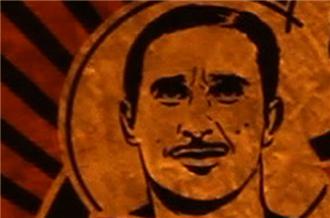 On April 13, 1958, in the midst of Algeria’s war of independence, ten Algerian professional players surreptitiously left France for Tunis. Among them was 21-year-old St. Etienne forward Rachid Mekhloufi, the central character in the second installment of the “Football Rebels” documentary on Al Jazeera.
Through evocative interviews, archival footage, and on-camera visits to important historical sites, the documentary crafts a lively, humanistic, and emotional account of the FLN team. In tours of North Africa, the Middle East, Eastern Europe, and East Asia between 1958 and 1961, the Algerians compiled a record of sixty-five wins, thirteen draws, and thirteen losses. Playing entertaining, attacking football, the FLN side heightened international awareness of the Algerian fight against French colonialism and garnered broad support for the FLN, at home and abroad. The Algerians even sought to become part of FIFA, but the world body rejected the application.
In a highpoint of the film, Mekhloufi remembers how wearing a national uniform, flying a national flag, and singing “Kassaman” (We Pledge)–which later became independent Algeria’s national anthem–in a stadium full of ordinary fans as well as guerrillas instilled pride in him and made an imagined “Algeria” real. “What I got out of that FLN team,” says Mekhloufi in the closing moments of the film, “couldn’t have been bought with all the gold in the world.” Indeed, by putting patriotism before profit and crystallizing an emerging national identity, the FLN footballers propelled the Algerian people’s quest for equality and freedom. What an incredibly powerful story about sport and human rights. Watch, listen, and learn.
For more details about this revolutionary football team, see my post “Death of a Striker, Fighter, and Socialist” on Ben Bella and my book African Soccerscapes. Other helpful sources are Ian Hawkey’s Feet of the Chameleon, Laurent Dubois’s Soccer Empire, and, for French readers, R. Saadallah and D. Benfars’s La Glorieuse Équipe du FLN and Michel Nait-Challal’s Dribbleurs de l’indépendance.
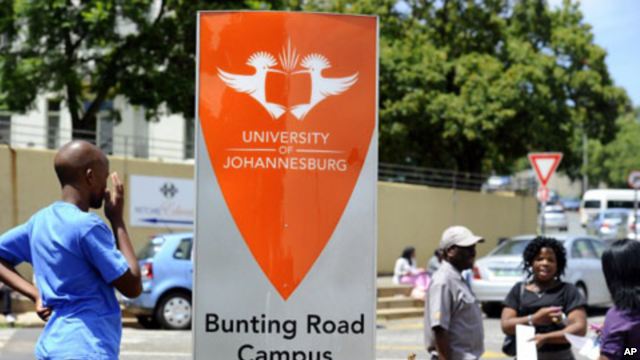
Next month the University of Johannesburg is hosting an exciting “Research Forum on South African Football.” Organized by the UJ Department of Sport and Movement Studies, the gathering will consider three papers that address socio-historical, sociological, and developmental aspects of football in South Africa, as well as broader issues related to the local game.
In his paper “Professional Football in Apartheid South Africa: Leisure, Consumption and Identity in the National Football League, 1959-1977,” sociologist Chris Bolsmann (Aston University) will present a preliminary analysis of the NFL, a “whites-only” league established in 1959 by a group of (white) Johannesburg businessmen. Playing in segregated stadiums, the NFL introduced professional football to South Africa. At the height of its popularity, it had two divisions, attracted significant corporate sponsorship, and recruited prominent foreign players, such as George Best and Bobby Charlton. The NFL became the leisure and sporting entertainment of choice for significant numbers of black and white South Africans and was unparalleled in popularity during this period.
Ethnographer Marc Fletcher (Department of Sociology, University of Johannesburg) will explore contemporary dynamics in a paper titled “Divisions, Difference and Encounters in Johannesburg Soccer Fandom.” This ethnography of Kaizer Chiefs, Bidvest Wits, and Manchester United supporters’ clubs in the city shows how supporters on the margins of these groups began to engage with the other, crossed racial and class divisions, and thus reinterpreted their understanding of soccer fandom and their wider experiences of everyday life in the city.
Last but not least, Chris Fortuin (Department of Sport and Movement Studies, University of Johannesburg) will discuss “Youth Football Development in South Africa.” The paper notes how in South Africa there is a severe lack of focus on youth football development to sustain national junior and senior teams. I also highlights that youth football development is not coordinated, there is limited success in nurturing young players for the international market, and coach development with a specific focus on youth football is strongly lacking.
This forum takes place on April 19, 2013, 10:00-12:00 at the University of Johannesburg’s Protea Auditorium, School of Hospitality and Tourism, Bunting Road Campus, Auckland Park. For more details please contact Dr. Chris Bolsmann (chris [dot] bolsmann [AT] aston [dot] ac [dot] uk or @ChrisBolsmann on Twitter).