[iOS users click here to listen.]
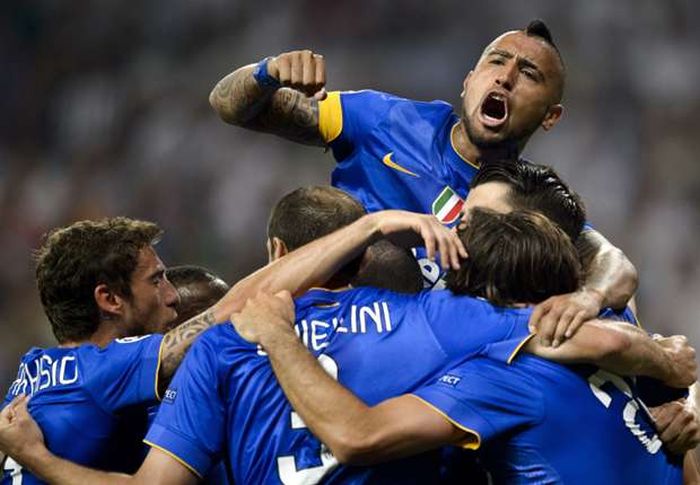
Juventus, the Old Lady of Italian football, is in the Champions League final for the first time since 2003. In an interview I did a year ago with Austin Long for the Soccer Nomad podcast, I explain how I came to support the bianconeri in the mid-1970s despite being from Rome.
Since I did not live in Turin, I supported Juve from afar and became religiously devoted to Michel Platini and, years later, to Roberto Baggio.
A day after eliminating Real Madrid to earn a date against Barcelona on June 6 in Berlin, it’s funny to hear my rational, realistic assessment of Juve’s prospects for success in Europe alongside my thoroughly irrational dream of winning the European Cup like Milan did in ’94–by thrashing Barca 4-0!
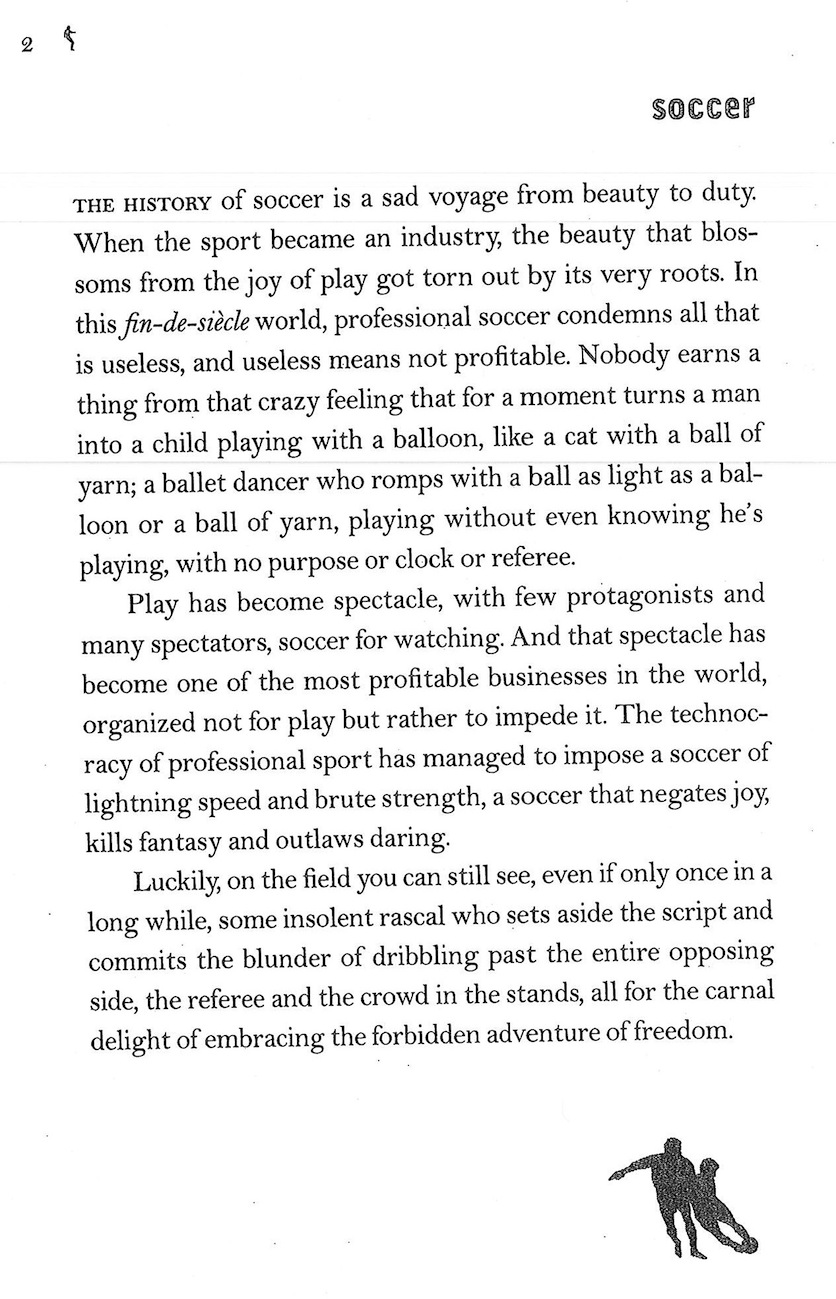
Eduardo Galeano, the Uruguayan conscience of a continent and author of my favorite fútbol book of all time died on Monday, April 13, at the age of 74.
“I’m wandering downtown in the rain searching for words to describe what I’m feeling right now. Something, anything to make sense of the loss,” is all the prose I could muster when I heard the sad news. Fortunately, many other more capable, more productive authors, activists, and scholars posted lovely tributes, although only a few highlighted Galeano’s art of fútbol writing (e.g. click here to read Dave Zirin’s eulogy in The Nation).
As I searched for the appropriate, any!, words to articulate my grief and gratitude, I thought back to when I translated a chunk of the Italian edition of Soccer in Sun and Shadow into English for Joe McGinniss, the American journalist and writer with whom I was corresponding from South Africa as he finished his book The Miracle of Castel di Sangro.
By the time I had returned to Boston to write up my PhD dissertation, the English edition had finally been published (brilliantly translated by Mark Fried) and I took to opening and closing class meetings in my Soccer and Imperialism course (sic!) with a reading from what I called “the Gospel according to Galeano.”
It’s now been four days since our fútbol bard’s passing and I’ve completely failed to find the just-exactly-right words to share with you.
So I returned to the source. Below is my favorite reading from Fútbology’s Sacred Text. Ciao Eduardo!
Zambia won the African Nations Cup in 2012. It is a recognized regional football powerhouse. As in most African countries, Zambians are fiercely passionate and knowledgeable about the game.
Yet to this day no academic history of soccer in Zambia exists. Hikabwa Decius Chipande, a native of Zambia currently completing his PhD in history at Michigan State University, is determined to eliminate this inexcusable oversight.
On March 26, the Football Scholars Forum, a fútbol think tank based in the MSU History Department, hosted an online discussion of Chipande’s paper titled “Mining for Goals: Football and Social Change on the Zambian Copperbelt, 1940s to 1960s.” This paper is part of Chipande’s larger doctoral dissertation in African history, which I am supervising at MSU.
The paper was precirculated on the FSF website and then, following the group’s tradition, the author was invited to make brief introductory remarks about the project before ably taking questions from the audience for 90 minutes.
Participants from three continents engaged in a discussion about the changing structure of clubs on the Zambian Copperbelt; sport in Africanist scholarship; the place of Zambia in wider south-central and southern African histories; local fan culture; and the importance of print media and oral interviews to represent multiple local voices and perspectives on the past.
The audio recording of the full session can be downloaded here.
Manifesto for a Better Game

The Football Action Network describes itself as an “open, unbureaucratic network of football activists [in Britain] that includes supporters’ trusts, independent fan groups, fanzines, campaigners in the women’s game and advocates for grassroots football.”
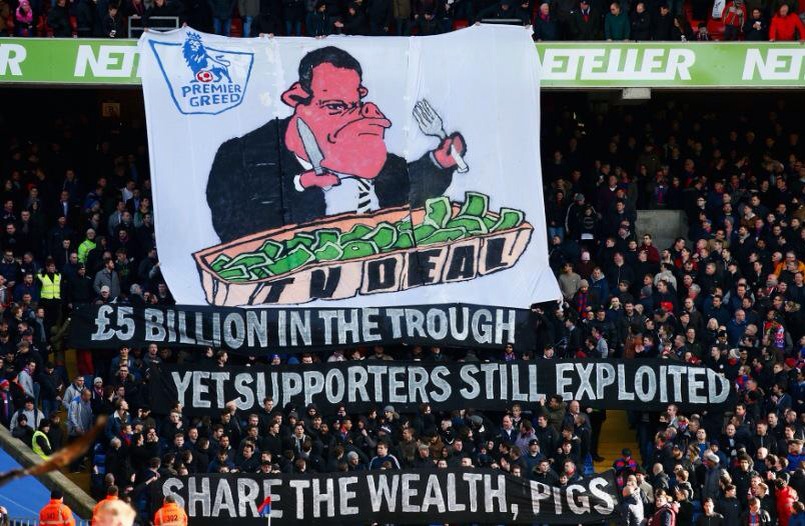
David Goldblatt, one of the world’s preeminent fútbologists, writing in The Guardian, laid out the group’s manifesto to improve the game in the land of the English Premier League and beyond. From economic justice and institutional reforms to fan freedom and equality for all, this program aims to reclaim and transform football by putting people before profits.
This is how FAN proposes to do it:
1. PASS A FOOTBALL REFORM BILL
2. PAY THE LIVING WAGE
3. SET FAIR TICKET PRICES
4. INTRODUCE SAFE STANDING
5. TIME FOR A FIT AND PROPER FA
6. TRANSPARENT CLUB OWNERSHIP
7. WINDFALL TAX ON THE PREMIER LEAGUE
8. BOOKIES TO PAY THEIR SHARE
9. SHIFT THE FOCUS: TO GRASSROOTS AND NON-LEAGUE
10. SWEEP AWAY FIFA: CLEAN UP THE GLOBAL GAME
11. A NEW CULTURE: A REAL FIGHT FOR EQUALITY
To read the full article click here.
This is the third post in Pelle Kvalsund‘s series rethinking Sport Development and Sport For Development. (Click here and here to read the previous posts.)
By Pelle Kvalsund
If you have visited sub-Saharan Africa then you know that Non-Governmental Organizations (NGOs) are everywhere, even in sports.
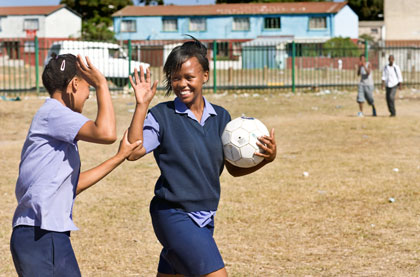
In 1999, I traveled from Norway to South Africa to work for Sports Coaches’ Outreach (SCORE). This NGO aims to create sporting opportunities for children and youth in disadvantaged urban and rural communities. The agenda was clear and the focus simple: Sport for all!
Since the pioneering days of the 1990s, thousands of new local and international sport for development organizations (S4D) began operating all around the world (partial list here). Most of these organizations feed on a broken local sport system to create, often successfully, high demand for their services. Sometimes their agendas are not clear or straight forward.
Sport NGOs are manna from heaven for Western governments and donors eager to boast about their efforts in developing civil society and reaching grassroots targets in the Global South. By offering sporting activities for boys and girls, S4D NGOs appear to have successfully “taken over” parts of the mandate for youth development usually given to local (including national) sport associations.
Backed by solid support from northern sponsors (public and private), many S4D groups have developed a strong internal organizational capacity that enables them to raise funds, submit grant proposals, market themselves, and run and evaluate activities according to the foreign aid industry’s terms and latest trends. These NGOs succeed by investing in their capacity and development. In the process, they create self-sustainable structures that go beyond their original function as “gap fillers” for outstretched African sport providers.
This process has fostered adversarial, even hostile, relationships between the NGOs and government-mandated sport bodies. Such rivalries stem from perceptions that the success of S4D NGOs stems at least in part from the sports governing bodies’ mismanagement and mistakes. In some cases, this animosity targets northern brokers who are seen to be undermining the local sport custodians’ mandates. The rivalry is rooted in struggles for material benefits, such as access to a new Land Cruiser, as much as by the fact that many NGOs and football academies are producing young footballers for sale in European and Asian markets.
Some governments and sport governing bodies have been developing strong policies and clear strategies that chart a coherent, productive direction for sport development in their countries. Chasing aid money, the NGOs often fail to align themselves with host countries’ strategic plans and begin operating in a parallel universe. This parallel universe does not only function in isolation; at times, it also produces some peculiar activities. As S4D’s agendas change because of funding levels and requirements, the sport activities they deliver also change.
Over the years, I have observed how using sport to address serious issues like AIDS, farming, sanitation, traffic safety (as well as some religious agendas) has backfired. NGOs forget (or choose to ignore) that the kids come first and foremost to play sports. They do not enjoy standing quietly in line passively listening to lengthy explanations about how to wash hands properly or safely cross the street.
Some of the S4D activities are so far removed from sport that they confuse both the boys and girls and sport development practitioners like myself. Such a wrong-headed approach has led to many youths choosing to pursue other activities and dropping out of sport all together.
What would the African and Asian sport associations (discussed in my previous post here) look like and how would they function today if northern brokers, supported by Western governments and companies, had invested the same amount of human and material capital in capacity-building and long-term development? The Norwegian Olympic and Paralympic Committee and Confederation of Sport, an umbrella organization for all national sports federations in Norway, has adopted this strategy. It will be interesting to follow its development over time.
Foreign white coaches’ involvement in African football dates back to the earliest days of colonialism. Beginning in the 1960s, independent African states continued to hire many Europeans (especially from the Eastern bloc and West Germany) and South Americans to manage national teams and player development programs.
This funny BBC video raises serious questions about this long-standing trend, noting the disproportionately high number of overseas coaches at the 2015 African Nations Cup. In a field of sixteen teams in Equatorial Guinea, the only local coaches on the sidelines were Honour Janza (Zambia), Florent Ibengé (DR Congo) and Shakes Mashaba (South Africa).
This is the second post in Pelle Kvalsund‘s series rethinking Sport Development and Sport For Development. (Click here to read the first post.) Kvalsund is an international sport development consultant from Norway and a former athlete, coach, and physical education teacher. As a consultant for over 15 years, he has worked in many countries including Vietnam, Sri Lanka, Burundi, Zambia, and Bosnia. Pelle has served a number of international organizations, both within sport and the area of community development, and is currently an advisor for the Norwegian Olympic and Paralympic Committee and Confederation of Sport and their partners in the Global South. He is the author of “Sport as a Response to Emergencies and Disasters” in Sport, Peace and Development, edited by Keith Gilbert and Will Bennett (free download here).
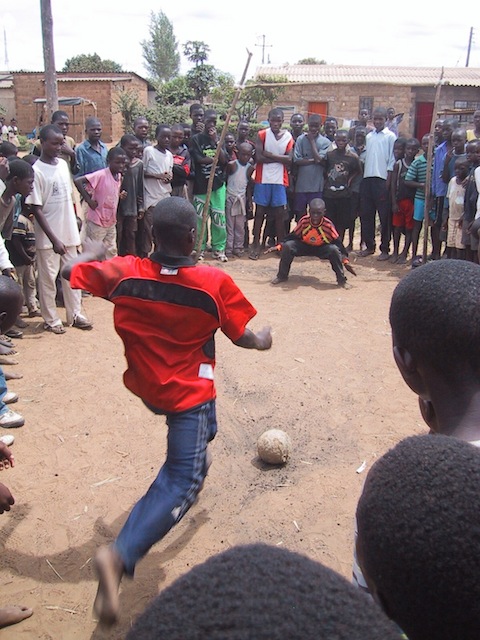
There are two main camps in sport development. The first believes that sport should be governed, administered, and developed exclusively by local, national, and international sport associations. Let’s call this group “the custodians.”
The other camp believes that the custodians have failed to fulfill their mandate and, as a result, sport needs a national boost through centrally driven sport programs for both youth and adults. Let’s call this group “sport for all” (though some countries use other terms like “mass sport” and “fitness programs.”)
Many countries combine the two forms of sport development, in addition to having non-governmental sport for development organizations and private sport academies operating in selected communities and districts.
Most football associations are “custodians.” They claim absolute sovereignty in the management of football affairs even though they receive more financial support from governments than the other national sport associations. Substantial financial assistance from FIFA and from sponsors, both parastatals (e.g. national breweries) and large private companies, help solidify this position.
Now, let’s look at a typical football association’s ability of to run all aspects of the game in their respective countries. While FAs view themselves as politically sovereign in domestic football matters, they are challenged by meager economic means (despite the aforementioned subsidies) and poor organizational infrastructure. These constraints make it difficult to prioritize, for example, development in rural areas. Furthermore, state and corporate funds are often earmarked for the best male players in elite programs, while the support from FIFA goes to capacity development of, in many cases, randomly selected leaders, coaches and referees. If any funding goes to grassroots development it is usually for youth national teams or FIFA-supported Football for Hope or similar corporate social responsibility initiatives.
Zambia, which won its first African Cup of Nations crown in 2012, is a case in point. The continental title was a great achievement, one that can be attributed to both historical factors (for the ones who know the history!) and a productive mix of talented young players, professional coaching staff, and capable leaders. It can also be attributed to a short systematic youth development approach put in place by Kalusha Bwalya, President of the Football Association of Zambia (FAZ). After pursuing his coaching training in the Netherlands, the former PSV Eindhoven and Zambia striker returned to Zambia in the early 2000s and became national technical director supervising a strong staff of coaches.
In spite of FAZ’s successful grooming of a few individual stars, the national football system in Zambia appears quite bare in terms of organized youth development. With over 46% of the population below age 15 (5th youngest in the world in 2013) and about 2 million youth between the ages of 15-24 (according to NationMaster data [January 17, 2015]), one might assume Zambian coaches would have a rich supply of skilled footballers to tap into enabling them to produce consistent good results for national team. But that has not been the case.
Into this development vacuum stepped both private football academies and local NGOs that organize sport as a tool for development. It is these organizations that train many of the players that end up representing Zambia’s top teams. While this is evidence that some of these academies and NGOs have been doing a satisfactory job creating opportunities for play and fostering talents, it also indicates that control and power to secure quality coaches, and to ensure players’ personal safety and development is out of the hands of the FAZ.
I don’t want to be overly critical of Zambian football because I know after many years of living in Zambia that FAZ and other national sport associations face numerous daunting tasks: from financing and operating capacity-building programs for coaches to managing myriad of leagues and tournaments for all the teams and clubs that train and develop players. It would, however, be interesting and worthwhile for them and other sport associations to assess their mandate and reexamine their approach to youth sport development.
Together with a few international sport federations’ development programs, a contingent of Western governments (unfortunately, a decreasing number) continue to support both sport development and sport for development initiatives in Africa. One of the dilemmas these governments face is: How do you provide assistance? Do you work with dysfunctional sport associations (“custodians”) in organizational capacity development so that they will eventually be able to run efficient youth sport for the masses? Or do you continue supporting government-driven and NGO-run sport-for-all programs that attempt to fill the gaps in the mandate left by the associations?