Guest Post by Chris Bolsmann (c.h.bolsmann [at] aston [dot] ac [dot] uk)
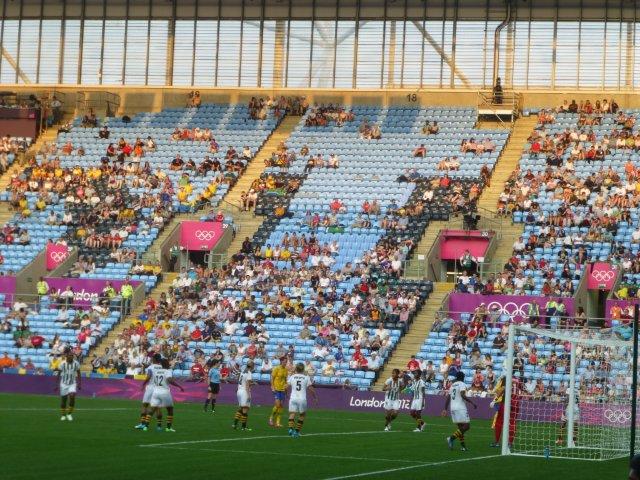
COVENTRY–In a week when South African cricketers and golfers recorded convincing victories, a hat trick of results would have seen South Africa’s women’s national team celebrate their first appearance at the Olympic Games by beating Sweden. But facing a team ranked 4th in the world, Banyana Banyana (Zulu for “the ladies”) could not pull off the miracle win.
The South Africans met their Swedish counterparts in Coventry, 100 miles north of London, in the second match of a double header. Japan beat Canada 2-1 in the early game in front of 18,000 spectators, while the 2011 World Cup third-place finishers defeated South Africa 4-1.
Normally called the Ricoh Arena and home to Coventry City FC, the City of Coventry Stadium looked quite different from its normal appearance full of advertising hoardings. The Olympic organisers were not quite able to cover up all of Coventry City’s history though, as a photo of the 1987 FA Cup winning team adorned one of the stadium walls.
While Banyana Banyana have always worn the yellow and green colours of the South African Football Association, this time the squad entered the pitch in a horrible-looking green and white vertically striped kit, courtesy of the South African Sports Confederation and Olympic Committee’s official kit supplier: Erke, from China. The crowd had dwindled to a few thousand for the second match and the majority of photo press had left the stadium. A small contingent of South African fans remained who were vocal throughout but were outnumbered by Swedish fans and locals who supported their European neighbours.
Sweden kicked off and, ominously, twice hit the cross bar in the opening six minutes. The Scandinavians went ahead in the 7th minute thanks to a Nilla Fischer shot from outside the box that was cruelly deflected past United States-based Roxanne Barker in the South African goal. Then the Swedes again hit the cross bar and doubled their lead in the 20th minute when Lisa Dahlkvist poked home a ball from the flanks. A minute later Sweden scored a third goal when South African stalwart Janine van Wyk was beaten for pace on a through ball and Lotta Schelin slotted past the on rushing South African keeper. After 21 minutes Banyana’s debut had turned into a nightmare and a real humiliation was on the cards.
The South African midfield were constantly over run by the more forceful and creative Swedes and the defence were outpaced on numerous occasions, allowing for the Swedes to cross balls into the box at leisure. To her credit, Barker dealt well with crosses and high balls and remained calm under constant Swedish pressure.
The second half saw Banyana kick off with far more purpose and creative intent. In the 60th minute, Portia Modise, a former World Player of the Year nominee, dispossessed a Swedish midfielder well within the South African half and from inside the centre circle unleashed a wonderful strike to beat Hedvig Lindahl. Modise’s goal restored South African spirits and momentarily gave South African supporters some hope. But three minutes later Schelin got her second goal of the match and restored the three-goal margin.
The final quarter of the game saw South Africa struggle with fitness and the match ended with a resounding victory for the Swedes. Sweden had over 57% possession and outshot South Africa 21 to 7. Banyana Banyana were outclassed by a technically superior and fitter Swedish side. After the shock of allowing three goals within 25 minutes, Banyana settled and showed a few individual moments of skill but were unable to retain possession for any length of time. It won’t get any easier in this tournament for South Africa: they face Canada on Saturday and World Champions Japan the following week.
Author: Editor
Guest Post by *Hikabwa Chipande
NDOLA — Zambia’s victory in the 2012 African Nations Cup has spawned a new fashion on the Copperbelt — the country’s industrial and football heartland — where people now wear Chipolopolo (Copper-bullets) replica jerseys as well as chitenge (women’s waist wraps) in the national colors. Selling Chipolopolo regalia has also become big business in street markets and makeshift stores. Clearly, the African champions have re-energized the mood of the nation and revitalized support for football among ordinary citizens, politicians, and business people.
The stability of copper prices, increases in copper production, an improving economy, and the pride of being African football champions, have led ZCCM Investments Holdings, formerly Zambian Consolidated Copper Mines, to reconsider supporting the sport. For instance, private companies such as Mopani Copper Mines and Copperbelt Energy have resumed their funding of Kitwe’s famous Nkana Red Devils and Power Dynamos.
“Winning the African Cup changed things,” says Red Devils head coach Linos Makwaza. “People have started coming back to football. At Nkana [Football Club] Mopani [Copper Mines] is now involved and has taken over which is good,” Makwaza says. The relationship between mining companies and football is not a new one. It has shaped the history of the game in Zambia. As far back as the 1920s, when copper mining started on the Copperbelt under British colonial rule, and into the independence era up to the privatization of the ZCCM mining company in 1991, government-controlled mining companies provided football grounds, financial resources, coaches, players, and stimulated a deeply rooted fan culture.
Zambia’s Nations Cup success has inspired politicians such as Sports Minister Chishimba Kambwili to encourage new owners of copper mining companies to sponsor Mighty Mufulira Wanderers, Nchanga Rangers, Nkonkola Blades, Roan United, Kalulushi Modern Stars and other important, but struggling, clubs in the mining province. Abraham Nkole, currently Mighty Mufulira Wanderers manager and a former player in the 1960s and 1970s, sees this shift as an opportunity to resuscitate the “lost glories” of Copperbelt football.
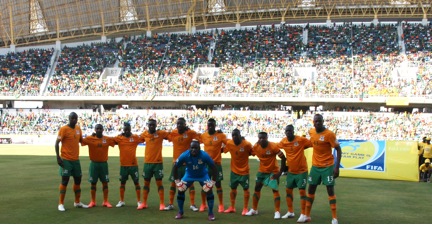
The opening of a modern stadium in the mining town of Ndola has also injected new life in Copperbelt football. I was in attendance on June 9, 2012, for the inauguration of the Chinese-built 40,000 capacity Levy Mwanawasa Stadium, which hosted a Zambia vs. Ghana 2014 World Cup group D qualifying match (see photo). Thousands of fans clad in green and orange Chipolopolo replica jerseys besieged Ndola. With Vice President Dr. Guy Scott in the stands, Chipolopolo beat the Black Stars 1-0 in the packed stadium, thus renewing their hopes for qualifying to Brazil 2014 after being thumped by Sudan 2-0 in Khartoum a week earlier.
Practitioners and fans I spoke to on the Copperbelt are encouraged by recent developments and hope the mining province will soon reclaim its dominant position in Zambian football after two decades of decline. The political and financial investment that is fueling the game’s resuscitation owes much to Chipolopolo’s international success. The question is whether such support will continue should the national team perform badly at next year’s African Nations Cup in South Africa.
*Hikabwa Chipande is a PhD candidate in African history at Michigan State University. His dissertation research is on the social and cultural history of football in 20th-century Zambia. He can be contacted at chipande [at] msu [dot] edu.
Guest post by Mohlomi Maubane
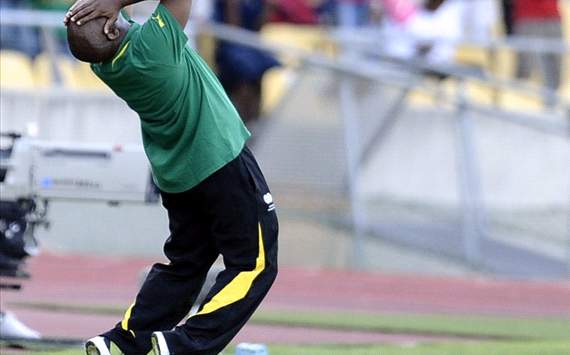
The Germans regularly find a way to excel in tournaments and are among the favourites to win the Euros in Poland/Ukraine. The South African football fraternity would do well to take a page out of the playbook that produced the current incarnation of Die Manschschaft when appointing a new Bafana Bafana coach. SAFA fired Pitso Mosimane this week after Bafana Bafana could only muster a 1-1 draw against Ethiopia in a 2014 World Cup qualifier in Rustenburg.
Eight years ago, the German national team was in dire straits after failing to win a single match in the group stages of the 2004 Euros. A rebirth seemed inevitable, and the newly appointed technical team of Jürgen Klinsmann and Joachim Löw pursued it with typical German precision.
Their first step was to give Die Manschschaft a new identity. The duo settled on a style based on playing the ball on the ground and transitioning swiftly from defence to attack. This was the outcome of an extensive consultation process. Workshops were held with German coaches and players to inquire how they wanted to play and how they wanted to be seen to be playing by their fans (and international ones too). Members of the German public also enjoyed the opportunity to provide input on how they wanted the national side to play.
From this inclusive process, Klinsmann and Löw drafted a curriculum for German football that was presented to the Bundesliga and the German FA. The latter then pressured teams in the former to build academy programmes that adhered to the overall strategy. Bundesliga teams were also encouraged to adopt a fitness programme that enabled the philosophy to be implemented. The newly appointed Under-21 coach also had to abide by the new policy.
By Mohlomi Maubane
SOWETO, South Africa — “Why the f**k did he not do that at West Ham!!!” reads a YouTube comment in response to the video clip above featuring Benni McCarthy’s superb free kick in the 2011 Telkom Cup quarterfinal between Orlando Pirates and Moroka Swallows. This is the best goal I have seen in the PSL era: an extraordinary strike in a tense match Pirates were losing by a goal to nil. And while Swallows players were still scratching their heads in bewilderment, he got a second and sealed the match.
West Ham were the last European team McCarthy played for in a chequered 14-year European career whose highlight was a 2004 UEFA Champions League medal with FC Porto under Jose Mourinho. A sometimes controversial character who had endless run-ins with the South African Football Association, Benni set tongues wagging in the local football scene when he decided to return to South Africa. Some critics believed he was over the hill while others knew he still had something to offer. The man himself said he still had a lot of football in him, and with the right service, he would excel. At Orlando Pirates, he found the perfect setting to shine although he would have to do it without Dutch coach Ruud Krol who had just left after three years at the helm.
The Mighty Bucs boasted one of the best squads in the country and were brimming with confidence after winning a treble the previous season. Krol’s long term (at least in South African terms) afforded him the required time to build a team and mould plentiful talent in service of the collective. Team-play became paramount above all else, and prima donnas were booted out. The defense became mean. Opponents learned the hard way that beating Pirates meant playing to the final whistle. For example, in a November league game against Swallows. The Dube Birds looked set for a 1-0 victory, but as my friend Katiso Motaung wryly noted, Pirates managed to turn defense into attack and Jele equalized in the nanoseconds it took the referee to lift the whistle to his mouth to blow full time.
Categories
Goal of the Week: A Goal and…a Spare
By Simone Poliandri
To celebrate the end of the football season and awaiting the kickoff of EURO 2012, Goal of the Week issues its concluding gem with a funny twist. On May 12, Toshihiro Aoyama of the Japanese league team Sanfrecce Hiroshima scored the go-ahead goal on a 70-meter-long shot that caught visiting Yokohama F. Marinos goalkeeper by surprise. Already a fantastic feat, this goal was paired with a much creative “Bowling” celebration by the home side akin to the “famous” goal celebrations introduced and performed by Icelandic team Stjarnan FC.
For the record, Yokohama won the game 1-3.
This goal offers a smile and provides the icing on the Goal of the Week first season cake.
See you in the fall!
By Simone Poliandri
This week we pay homage to amateur youth football, showcasing a gem by Farai Mutatu, a Zimbabwean player of TNT Dynamite Soccer U13 Boys Red team of Lansing, Michigan. In the 29th minute of the first game of the season against team SCOR, Farai scored the game winning goal by bicycle kicking a deflected ball into the opponent net. A feat of readiness and great coordination. The final score of the match, played on April 16, was 3-2.
Categories
Goal of the Week: Ladies’ magic
By Simone Poliandri
This week we celebrate women’s football with a spectacular goal by one of the best players in the world, Brazilian striker Marta Vieira Da Silva. Voted FIFA player of the year for five consecutive years (2006-2010), Marta, who just signed a two-year contract with the Swedish first-division team Tyresö FF, gave proof of her exceptional talent in a recent game that her team won 7-0 against KIF Örebro. In the 55th minute, Marta controlled a loose ball in the box with her right foot and back-heeled it with her left to make the score 5-0. As Marta played her first game for Tyreso in March 2012, this is the beginning of a season of extra work (and headaches) for opposing defenders and goalkeepers.
[iPad users click here for video.]