Guest Post by “Er Prof”
My friends,
AS Roma was magnificent in Milan: glory, glory AS Roma!
Italian football’s Jedi, the holy man Zdenek Zeman, is now recognized as The Master not only in Rome, but in all of Italy. La Gazzetta dello Sport, the pink sports newspaper printed in Milan, which is, sadly, the most important Italian daily in terms of sales, is asking Andrea Stramaccioni, the youngest Italian coach now sitting on the Inter Milan bench, to learn the lessons imparted by Zeman’s AS Roma 3-1 thrashing of the nerazzurri on Sunday night.
The match wasn’t the typical Zemanian all-out assault I was used to watching 13 years ago during the Bohemian’s last stint as AS Roma manager. Sure, Inter’s Europa League qualifier on Thursday, which they played with only ten men for most of the game, partly explains their loss of pace in the second half. But the most important revelation of the game came from AS Roma’s new players, some of them very young and playing for the first time at the San Siro/Meazza, also known as “La Scala” of Italian soccer.
With AS Roma depleted in midfield — De Rossi came off after half an hour, Michael Bradley is out for a month, and Pijanic watched from the bench — the Greek Panagiotis Tachtsidis and the Rome-born wonder Alessandro Florenzi (both age 21) turned in amazing performances. They are two hugely promising young midfielders I was really curious to watch. Remarkably, instead of being intimidated by the grand San Siro stage, they played without any hint of fear. Both of them ran from the first minute to the last second of injury time. Florenzi, Tatchidis and Marquinho were more than mere replacements: incredibly efficient, they covered the entire pitch, giving space and opportunities for Totti to unleash the great Osvaldo and wreak havoc on the Inter defense.
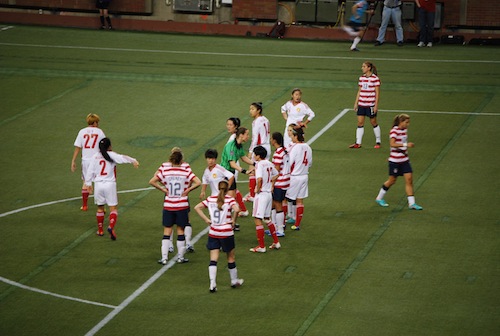
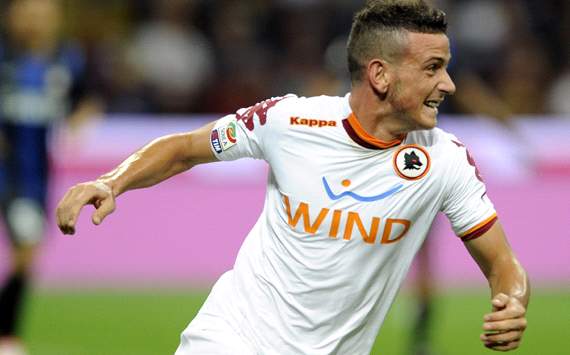
Totti was incredible, heroic. He served a terrific cross that Florenzi (in photo above) headed in for the first goal and then midway through the second half dished a wonderful assist to Osvaldo, who spooned it over the keeper to score the second. Marquinho, De Rossi’s substitute, finished Inter off with a great goal nine minutes from time. Meanwhile, Inter had equalized without merit through a deflected shot by Cassano right before the halftime break. The only negative news came from Mattia Destro, the 21-year-old striker making his debut with the giallorossi. The tenacious marking of Nagatomo stifled him, the Japanese being one of the few Inter players able to do something against the mighty AS Roma.
In the end, the match stood out as a lesson in tactics from the oldest serie A coach to the youngest. As I look forward to the match against Bologna at the Olimpico this weekend, my ears are still ringing with the chant of AS Roma supporters on the San Siro terraces: “Corete, scappate, ariva lo squadrone gialllorosso, giallorosso” (run, flee, the great yellow-and-red team is coming; video sample here).
Author: Editor

Guest Post by “Er Prof”
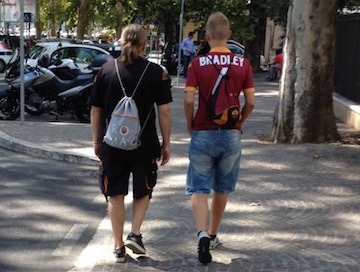
ROME–This past Sunday at the Stadio Olimpico I screamed in honor of Michael Bradley’s first serie A match with “La Magica Roma.” I howled so much during the 2-2 draw with Catania that I’m still hoarse three days later.
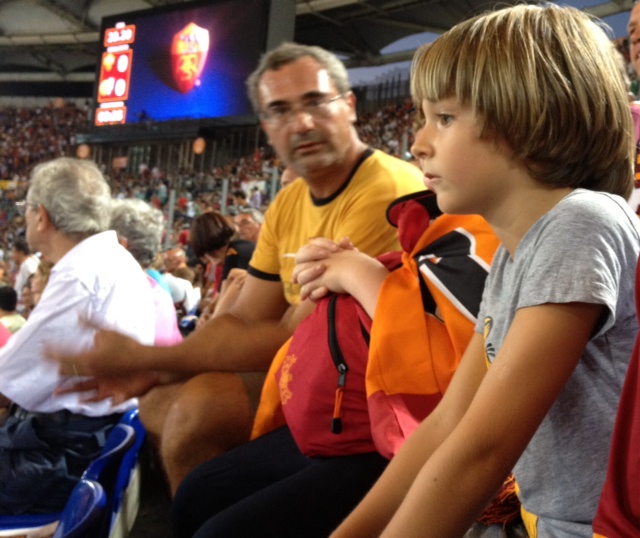
I am proud to say that I yelled only encouraging, positive things because I had my two boys, Alberto (age 9) and Luca (age 6), with me in the “Family” section of the Distinti Nord. (Long gone are my days with the Commando Ultrà Curva Sud.) In truth, I was also heeding my wife’s warning that if the kids returned home swearing she’d kick me out of the house.
It was so beautiful to see Luca absolutely mesmerized by the stadium atmosphere and the chaos; Alberto got into it too, especially after we drew level and he started believing in a miraculous victory even more than me.
There are at least two ways to comment on what happened in this strange opening game of the 2012-13 season. The first draws on the “dietrologia” (“behindology”) typical of the frustrated Romanista of the post-Capello era: “there you go, Zeman speaks the truth [about corruption and other ills affecting calcio] and those goddamn refs nail us immediately: Catania’s two goals were ludicrously offsides; we were denied a clear penalty; and Osvaldo was, absurdly, deemed offside on a breakaway that would have, surely, resulted in a goal. Two stolen points to keep those Juve bastards calm and content.”
Somehow I managed not to insult the referee for the entire ninety minutes, despite the time-tested knowledge that when in doubt referees always make important calls against us. It may sound like bullshit, but accepting this disgusting (“schifoso”) state of affairs is a big step forward for us as we move towards a different future, one defined by clean, clear, decisive victories achieved in spite of crooked referees.
The second way to reflect on the game is calmer, the kind possible only after the game; it is more focused on the sporting side of things. In the first half, La Roma played like utter shite. The team seemed confused and also intimidated by Catania’s toughness and fitness (a team with nine Argentineans!). Totti and Lamela were almost invisible; Bradley tactically too horizontal; De Rossi couldn’t deliver a vertical pass; and Piris shanked every cross. In the second half, La Roma started playing more seriously, but only through Florenzi and the 19-year-old Uruguayan Nico Lopez did it become truly dangerous. Shortcomings aside, we deserved to win handily. And we would have had it not been for the five officials: five pairs of eyes that managed to miss amazing offsides on Catania’s goals and an incredible handball in their box.
At halftime a child in our section asked his father why we were losing. The man replied with extraordinary wisdom: “because we were born to suffer” (“perchè semo nati pè soffrì”). That was a damn good answer, but the best line may still be the graffiti etched on a wall in our Eternal City: “VIVA LA PAZZA GIOIA D’ESSE ROMANISTIII” (“Long live the crazy joy of being Romanisti”).

Guest Post by Chris Bolsmann (c.h.bolsmann [at] aston [dot] ac [dot] uk)
After the disappointment of Banyana Banyana’s loss to Sweden (read my post here), I looked forward to the Opening Ceremony of the London Olympic Games and the parade of athletes in particular. The three hour spectacle turned out to be full of contradictions. Danny Boyle provided a fascinating, although selective, history of Britain. He paid homage to the Suffragettes, the National Health Service and immigrants from the West Indies among others, although no reference was made to either slavery or colonialism. I particularly enjoyed his musical selection which included The Jam, Sex Pistols, and The Specials. Watching excited athletes entering the Olympic Stadium can be fun and I was heartened to see Caster Semenya carrying the South African flag.
The lack of visible corporate sponsorship in the stadium and at all Olympic venues is really pleasing to a sports fan’s eye. What a stark contrast to the 2010 World Cup in South Africa where FIFA’s corporate sponsors were visible everywhere. I have yet to come across the Olympics “brand police,” unlike in South Africa where fans wearing Orlando Pirates and Kaizer Chiefs replica shirts emblazoned with the Vodacom sponsor were told to cover them up because MTN — a rival telecom firm — was a national FIFA corporate partner.
Despite the International Olympic Committee’s apparent subtlety, one just has to turn over any Olympic Ticket and the IOC’s “Worldwide Olympic Partners” are clearly visible. The usual suspects appear: unhealthy soft drinks, measly hamburgers and the like, but also a multinational chemical company. Athletes seem unhappy with the restrictions placed on them under the IOC’s Rule 40 protecting official sponsors from “ambush marketing.” Given that athletes can even be disqualified for promoting their individual sponsors, South African swimmer Cameron van der Burgh, Africa’s first gold medal winner, must be cautious since he endorses a range of corporate sponsors on his twitter account which are not “Worldwide Olympic Partners.”
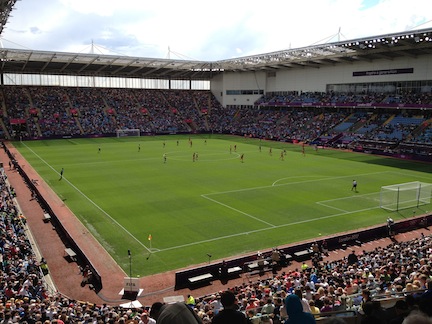
So despite the veneer of a corporate-free Olympic Games, the sponsors and their logos are everywhere. Fizzy soft drinks are even sold as “healthy food” alternatives inside Coventry City’s Ricoh Arena, which has been temporarily renamed the “City of Coventry Stadium” for the Games because the Japanese electronic giant is not an official partner of the IOC. Even the toilets are not safe from the IOC’s attempt at cleansing all traces of rival sponsors. The toilet cisterns and hand dryers have their manufacturer’s names covered up!
I got to watch a double header in this sanitised stadium yesterday as Mexico beat Gabon and South Korea defeated Switzerland. At £20 for a ticket, this represented genuine value for money. Match tickets are cheaper than what Coventry City FC charge in the 3rd tier of English football. The 32,000 seater arena was almost full with 28,000 spectators filling the stands. The empty seats, unfortunately, were the best seats available, those on the half way line behind both substitutes’ benches. According to the IOC, these were seats reserved for their “Worldwide Olympic Partners.” A shame. Besides the fans of the teams on the pitch, there were many families with young children, helped by cheaper youth ticket prices and the Sunday afternoon kickoff time.
As much as I wanted Gabon to silence the Mexican fans’ homophobic chants during opposing goalkeepers’ goal kicks, El Tri were undeniably stronger than their West African counterparts. In an evenly contested first half, Mexico had a couple of good opportunities, but Didier Ovono in the Gabonese goal was equal to the task. The introduction of Giovani dos Santos in the second half gave the Mexicans more creative options up front and he latched onto a long ball in the 62nd minute to put Mexico in front. Giovani sealed the game in the 90th minute after Gabon conceded a late penalty.
Football at the Olympics is different from the World Cup. The kits are different as the German manufacturer is not permitted to advertise their stripes. Football federation logos are replaced by national Olympic associations And for the men, 15 of the 18 members of the team are under 23 years of age. But one just has to look to the corner flags where FIFA has printed its logo and up to the official flags where the IOC’s flag hangs next to that of FIFA. In the end, the corporate interests of the IOC and FIFA merge.

Guest Post by Chris Bolsmann (c.h.bolsmann [at] aston [dot] ac [dot] uk)
COVENTRY–In a week when South African cricketers and golfers recorded convincing victories, a hat trick of results would have seen South Africa’s women’s national team celebrate their first appearance at the Olympic Games by beating Sweden. But facing a team ranked 4th in the world, Banyana Banyana (Zulu for “the ladies”) could not pull off the miracle win.
The South Africans met their Swedish counterparts in Coventry, 100 miles north of London, in the second match of a double header. Japan beat Canada 2-1 in the early game in front of 18,000 spectators, while the 2011 World Cup third-place finishers defeated South Africa 4-1.
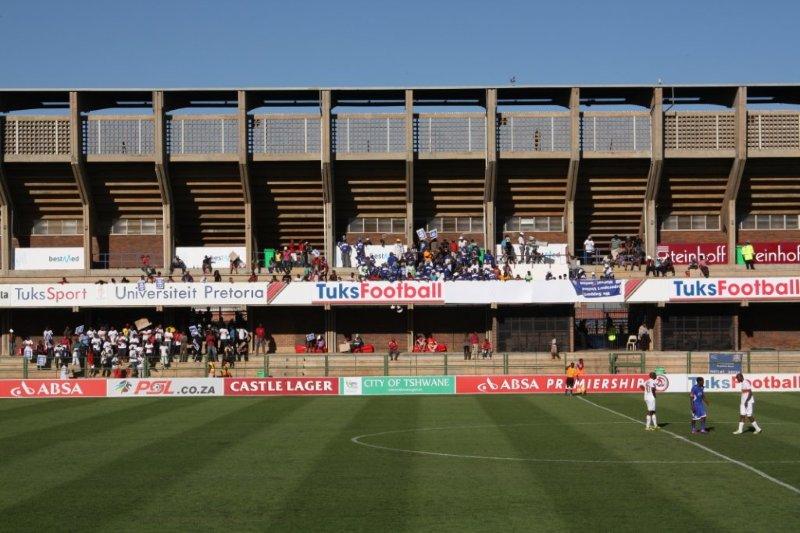
Normally called the Ricoh Arena and home to Coventry City FC, the City of Coventry Stadium looked quite different from its normal appearance full of advertising hoardings. The Olympic organisers were not quite able to cover up all of Coventry City’s history though, as a photo of the 1987 FA Cup winning team adorned one of the stadium walls.
While Banyana Banyana have always worn the yellow and green colours of the South African Football Association, this time the squad entered the pitch in a horrible-looking green and white vertically striped kit, courtesy of the South African Sports Confederation and Olympic Committee’s official kit supplier: Erke, from China. The crowd had dwindled to a few thousand for the second match and the majority of photo press had left the stadium. A small contingent of South African fans remained who were vocal throughout but were outnumbered by Swedish fans and locals who supported their European neighbours.
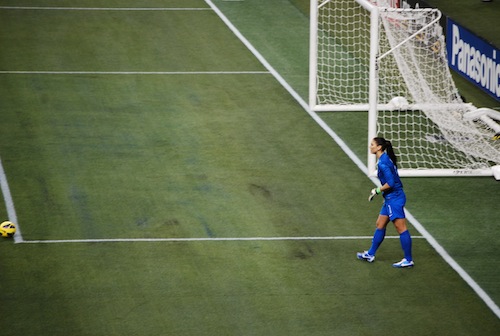
Sweden kicked off and, ominously, twice hit the cross bar in the opening six minutes. The Scandinavians went ahead in the 7th minute thanks to a Nilla Fischer shot from outside the box that was cruelly deflected past United States-based Roxanne Barker in the South African goal. Then the Swedes again hit the cross bar and doubled their lead in the 20th minute when Lisa Dahlkvist poked home a ball from the flanks. A minute later Sweden scored a third goal when South African stalwart Janine van Wyk was beaten for pace on a through ball and Lotta Schelin slotted past the on rushing South African keeper. After 21 minutes Banyana’s debut had turned into a nightmare and a real humiliation was on the cards.
The South African midfield were constantly over run by the more forceful and creative Swedes and the defence were outpaced on numerous occasions, allowing for the Swedes to cross balls into the box at leisure. To her credit, Barker dealt well with crosses and high balls and remained calm under constant Swedish pressure.
The second half saw Banyana kick off with far more purpose and creative intent. In the 60th minute, Portia Modise, a former World Player of the Year nominee, dispossessed a Swedish midfielder well within the South African half and from inside the centre circle unleashed a wonderful strike to beat Hedvig Lindahl. Modise’s goal restored South African spirits and momentarily gave South African supporters some hope. But three minutes later Schelin got her second goal of the match and restored the three-goal margin.
The final quarter of the game saw South Africa struggle with fitness and the match ended with a resounding victory for the Swedes. Sweden had over 57% possession and outshot South Africa 21 to 7. Banyana Banyana were outclassed by a technically superior and fitter Swedish side. After the shock of allowing three goals within 25 minutes, Banyana settled and showed a few individual moments of skill but were unable to retain possession for any length of time. It won’t get any easier in this tournament for South Africa: they face Canada on Saturday and World Champions Japan the following week.

Guest Post by *Hikabwa Chipande
NDOLA — Zambia’s victory in the 2012 African Nations Cup has spawned a new fashion on the Copperbelt — the country’s industrial and football heartland — where people now wear Chipolopolo (Copper-bullets) replica jerseys as well as chitenge (women’s waist wraps) in the national colors. Selling Chipolopolo regalia has also become big business in street markets and makeshift stores. Clearly, the African champions have re-energized the mood of the nation and revitalized support for football among ordinary citizens, politicians, and business people.
The stability of copper prices, increases in copper production, an improving economy, and the pride of being African football champions, have led ZCCM Investments Holdings, formerly Zambian Consolidated Copper Mines, to reconsider supporting the sport. For instance, private companies such as Mopani Copper Mines and Copperbelt Energy have resumed their funding of Kitwe’s famous Nkana Red Devils and Power Dynamos.
“Winning the African Cup changed things,” says Red Devils head coach Linos Makwaza. “People have started coming back to football. At Nkana [Football Club] Mopani [Copper Mines] is now involved and has taken over which is good,” Makwaza says. The relationship between mining companies and football is not a new one. It has shaped the history of the game in Zambia. As far back as the 1920s, when copper mining started on the Copperbelt under British colonial rule, and into the independence era up to the privatization of the ZCCM mining company in 1991, government-controlled mining companies provided football grounds, financial resources, coaches, players, and stimulated a deeply rooted fan culture.
Zambia’s Nations Cup success has inspired politicians such as Sports Minister Chishimba Kambwili to encourage new owners of copper mining companies to sponsor Mighty Mufulira Wanderers, Nchanga Rangers, Nkonkola Blades, Roan United, Kalulushi Modern Stars and other important, but struggling, clubs in the mining province. Abraham Nkole, currently Mighty Mufulira Wanderers manager and a former player in the 1960s and 1970s, sees this shift as an opportunity to resuscitate the “lost glories” of Copperbelt football.
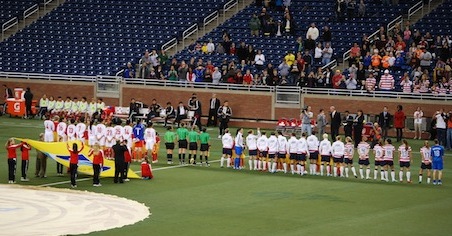
The opening of a modern stadium in the mining town of Ndola has also injected new life in Copperbelt football. I was in attendance on June 9, 2012, for the inauguration of the Chinese-built 40,000 capacity Levy Mwanawasa Stadium, which hosted a Zambia vs. Ghana 2014 World Cup group D qualifying match (see photo). Thousands of fans clad in green and orange Chipolopolo replica jerseys besieged Ndola. With Vice President Dr. Guy Scott in the stands, Chipolopolo beat the Black Stars 1-0 in the packed stadium, thus renewing their hopes for qualifying to Brazil 2014 after being thumped by Sudan 2-0 in Khartoum a week earlier.
Practitioners and fans I spoke to on the Copperbelt are encouraged by recent developments and hope the mining province will soon reclaim its dominant position in Zambian football after two decades of decline. The political and financial investment that is fueling the game’s resuscitation owes much to Chipolopolo’s international success. The question is whether such support will continue should the national team perform badly at next year’s African Nations Cup in South Africa.
*Hikabwa Chipande is a PhD candidate in African history at Michigan State University. His dissertation research is on the social and cultural history of football in 20th-century Zambia. He can be contacted at chipande [at] msu [dot] edu.

Guest post by Mohlomi Maubane
The Germans regularly find a way to excel in tournaments and are among the favourites to win the Euros in Poland/Ukraine. The South African football fraternity would do well to take a page out of the playbook that produced the current incarnation of Die Manschschaft when appointing a new Bafana Bafana coach. SAFA fired Pitso Mosimane this week after Bafana Bafana could only muster a 1-1 draw against Ethiopia in a 2014 World Cup qualifier in Rustenburg.
Eight years ago, the German national team was in dire straits after failing to win a single match in the group stages of the 2004 Euros. A rebirth seemed inevitable, and the newly appointed technical team of Jürgen Klinsmann and Joachim Löw pursued it with typical German precision.
Their first step was to give Die Manschschaft a new identity. The duo settled on a style based on playing the ball on the ground and transitioning swiftly from defence to attack. This was the outcome of an extensive consultation process. Workshops were held with German coaches and players to inquire how they wanted to play and how they wanted to be seen to be playing by their fans (and international ones too). Members of the German public also enjoyed the opportunity to provide input on how they wanted the national side to play.
From this inclusive process, Klinsmann and Löw drafted a curriculum for German football that was presented to the Bundesliga and the German FA. The latter then pressured teams in the former to build academy programmes that adhered to the overall strategy. Bundesliga teams were also encouraged to adopt a fitness programme that enabled the philosophy to be implemented. The newly appointed Under-21 coach also had to abide by the new policy.
By Mohlomi Maubane
SOWETO, South Africa — “Why the f**k did he not do that at West Ham!!!” reads a YouTube comment in response to the video clip above featuring Benni McCarthy’s superb free kick in the 2011 Telkom Cup quarterfinal between Orlando Pirates and Moroka Swallows. This is the best goal I have seen in the PSL era: an extraordinary strike in a tense match Pirates were losing by a goal to nil. And while Swallows players were still scratching their heads in bewilderment, he got a second and sealed the match.
West Ham were the last European team McCarthy played for in a chequered 14-year European career whose highlight was a 2004 UEFA Champions League medal with FC Porto under Jose Mourinho. A sometimes controversial character who had endless run-ins with the South African Football Association, Benni set tongues wagging in the local football scene when he decided to return to South Africa. Some critics believed he was over the hill while others knew he still had something to offer. The man himself said he still had a lot of football in him, and with the right service, he would excel. At Orlando Pirates, he found the perfect setting to shine although he would have to do it without Dutch coach Ruud Krol who had just left after three years at the helm.
The Mighty Bucs boasted one of the best squads in the country and were brimming with confidence after winning a treble the previous season. Krol’s long term (at least in South African terms) afforded him the required time to build a team and mould plentiful talent in service of the collective. Team-play became paramount above all else, and prima donnas were booted out. The defense became mean. Opponents learned the hard way that beating Pirates meant playing to the final whistle. For example, in a November league game against Swallows. The Dube Birds looked set for a 1-0 victory, but as my friend Katiso Motaung wryly noted, Pirates managed to turn defense into attack and Jele equalized in the nanoseconds it took the referee to lift the whistle to his mouth to blow full time.