With his top-flight football career coming to a slow end, most football pundits writing him off and most of the big clubs not interested in his wage demands (the only English Premier League clubs interested in his services at this point, are also-rans Hull and Stoke), Michael Owen must have wondered about life after football.
He could always sell real estate in Dubai. But he may have to improve his presentation (and acting) skills if this 9-minute video for Dubai-based British real estate conglomerate, The First Group, is anything to go by. (Note: The Dubai real estate market is currently down).
BTW, The First Group also use Andre Shevchenko (for their Russian clients) and rugby player, Bryan Habana, to sell their wares.
Categories
5 reasons why the US defeated Spain
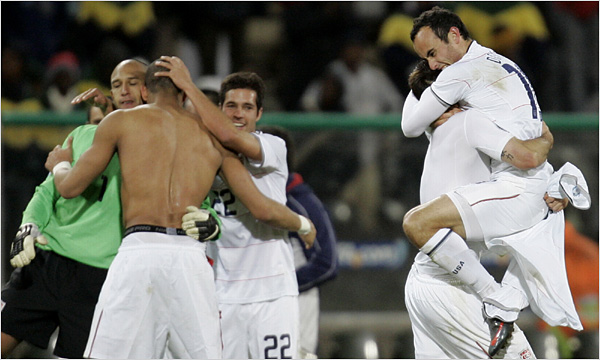
The victory by the United States (ranked 14th by FIFA) over Spain in the Confederations Cup is certainly one of the biggest upsets in recent football history. And you can’t blame some US soccer media for celebrating like they won the World Cup or referencing the Cold War and ice hockey. After all they did beat the world’s number one ranked team–that was poised to make a record unbeaten run (this is the first Spanish defeat since 2006)–in a competitive FIFA tournament.
So how did the Americans pull this one off.
One, for being aggressive out the gate. In the early going, the US made most of the attacking and looked like a different team than the players that lost to Italy and Brazil in the first round. Both Charlie Davies (where did he come from?) and Jozi Altidore made shots on goal. Then Fulham’s Clint Dempsey shot just wide of goal in the 8th minute. As a result when Altidore scored in the 28th minute it did not come as a surprise.
Two, once the US had the lead, they relied on counter-attacking and, crucially, defending that lead. That meant confidently fighting for every ball and closing down space when Spain attacked. Carlos Bocanegra, starting a match for the first time in a while, along with centerbacks Oguchi Onyewu and Jay DeMerit, and Jonathan Spector, were excellent. Whenever a Spanish attacker launched a shot at goal, an outstretched leg or head would meet the ball from Xavi Alonso, Cesc Fabregas, or David Villa.
Three, Everton’s Tim Howard in goal. This was El Hadary against Italy all over again. Howard must have made about seven or eight saves from Fernando Torres and David Villa.
Four, the coach Bob Bradley (who also saved his job with the last two victories) left DeMarcus Beasley out of the starting line-up or did not even use Beasley off the bench. The winger who hardly plays at his club Glasgow Rangers, has certainly lost a yard or two, easily gives the ball away and hardly finishes his passes giving the ball away, and proved a liability in previous games.
Five: defense, defense. defense. Again.
Categories
Vuvuzelas originate in the United States
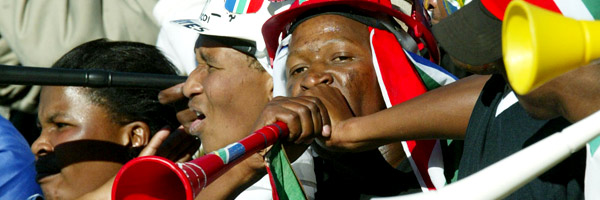
You’re either a fan of vuvuzelas, the plastic horns that sounds like bees during Confederations Cup games, or you’re not. (Here‘s a qualified defense) Players have complained about the monotonous drone of the vuvuzelas. South Africa has made the horns a part of its 2010 marketing campaign and even invented a history for the cheap horns. The horns can apparently be traced back to the kudu horn “… blown to summon African villagers to meetings.”
This is all nonsense.
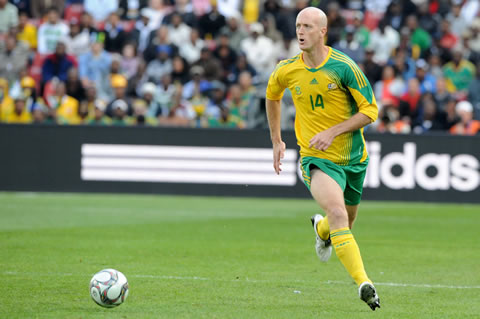
The tall defender Matthew Booth is the only white player in South Africa’s national side. The crowds at South Africa’s matches are overwhelmingly black. Booth, who plays for local club Mamelodi Sundowns, is back in the national team after a long absence. When Booth touches the ball, you can hear sounds of “Boooooootttt.” Booth, who plays for local club Mamelodi Sundowns, is back in the national team after a long absence.
But as Mark Gleeson (probably the most knowledgeable reporter on African football) writes on the Reuters Soccer Blog, some foreign reporters (and visitors) think the crowds are booing Booth:
Categories
The Classics: Italy vs Zambia, 1988
In the 1960s African teams were not taken seriously by FIFA, which denied them a single guaranteed place in the World Cup finals until 1970. Yet African sides performed well in Olympic football tournaments. Ghana reached the quarterfinals in 1964 and Nigeria drew with Brazil in 1968. But most impressively, Zambia demolished Italy 4-0 in 1988. Led by Kalusha Bwalya—the greatest Zambian player ever—Chipolopolo (The Copper Bullets) proved that African national teams could hold their own on the world’s stage. Tragically, many of the stars of that game died in a plane crash on 27 April 1993.
Read the report about the plane crash here. Football historian, Paul Darby, has written about these tragic events in a book about disasters.
Categories
Robinho showboats
In a video posted online today Brazil’s Robinho clowns around during team practice before Thursday’s semi-final match against South Africa in the Confederations Cup. Brazil are favorites to go through to the final, where they’ll most likely play against Spain.
Categories
Obama’s going to the World Cup
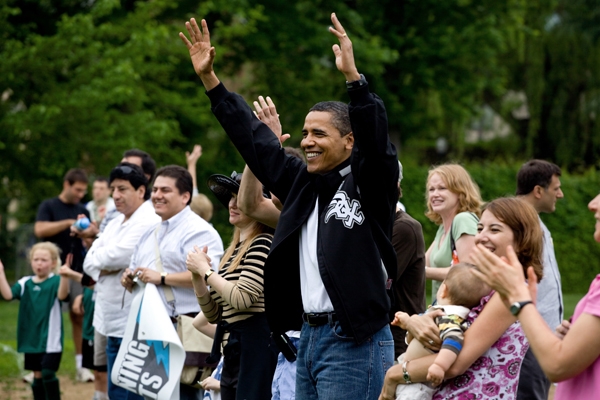
Barack Obama plays basketball and is a fan of the Chicago Bulls. More recently he has taken an interest in soccer. He’s a fan of his daughters’ soccer teams. (That’s him cheering them on at a field in Washington D.C.) Then there’s the story that Obama attended a West Ham game while visiting Britain six years ago. (Enough, by the way for Hammers fans to claim he is a loyal supporter.)
Obama also supports the US bid for the World Cup for 2018 or 2022.
Now it appears Obama will attend the opening ceremony of the 2010 World Cup.