[David Patrick Lane, writing from Liverpool, is working his way through the European qualifiers for the World Cup in South Africa. Last week he reviewed Scotland‘s chances. This week it’s Norway. Next week, Macedonia]
Lurking in dead last place in Europe’s Group 9 is Norway.
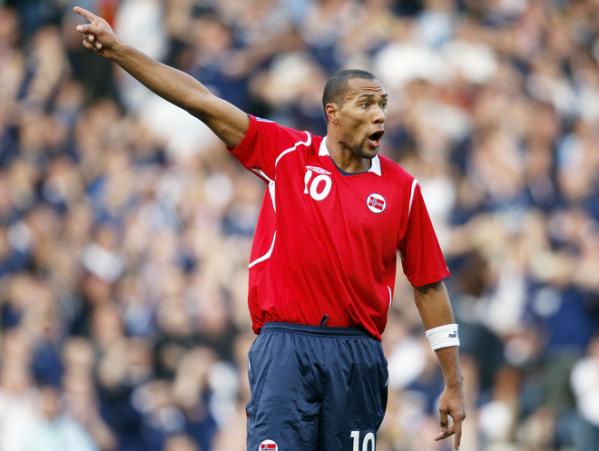
Winless: Three points accumulated through three grinding draws. Toothless: Two goals scored, both at home in their opening fixture against Iceland. South Africa may seem further away than usual to supporters in Spitsbergen.

The weekly news and business magazine, The Economistpublished a story this week on South Africa’s preparations for next year’s World Cup. The magazine, not known for singing South Africa’s praises, not only concluded that South Africa is on track and that “… the doubters are so far being proved wrong.”
When, in 2004, South Africa was chosen to be the first African country to host football’s World Cup many fans around the world were doubtful. South Africa would mismanage it, they said. It would be a commercial flop. They mooted Australia as an alternative should South Africa’s organisers fail to get their act together. Five years on, the doubts have diminished as new stadiums rise up across the country. Indeed, next year’s tournament may turn out to be the most profitable yet, thanks to the sale of broadcasting rights …
Goal of the Week
English fans want to quickly forget the 4-0 loss to Germany in Monday’s UEFA European Under 21 Championship Final in Sweden. And Sandro Wagner, a 21-year old former Bayern Munich midfielder now at another German Bundesliga club, MSV Duisburg, played a big part in the unraveling of the England team. Wagner scored twice for Germany in that game. (It’s not clear whether the Bundestrainer, Joachim Löw, has plans to take him to South Africa next year). This was his second goal. The German commentator loses it.
[By the way, this is a new weekly Friday feature on this site. Send us your votes for Goal of the Week]
David Beckham’s American misadventure

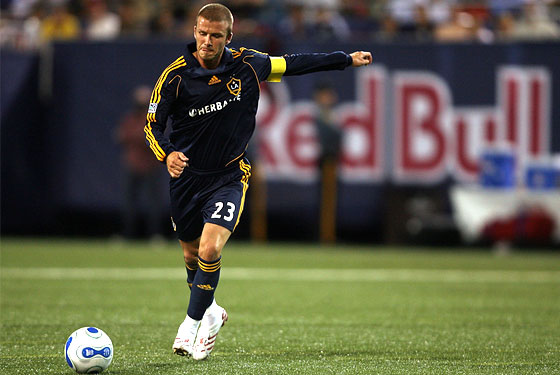
In two weeks time the ageing David Beckham has to return to the United States and play for the Los Angeles Galaxy in the MLS (against the New York Red Bulls at Giant Stadium outside New York City). In January this year, Beckham left the MLS mid-season to go play for AC Milan in Italy’s Serie A. Blasphemous to the MLS. Not surprisingly, Beckham has not been very enthusiastic about returning to the US. In 2007 Beckham had arrived, with much fanfare, at the Galaxy. His salary about 10 times that of the average MLS player. Sports Illustrated’s football writer, Grant Wahl, has been following Beckham for the last two years and his book on Beckham’s time at the Galaxy is coming out this month in the US (on July 14). As part of the hype, SL today published a lengthy excerpt from the book on its website. (It’s also in the latest issue of the magazine.) Among other things, Wahl writes about the cold war between Beckham and the Galaxy’s Landon Donovan (over who was the bigger star, as there is any comparison here), describes Beckham’s time at the Galaxy as “an epic disaster” and a “soccer fiasco,” that Beckham was a “cheapskate” (he did not pick up the tab after a night out with his much poorer teammates), reveals the process behind who appointed disastrous coach Ruud Gullit, and Beckham’s deficient captaincy skills. This should be fun.
Read here.
Did Stephen Colbert play himself?
| The Colbert Report | Mon – Thurs 11:30pm / 10:30c | |||
| Is it Time to Care About Soccer? | ||||
|
||||
Like a number of other US commentators, comedian Stephen Colbert, who plays a faux-Bill O’Reilly on his show, had to discuss the future of football in the United States. As he describes soccer in the video, above: “.. The sport that [Americans] are the world champions at ignoring.” The US’s success in the Confederations Cup (against all expectations they made it to the final where they lost, after leading 2-0, to Brazil on Sunday), leads Colbert to mock-ask: “Is it time to care about soccer?” What follows is a send-up of American caricatures of football: rioting, David Beckham and warm beer. It’s satire after all. But then Colbert asks his producer to show some “thrilling soccer highlights” and we see video of players of a team in blue passing the ball around sort of aimlessly. The camera then cuts back to Colbert snoozing.
The thing is, unless Colbert or his producers (and his audience?) were in on the joke, they made fools of themselves with that clip as they missed one of the greatest goals of all time: a 25-pass move that resulted in a goal for Argentina against Serbia in the 2006 World Cup in Germany:
FIFA denied my request for tickets so I followed the Confederations Cup from home. I drew on my observations from afar as well as media coverage and conversations with friends in South Africa to learn these five things from the tournament:
1. This beautiful yet scarred country will host an eventful World Cup next year. The stadiums are nice and the climate in different cities may surprise visitors. Also, the difficulties with transport, accommodation, communications, and moving people to the stadiums may be mitigated by next year but are not likely to disappear.
2. The Confed Cup is not a terribly interesting competition. It features too many marginal sides (New Zealand, Iraq, South Africa) and tired European giants (Spain and Italy). No wonder we had to depend on the depth and individual brilliance of Brazil and the do-or-die attitude of the improving USA for entertainment.
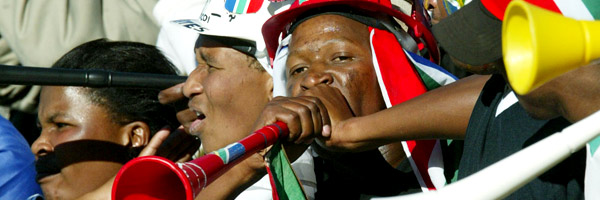
3. Despite what the organizers tell us, the vuvuzelas are not part of South Africa’s ‘traditional’ fan culture. The horns appeared in the mid-1990s and did not become widespread until a few years ago. And they were ‘invented’ by a white guy.
4. The trend of the past decade that saw raw speed and set pieces decide so many matches will probably continue in 2010. Given the heavy-handed emphasis on defensive tactics, the pace of players like Kaka’ offers precious opportunities to burst through defensive walls and exploit open space on counter-attacks. Corners and free kicks are key, just ask the USA and South Africa.
5. The 2010 World Cup is a huge national project aimed at enhancing ‘Brand South Africa’ — the image of the country as a modern, democratic, business-friendly, tourist destination. Football-crazy South Africans legitimize this political and economic agenda, even though they pay billions to host the event while FIFA keeps most of the financial profits.
South African defender Matthew Booth decided to film his teammates during the recent Confederations Cup competition. (Remember him? He’s the only white guy in the team who fans greet with a loud “Boooottthhh” whenever he touches the ball and who Spanish reporters, looking for black racism decided was booed by the fans.) Booth, who maintains quite an active Youtube channel, regularly films his teammates, and in the video, above, captured them (and their Brazilian coach Joel Santana) singing on camera in the dressing room before their game against Spain in the first round. Check it out. (Here‘s another example.) It also made me wonder again why South African fans don’t leave the vuvuzelas outside the stadium and do some actual singing? That would not sound only better, but would present an actual, not corporate-induced part of football culture in that country, to visiting fans.