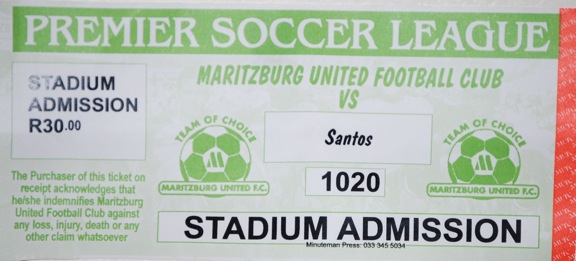
The South African Football Association and the Premier Soccer League have announced a dramatic increase in ticket prices for 2010-11 PSL season. The official explanation given was a need to ensure the long-term sustainability of World Cup stadiums and provide funds for grassroots football.
‘It’s nice to say we filled Soccer City with 88,000 people, but how much do we charge them, R50? [Generally, it’s R20-25.] ‘What is the cost of hiring that stadium? Over R500,000,’ SAFA CEO Leslie Sedibe recently told a parliamentary committee.
PSL chairman Irvin Khoza said on Friday that high stadium costs and an agreement with the South African Players Union for a minimum wage and basic rights meant that, ‘We have no option but to increase our prices. It is always unfortunate when one has to make increases, but there is no way we can continue to charge R20 for 90 minutes any longer.’
Neither Sedibe nor Khoza commented on the inconvenient fact that only two of the ten expensive World Cup stadiums are scheduled to regularly host PSL matches. The exceptions are: Durban’s Moses Mabhida Stadium, AmaZulu’s home base, and Royal Bafokeng in Rustenburg, home of Platinum Stars. Perhaps a third one will follow if Ajax Cape Town end up using Cape Town Stadium. Cities without PSL teams like Polokwane, Port Elizabeth and Nelspruit are desperate to get rugby into their new stadiums to have a (distant) shot at making ends meet.
Meanwhile in Gauteng, Orlando Pirates, Kaizer Chiefs, Moroka Swallows, Mamelodi Sundowns and Supersport United announced their home grounds for 2010-11: Orlando Stadium, Rand Stadium, Dobsonville Stadium, HM Pitje Stadium, and Super Stadium respectively. These high-powered clubs, in other words, shunned the 2010 venues of Soccer City, Ellis Park, and Loftus Versfeld for smaller, cheaper grounds.
Local football bosses have also argued that ticket revenues would, of course, benefit grassroots football. ‘Prices will have to be revisited if we are serious about funding development because that’s where the money will come from,’ said Sedibe. SAFA’s pitiful record in every aspect of local football development — infrastructure, youth programs, coaching, administration — means only the most delusional fans believe that additional ticket revenues will suddenly make SAFA ‘serious’ about improving the grassroots game.
With R40 billion in public funds spent on World Cup stadiums and other 2010 construction projects, it is no wonder that fans are angry about the ticket increases. R40 is a substantial amount of money for a typical local supporter who earns about R1500 a month; and he or she is among the fortunate ones who have a job since the unemployment rate in South Africa is 25 percent (the unofficial rate is 40 percent). As the seventh richest league in the world, shouldn’t the PSL, rather than blue-collar fans, help offset some of the costs? Imagine, a wealthy private company not dumping all of its costs on the backs of ordinary people!
The ticket saga highlights a crucial legacy of the World Cup: South Africa’s deeper incorporation into the media-driven global football business. The powerbrokers in domestic football appear less interested in expanding the fan base than in creating more profitable audiences. These are made up of middle-class folks willing and able to pay for pricier tickets, merchandise, satellite TV packages, broadband internet and the other luxuries of contemporary fandom.
In light of these changes, what can be done? Well, one good place to start is to fight to ensure equitable access to the professional game at stadiums and on television. Fans should be able to pay fair and reasonable ticket prices, especially when stadiums are built with public funds. In addition, pressure must be put on broadcasters, football bodies, and regulatory authorities to show as many local and international matches as possible on free-to-air TV. It is the People’s Game after all.
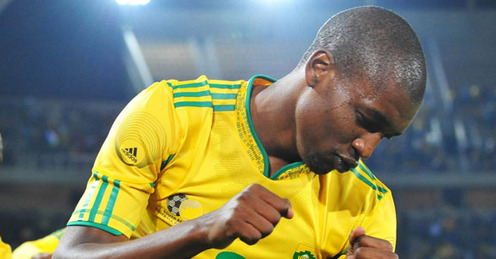
National football styles are intertwined with a country’s history and culture. Can Pitso Mosimane, Bafana Bafana’s new homegrown coach, develop a common ‘South African’ playing style? If the former SuperSport coach and Bafana assistant succeeds, he will have done better than his Brazilian, Romanian, English, Portuguese, and French predecessors.
‘South African football is a sort of United Nations,’ writes Izichwe Youth Football director Thabo Dladla in his ‘Talking Football’ column this week. ‘You have parts of the country like the Western Cape with their English influence, inland areas with diski [street style] influence, some German and Dutch influence in SAFA structures, [and more recently] Brazilian and Serbian influences.’
Clearly, Mosimane faces a daunting challenge in trying to craft a common style out of a melange of local and foreign influences. ‘South African football is more about ball retention and individual improvisation,’ Dladla notes. ‘We grow up playing in small spaces, on hard, bumpy surfaces. The small frame and short-to-medium height of the majority of our players make it logical to play mainly short passes on the ground.’
World champions Spain point the way forward for South Africa. It’s not a question of conveniently jumping on the winners’ bandwagon. Rather, Dladla notes that ‘Spanish football is based on technique, ball possession and nimble short-passing combination.’ That Spain’s 11 starters in the World Cup all play in La Liga further inspires many South Africans eager to raise the quality of the domestic Premier Soccer League.
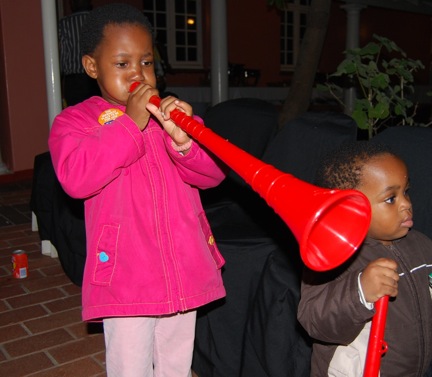
Will South Africa’s performances improve under Mosimane? Will a new national style of play reflect the sharper sense of South Africanness left by the 2010 World Cup? Perhaps, but until that time local fans will keep on blowing vuvuzelas in the stadiums: ‘They are bored,’ says Dladla, ‘There is nothing to entertain them between the lines.’
Phillip is Here!
The Footsak exhibit at the Museum of Contemporary Art in Durban inspired me to make this 5-minute film about art + football. I shot it with a FlipVideo camera at the museum, World Cup matches, a tennis court in Joburg, a sports ground at UKZN Pietermaritzburg, and our veranda. Take a look.

Chris Bolsmann (Sociology, Aston University) is the special guest in our latest episode of the Africa Past and Present podcast reflecting on the 2010 World Cup. Topics covered include experiences at stadiums and fan parks in South Africa; FIFA‘s Disney-fied World Cup; Pan-Africanism and the performance of African teams; and the political and economic impact of the tournament.
Click here to listen to the podcast. (mp3)
After the World Cup: Football Again!

The 2010 World Cup in Disney-like FIFAland ended only seven days ago and since then South African columnists and cartoonists, corporate managers and car guards, compulsive fans and casuals alike have been vexed by the same post-World Cup question: what do we do now?
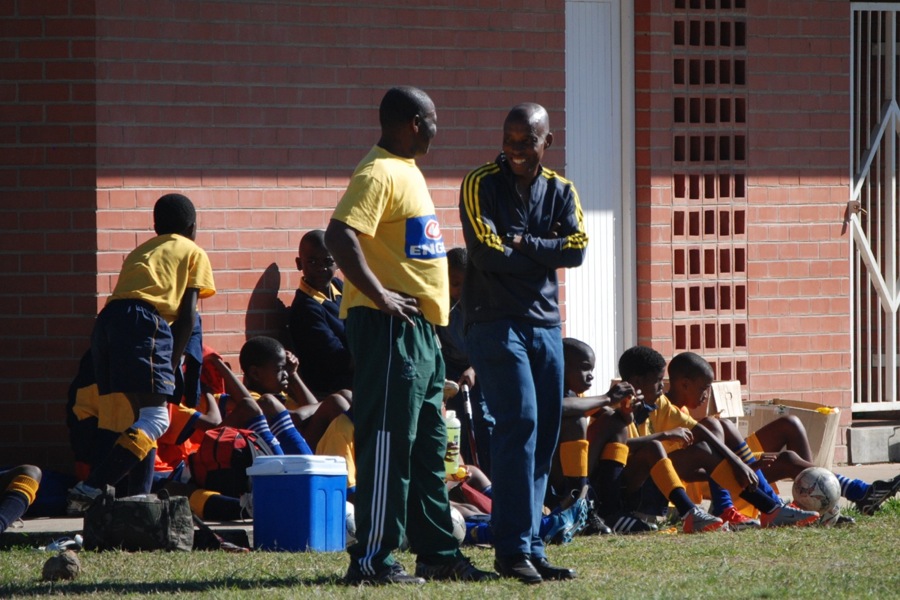
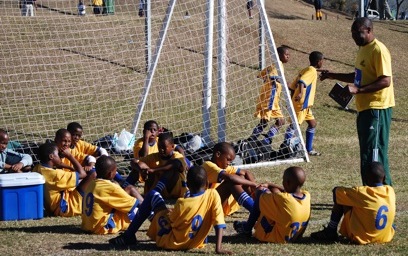
The immediate answer was stunningly simple. Back to the pitch! For me, that means training with the four dozen youngsters and the committed coaches of the Izichwe Youth Football program here in Pietermaritzburg. On Saturday, at the University of KwaZulu-Natal’s Peter Booysens sports ground, the teenagers played against the Durban (eThekwini) under-15 representative side due to compete in the ‘One Nation’ tournament in Bremen, Germany, in a few months.
Even though the visitors from the big city won, it was a glorious day for pure football. The illuminating pass, the righteous tackle, the crisp give-and-go, and the delicate chip shot over the keeper and into the back of the net. There will be time for improving team tactics and defensive organization. For now, let’s keep playing, learning, and giving Bafana Bafana hope for the future.

Yesterday’s final ushered me into an emotional, existential Kalahari. Unable to resume life as usual here in South Africa, whatever that means, my therapy consists in part of playing everyone’s favorite fun game: World Cup All-Stars, version 2.0 (click here for 1.0).
Initially, the simple choice was to pick the entire Spain squad with just two changes: Fucile for Capdevila and Forlan for Torres/Pedro. But that wouldn’t be much fun. So here are my picks:
Neuer
Fucile, Juan, Pique, Sergio Ramos
Mueller, Schweinsteiger, Xavi, Sneijder
Villa, Forlan
Best Players: Forlan and Sergio Ramos (because defenders are people too)
Goal of the Tournament: Van Bronckhorst in Netherlands v Uruguay (quality and importance)
Best Match of the Tournament: USA-Slovenia 2-2 (which should have gone down as one of the greatest comeback victories in World Cup history, right Mr. Coulibaly?)
Best Referee: Viktor Kassai of Hungary (This cool cat ref’d one of the cleanest World Cup semifinals ever: Spain-Germany)
Best Moments: Tshabalala’s goal for Bafana in the opener vs Mexico (when, for a few minutes, it seemed another World Cup was possible) and Buffon signing my daughters’ jersey and flag before Slovakia-Italy.

Spain are World Champions! Iniesta scores in the 116th minute to give La Roja a 1-0 victory over the Dutch at Soccer City.
Click here to read The New York Times match report, with a few words from yours truly.
Click here to read Johan Cruyff lambasting the anti-football of the Dutch and the refereeing of Howard Webb.