Another uplifting football moment courtesy of the women who play, officiate and support the game.
Categories
Another uplifting football moment courtesy of the women who play, officiate and support the game.
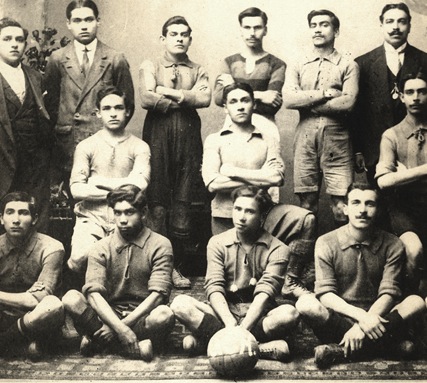 The Football Scholars Forum launches its 2011-12 season this Friday (Sept. 23, 3pm EDT) with Brenda Elsey’s new book Citizens and Sportsmen: Fútbol and Politics in Twentieth-Century Chile (University of Texas Press, 2011). It’s a fresh look at life in twentieth-century Chile through an exploration of how fútbol clubs integrated working-class men into urban politics, connected them to parties, and served as venues of political critique. You can join the conversation online via Skype. For more information visit the FSF website.
This short film is based on a true story. In 1986 a football team that lived on a little island in the south of Thailand called Koh Panyee. It’s a floating village in the middle of the sea that has not an inch of soil. The kids here loved to watch football but had nowhere to play or practice. But they didn’t let that stop them. They challenged the norm and have become a great inspiration for new generations on the island.
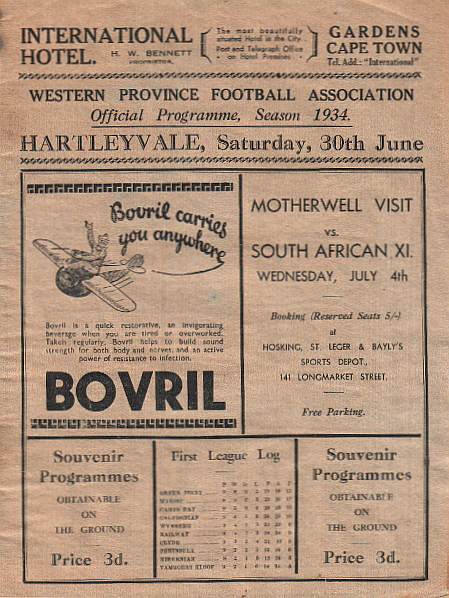
Motherwell, the Scottish Football Club who introduced a sophisticated passing game and a collective team approach to spectators in South Africa, are once again at the forefront of the game’s development. This time Motherwell are showing how to tackle the hooligans that hang out in far too many board rooms.
According to a report by Gavin McCafferty in today’s “Scotsman“, Motherwell plan to bring two fans on to their board as a first step towards the aim of making the club owned wholly by supporters. There will be a £300 one-off fee, with a voluntarily annual fee of £50 thereafter to retain benefits. More wealthy supporters and businesses can pay up to £25,000 to join, with added benefits, but each member will have one vote. The members will vote representatives on to the club’s board, initially two, but chief executive Leeann Dempster yesterday revealed the end game was full ownership and total democracy in running the Lanarkshire club.
About 300 fans turned up at an open meeting on Monday and Dempster was encouraged by the general feedback from supporters. “They can contribute to the financial security of the club,” Dempster said. “This is the first time they have the opportunity to be properly involved. I think that’s what excites people the most – the thought of being able to nominate or be nominated to be on the board. Two members of the society will be on the board. They will enact the wants of the other members. “We want to get to a stage where that will develop further and more members will come on to the board. Hopefully to a point where, once it’s clear that the model is working, we can transition full ownership of the club over to the society. You can’t go from a model of having one benefactor on the board to the next day having supporters running the club. That would cause enormous problems. So we’re not naive enough to think you can just do that and forget about it.”
Although I was born and raised in Rome, I support Juve. My choice was based on the need to find a club that could compete with AC Milan and Inter, my older brothers’ favorite teams. I was barely six years old when I first saw Juve play. It was in Perugia (my father’s team) and “we” somehow lost 0-1 thanks to a goal by Renato Curi. As a result, Torino won the scudetto. What a tragedy! But the real tragedy happened a year later when I returned to Perugia hoping for a better Juve performance: Curi collapsed on the pitch and died of a heart attack. Talk about putting things in perspective.
Over the next decade, I watched Juve “under cover” at the Olimpico against Roma and Lazio, and in other cities as well. It could be dangerous. At Marassi stadium, for instance, Genoa’s ultras invaded our curva (end) wielding broken bottles. When all was said and done, a guy two rows in front of me was oozing blood from a stab wound in his leg. Surely it would have been safer in Turin, but as a young teenager living more than 400 miles away it was tough to make the pilgrimage to the Stadio Comunale. And after I moved to the United States in the mid-1980s, it seemed as if I had been sentenced to never attend a Juve “home” match. A victim of contrappasso for my act of betrayal of Roma and Lazio?
The inauguration of Juve’s new stadium is inspiring me to finally make the journey to Turin.
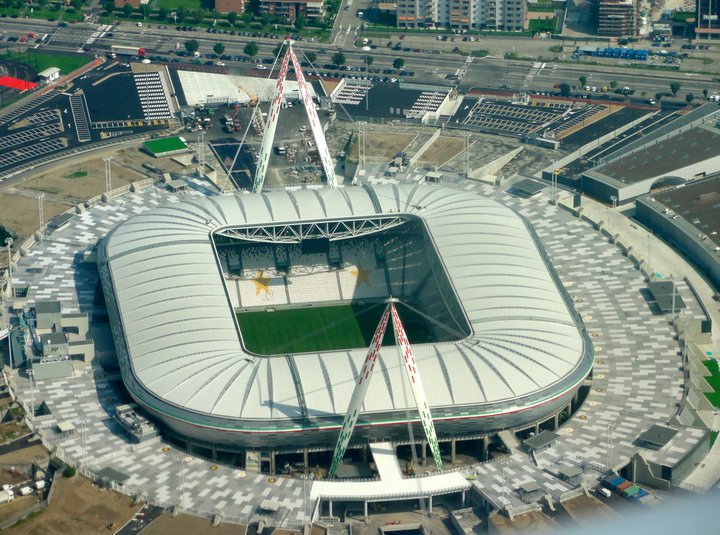
September 8, 2011, heralds the arrival of a new era in Italian football, or calcio as we call it. Juve’s friendly against Notts County — the club responsible for the Old Lady’s adoption of black-and-white kits — marks the first time an Italian club will play in its privately owned stadium.
It is a welcoming football-specific stadium: no track, no moat, no fence. It has a capacity of 41,000 seats and a design similar to many English Premier League grounds. Juve’s stadium provides a long-awaited alternative to overpriced, under-serviced, militarized, and outdated grounds found all over the peninsula. It rises on the ashes of its cursed predecessor, the Delle Alpi. Built on the outskirts of Turin for the 1990 World Cup, Delle Alpi stadium was twice as expensive as originally planned, featured terrible sight lines (largely due to a never-used running track), a bumpy playing surface, and abominably high maintenance costs. In 2003 Juve took it over from the city under a 99-year lease and demolition started in 2008. In the meantime, both Juve and Torino relocated to the downsized ex-Comunale stadium, renamed Olimpico after hosting the inaugural and closing ceremonies for the 2006 Winter Olympics.
Looking at the calendar, I could make the Piedmont derby between Juve and Novara on December 18 . . .
For a virtual tour of the new stadium click here. For videos documenting the construction process go here, here, here, here, here, here, and here.
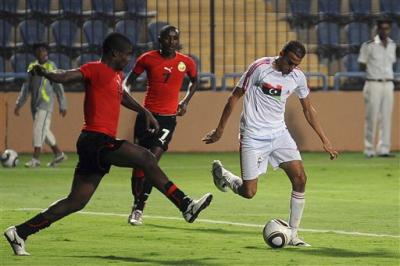
The Catenaccio was deployed in Maputo the last time Libya played Moçambique. Green shirts, green shorts, green socks all stacked up against the Mambas. Smoke from the said SMS revolution had barely cleared when Libya sneaked away from Estádio da Machava with a 0-0 draw. Last night in neutral Cairo, Libya also remembered to score.
Rebels 1 Mambas 0. It must have been that sexy new kit.
Dramatic footage of the shooting outside Corona Stadium in Torreon, Mexico, during the Santos-Morelia match on August 20, 2011. “In Mexico, there are not too many comments in media and newspapers about the event, besides a few comments stating that everybody was and is OK,” reports Football Scholars Forum member Alejandro Gonzales. “On the radio, they are explaining more . . . they have catalogued this event as a metaphor of the current state of affairs in Mexico.”