Categories
Video

Goal of the Week: A glimpse into the future of football


By Simone Poliandri

This week we pay homage to amateur youth football, showcasing a gem by Farai Mutatu, a Zimbabwean player of TNT Dynamite Soccer U13 Boys Red team of Lansing, Michigan. In the 29th minute of the first game of the season against team SCOR, Farai scored the game winning goal by bicycle kicking a deflected ball into the opponent net. A feat of readiness and great coordination. The final score of the match, played on April 16, was 3-2.

Categories
Hosting

A Global History of an African Left Winger


The football skills of Richard W. Msimang, a prominent early member of the now 100-year-old African National Congress in South Africa, were reportedly as sharp as his legal mind and political acumen. Last year on this blog I posted a portion of an article published in a 1913 issue of the ANC’s newspaper Abantu Batho (given to me by Peter Limb) that provided a glimpse into Msimang’s sporting past as a student in South Africa and Britain.

Born in Edendale, a freehold black area on the outskirts of Pietermaritzburg, KwaZulu-Natal, a community with a well-deserved reputation for defiance of colonial authority, Richard and his brothers Selby and Herbert grew up refusing to be black servants of white masters. Sport, formal education, and political activism channeled the enlightened self-interest of the Msimangs much like they informed the 20th-century South African struggle for political and cultural empowerment. Thanks to the kindness and generosity of Geoff Bisson (Queen’s College, Taunton), Brian Willan (Rhodes University), and once again Peter Limb, I can now share additional evidence of Richard Msimang’s prowess on the football and rugby pitch.

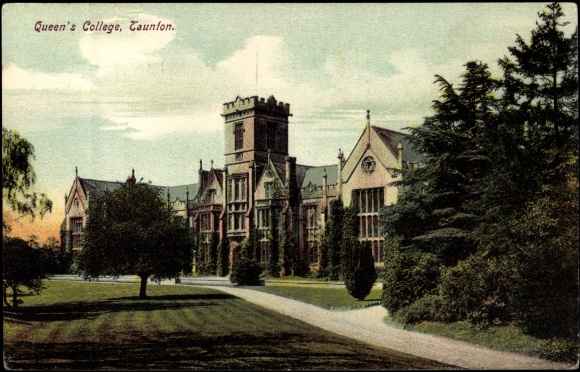
The revealing passage below focuses on Msimang’s time at Queen’s College, Taunton (see postcard), a boarding school in the West of England. In his book History of Queen’s College, Taunton (Taunton, England: Old Queenians’ Association, 1957; p. 157), H. J. Channon writes:

On a cold, wet afternoon in November, 1904, a few of us were practising shooting at goal on the Lower. We noticed a dark figure, in a bowler hat and a heavy black overcoat, standing on the terrace watching us. It was the first day at Queen’s of a Zulu, R. W. ‘Msimang. He passed through the gap on to the field. The soccer ball was thrown to him, and he could not resist the temptation of racing towards it. Unfortunately for him the ball stopped just in front of a deep pool. Through the water ‘Oomsi dashed, slipped and sat down, with his bowler floating away from him. We took him up to the Linen Room for a complete change of clothes. His charming smile we saw for the first time it never seemed to desert him. In his own country he had played a lot of soccer, but on the hard grounds he had never worn boots. It was not long before he was in the first XI, and at first when the ground was hard he dispensed, with football boots. I can see him now dashing down the left wing to the corner flag and middling the ball with perfect accuracy. After several years he was articled to a Taunton solicitor, but continued to live at the school. He took up rugby, and became the most popular player Taunton has ever had. The crowd loved to see him emerge with a smile from the bottom of a heap of forwards. He was a brilliant scrum-half [fly half according to Willan], tough and with a swerve that made it difficult to bring him down. So popular was he, that sometimes he had to leave the ground by a back exit to avoid the crowd. After he had passed his final law examination he returned to South Africa, where he became a State Attorney under the Transvaal Government.

Categories
Players

European Soccer Paychecks Top US Sports Wages

ESPN The Magazine’s Money Issue salary survey project reveals that average paychecks of athletes in US professional leagues pale in comparison to the wages of top soccer players in Europe. Barcelona topped the rankings with a total wage bill of $217 million and an average player salary of $8.7 million. Real Madrid’s average wages came in second at about $7.8 million though the club’s total payroll was about $3 million less than the New York Yankees baseball team.

7 of the top 10 highest paying sports teams are European soccer clubs, including Manchester City, Chelsea, AC Milan, Bayern Munich, and Inter. The lowest-paying teams are from Major League Soccer and the Canadian Football League.

The survey was conducted by sportingintelligence.com for ESPN. It accounted for 278 teams in 14 major pro leagues, covering seven sports in 10 countries, comprising 7,925 athletes making a combined $15.69 billion in salary. Read the full article here.

For more information, see Deloitte’s annual report on European soccer revenues here.

Categories
Video

Goal of the Week: Ladies’ magic


By Simone Poliandri

This week we celebrate women’s football with a spectacular goal by one of the best players in the world, Brazilian striker Marta Vieira Da Silva. Voted FIFA player of the year for five consecutive years (2006-2010), Marta, who just signed a two-year contract with the Swedish first-division team Tyresö FF, gave proof of her exceptional talent in a recent game that her team won 7-0 against KIF Örebro. In the 55th minute, Marta controlled a loose ball in the box with her right foot and back-heeled it with her left to make the score 5-0. As Marta played her first game for Tyreso in March 2012, this is the beginning of a season of extra work (and headaches) for opposing defenders and goalkeepers.

[iPad users click here for video.]

Categories
Hosting

Death of a Striker, Fighter, and Socialist


Ahmed Ben Bella, the first president of Algeria, died in Algiers at the age of 93. The son a farmer and petty trader, Ben Bella lived a life of struggle, beginning at the age of 16. As James Gregory’s poignant obituary in today’s New York Times explained, “Ben Bella chafed at colonialism from an early age — he recalled a run-in with a racist secondary school teacher — and complained of France’s cultural influence. ‘We think in Arabic, but we talk in French,’ he said.” Ben Bella’s political conscience was sharpened on high school football pitches under colonial rule. “When I maneuvered at speed against the enemy,” Bella remembered, “nobody asked me whether I was European or Algerian — I either scored or I didn’t, and that was that. I was responsible only to myself for success and failure alike.”

Conscripted into the French military in 1937, Ben Bella “took to soldiering as readily as he had to soccer back home. He was promoted to sergeant and won celebrity as a soccer star in Marseille,” according to the Times. He earned the Croix de Guerre for bringing down German bombers with his anti-aircraft gun during the Nazi assault in 1940. After the fall of Marseilles, Ben Bella was offered a professional football contract but turned it down and returned home instead. He eventually joined the Free French forces under De Gaulle and was decorated again for his role in the Italian campaign of 1944. After the war, he became a leader in the Algerian independence movement.

Ben Bella, like other African nationalists, believed that football — originally a European colonial game — could be appropriated and made to express African people’s desire for equality and freedom. While in exile during the second phase of Algeria’s war of independence (1958-62), he lent his imprimatur to the FLN XI — a remarkable team of France-based professionals formed in 1958 that came to symbolize Algeria’s quest for freedom and its crystallizing national identity. (For more details about the history of this team, see my book African Soccerscapes and Ian Hawkey’s Feet of the Chameleon. French readers can also consult R. Saadallah and D. Benfars’s La Glorieuse Équipe du FLN and Michel Nait-Challal’s Dribbleurs de l’indépendance.)

Ben Bella later became Algeria’s first Prime Minister and then its first president (1963-65), until a military coup got rid of him and kept him under house arrest for 14 years. Exiled in 1980, he still managed to celebrate Algeria’s 2-1 victory over West Germany in the 1982 World Cup: the first World Cup win by an African team against a European side (highlights here). Ben Bella returned to Algeria in 1990 and remained politically engaged, as an opponent of the U.S. war in Iraq, and as a critic of global capitalism and radical Islamism. Ultimately, his football style and leadership style informed each other: “Ben Bella always wanted his teammates to pass the ball so that he could score,” a former schoolmate recalled. “He was the same in politics.”


Suggested Reading

Mahfoud Amara, “Football Sub-Culture and Youth Politics in Algeria,” Mediterranean Politics, 17, 1 (2012): 41-58.

Categories
Video

Goal of the Week: Rewind to…1988 volley!


By Simone Poliandri

The opening goal in Real Madrid’s 5-1 away victory against Osasuna in matchday 31 of the Spanish Liga brings all long-term football aficionados back to memories of past champions. On March 31, Madrid striker Karim Benzema volleyed a surgically accurate cross by Cristiano Ronaldo into the opposite top corner of Osasuna’s net. This marvel of coordination and accuracy resembles closely Dutch phenom Marco van Basten’s splendid goal against USSR in the 1988 European Cup final.

Categories
Players

Long John is Gone

Giorgio Chinaglia died yesterday, April 1, in Florida at the age of 65. The sad news brought back a flood of memories. I remember how as a kid in Rome in the 1970s, my grandfather had a funny habit of responding to my detailed stories about meaningless youth football matches by saying: “You are just like Giorgio Chinaglia.” Maybe it was the curly hair, pronounced chin, and slightly curved shoulders. Or maybe it was the unmitigated joy of my goal celebrations, I don’t know.

I was not a Lazio supporter, but I liked how my grandfather connected me to the prolific striker who had recently won the scudetto (Italian league title) and then had joined the most glamorous team in the world: the New York Cosmos. Growing up in a bicultural family (American dad / Italian mom), I also shared a linguistic connection with Chinaglia. His family had immigrated to Wales after World War II (his father found work in a foundry) and he had started his professional career at Swansea City before returning to Italy. This Welsh background explained his “Long John” nickname, inspired by Juventus’s Welsh center-forward John Charles of the late 1950s and early 60s. I was too young to watch the broadcasts of the 1974 World Cup, but I knew of Long John’s performance in Italy’s opener against minnows Haiti. With Italy leading 2-1, Chinaglia was substituted and refused to shake coach Valcareggi’s extended hand, offering instead a theatrical “vaffanculo” (“fuck off”) for the television cameras. Needless to say, that was the end of Chinaglia’s Italy career.