The New York Times today has a piece by Jere Longman about homophobia in the Nigerian team about to play in the 2011 Women’s World Cup. While it’s nice to see the newspaper of record in the U.S. paying attention to the women’s game and to African women in particular, the overall thrust of the article is that homophobia is an example of the “cultural obstacles that remain for many African women who play soccer.”
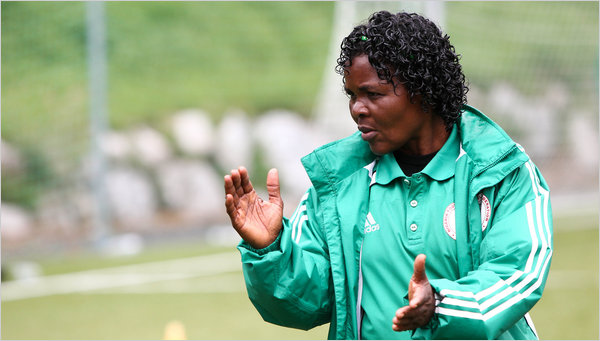
The story focuses on a single character: head coach Eucharia Uche. A former player and fervent evangelical Christian, Uche claims to have “used religion in an attempt to rid her team of homosexual behavior,” describing the latter as a “dirty issue,” and “spiritually, morally very wrong.”
There are several problems with the article, but I’ll focus on two key ones: (1) blaming “culture,” and (2) African “exceptionalism.” Let’s tackle the first one. While “cultural inhibitions are still cited as inhibitions to girls playing” notes Martha Saavedra’s seminal 2003 overview of the African women’s game published in Soccer and Society, “the general economic troubles and the lack of resources overall is still perhaps the most serious hindrance. Even the bans on women’s football in Northern Nigeria may be indirectly linked to this.” Yes, cultural conservatism (not “culture”) is a factor in some areas, but this does not necessarily apply to all of Nigeria, let alone all of “Africa” as the article’s headline suggests.
This reductionism leads to my second point: African exceptionalism. The first thirteen paragraphs of the article create the impression that homophobia is a singularly “African” issue. It is only in the 14th paragraph that some de-exoticization finally takes place: “The treatment of lesbians in sport is not a matter restricted to women in Africa. Some women on previous United States national soccer teams have been reluctant to live openly gay lifestyles for fear of repercussions.” Surely, American readers of the Times would have been quite interested to learn more about the existence of a “culture” of silence and repression in elite U.S. soccer. It might even invite a comparison with the grim situation in Uche’s squad.
The lack of discussion about women’s football in Nigeria is puzzling as well. The article contains not a single reference to the rich history of the game in Africa’s most populous nation. As I write in African Soccerscapes, women in Nigeria were playing as early as 1943. The 20 October 1943 issue of the Nigerian Spokesman newspaper ran this story:
In response to the demand of the people of Onitsha, the Sierra Leonean friendly Society has started to make arrangements for the replay of the ladies’ football mach which so thrilled the township recently. Good news for football enthusiasts . . . It was the first of its kind to be staged in Onitsha.” Fine show but not up to the standard of boys soccer. “It seemed odd to some to see our women in shorts kicking a football about the field, or clashing with one another after the manner of men . . . but the game itself, when it came to be played, exploded all the fantastic theories some malevolent individuals had concocted about it, and it was a colossal success both in the fun that it provided and on the financial side of it.
By 1960 (Nigeria’s independence) there were women’s teams in Jos, Lagos, Calabar, Onitsha, Kanu, Enugu and other towns. By 1989 there were 28 women’s clubs active, as well as a Nigerian Female Football Organizers Association. This history is vital to gaining a sharper understanding of the Super Falcons’ continental dominance since they first represented Africa at the WWC in 1991.
Let’s hope that future U.S. media coverage of the 2011 WWC will be more informed and more tightly focused on the game itself. The fans deserve it. The players deserve it. Football deserves it.