Categories
Players

Spotlight on African Coaches


Editor’s Note: This post begins a multi-part series on African coaches.

Continuing with Pitso is Regressing

Guest Post by Mohlomi Maubane

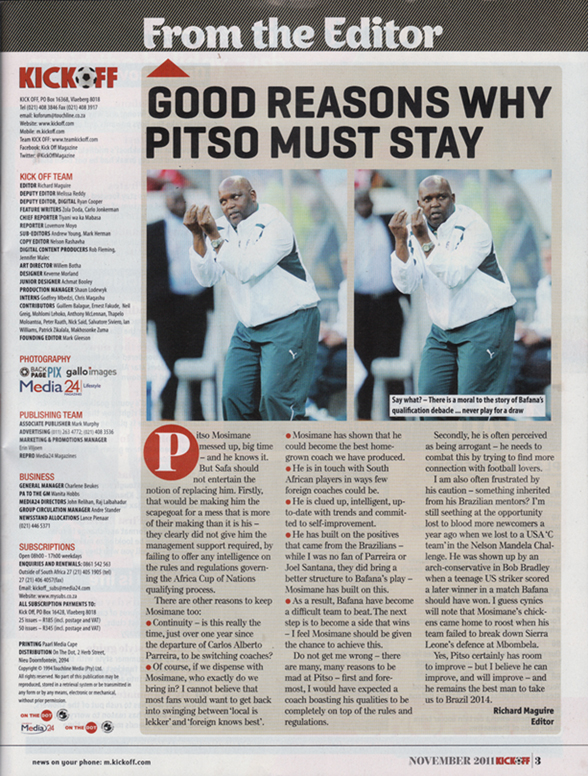
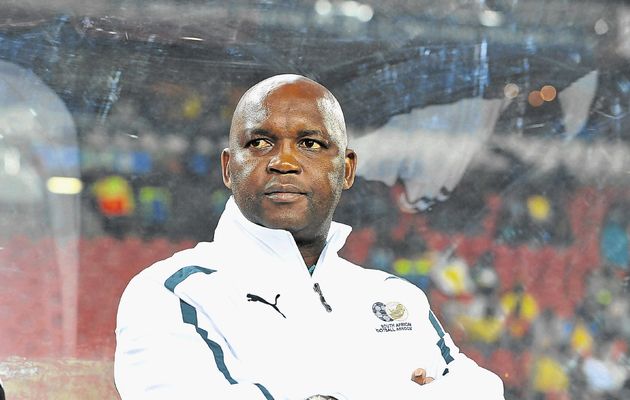
SOWETO, SOUTH AFRICA — In a recent issue of Kick Off, South Africa’s leading soccer magazine, Editor Richard Maguire argued against firing Bafana Bafana coach Pitso Mosimane (in photo above). Pitso, of course, is singularly responsible for South Africa’s embarrassing failure to qualify for the 2012 African Nations Cup finals (aka The Comedy in Nelspruit). I have been collecting Kickoff since high school. As a magazine, it expects vision, competence and innovation from every member of the South African football fraternity; hence the editorial vouching for Pitso to stay on as Bafana Bafana coach was surprising.

The crux of Maguire’s argument is that Mosimane should remain in charge for the sake of continuity. I say there should not have even been a beginning. Mosimane’s coaching success has been overblown. At club level, he led well-endowed Supersport United to five cup finals, losing three, and at national team level he was an assistant coach during a mediocre run from 2006 to 2010, when Bafana sunk to 90th in the FIFA World Rankings.

The ridiculous manner in which South Africa failed to qualify for the 2012 African Nations Cup finals showed Mosimane to be as unprofessional as his employers. How can a national coach fail to read or grasp competition rules? This is a man who thinks of himself as a “modern” coach always in step with the latest developments in the world game. Perhaps common sense is not part of the curriculum of the courses Mosimane often brags of attending. And for all his supposed keeping abreast with the latest trends in the game, Mosimane’s idea of “global football” is confined to the English Premier League and La Liga.

SAFA appointed Pitso Mosimane as Bafana Bafana coach soon after the 2010 World Cup. At the time, there was talk of the dawn of a new era in South African football. In truth, there was the usual lack of specific detail on how to make this new epoch come about. Instead, SAFA officials spoke at length about Vision 2014, Bafana Bafana’s campaign to qualify for the World Cup in Brazil. The seven other national teams under SAFA’s auspices were left unmentioned. Now, a year after the Vision 2014 was unveiled, we are a joke in the football world.

More than anyone else, it was Mosimane’s job to ensure Bafana qualified for 2012. He was entrusted with the troops and should have known the rules of engagement. When he was introduced as the new Bafana coach after the World Cup, Mosimane was his typical pompous self, saying he did not expect favors from anyone, he knew his mandate, and that he wanted to be judged by the results. Here are the Nations Cup results: 2 wins, 3 draws, and 1 loss, 4 goals scored, 2 against. Having failed to qualify, his story has now changed. In his first press conference after the Comedy in Nelspruit, Mosimane had the audacity to say he did not fail because South Africa finished top of their group! That Bafana actually failed to qualify was in the past; it was time to move on, he said.

Indeed it is time to move on, and perhaps it is best to do so with a coach who reads and understands the rule book; one whose trophies and coaching acumen supersede his chest-thumping bravado. Pitso Mosimane has been in the national structures for more than five years and South African football would not be served well by a continuation of his underachievement.

If Mosimane were a football journalist and wanted to write for Kick Off, I suspect Maguire would send him away with the disdain he probably feels when the magazine has to document yet another SAFA cock-up.
Categories
Video

Goal of the Week: “Hail Mary” shot


By Simone Poliandri


Harrogate Railway Athletic vs Guiseley AFC Lions. West Riding County Cup game, Harrogate (England), Nov. 29, 2011: Guiseley’s Danny Forrest’s 92nd minute wonder winning strike from the kickoff after Harrogate had just tied the game 3-3. The Lions went on to win the game 4-3.

Goal of the Week is a new series by Italian anthropologist footballer (or footballer anthropologist) Simone Poliandri.

Categories
Hosting

Kick Blatter Out


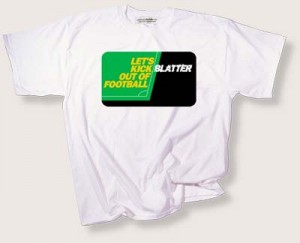
A must-have t-shirt that riffs off the brilliant Kick it Out campaign, courtesy of our friends at Philosophy Football. “From vote-rigging to covering-up corruption, via advocating tight-fitting kits for women footballers, selling the game short to sponsors and now fighting racism with a handshake. It’s surely time for Blatter to go.”

Get yours here.

Categories
Players

“Playing the Game”

“Playing the Game” by Sophie Alegi


Chests heave
Legs run
Tendons work
Bones stretch and pull
Muscles bulge
Brains flash in a spark of neurons
Sweat drips.
The defender tears a tendon trying to steal the ball.
The midfielder blows past a defender in a flash of speed.
And the forward collects the ball and shoots.
The goalie stretches all of her fibers to catch the ball.
But it slams into the net.

Categories
Hosting

The Mighty Bucs Reign Supreme


By Mohlomi Maubane in Soweto, South Africa

A few days before the 2010 World Cup kicked off in South Africa, the New York Times Magazine published an insightful piece on football development focused on Ajax Amsterdam’s famous youth academy. “How a Soccer Star is Made” by Michael Sokolove is a must read for the myopic beings who masquerade as the game’s sole custodians in South Africa and who have turned fiddling while Rome burns into an art. I was reminded of the NYT article during this past weekend’s dramatic finish of the 2010-2011 PSL season.

In the story, Sokolove recounts his encounter with David Endt, manager of the Ajax first team and a former Ajax player. Endt also serves as the team’s unofficial conscience and historian. His office is a mini-museum and on his desk was a pair of scissors, once allegedly used by an Ajax player to attack a teammate in a dressing room squabble a few decades back.

If Orlando Pirates — the Soweto giants crowned PSL champions on Saturday — had a museum, the orange shirt of one of Ajax’s most decorated products would find a place in it. For months, Pirates’ coach Ruud Krol’s bright shirt has been the source of jokes among many soccer scribes in South Africa. However, for Krol, who played 339 games for Ajax and 83 times for The Netherlands (including two World Cup finals), the orange shirt was no laughing matter. Not only is orange his national colour, but it was also a good luck omen. And you sure need a dose of good luck to stay at the helm of the Mighty Bucs.

The last two times Pirates were crowned league champions, the victorious coaches were fired early in the following season. A manager can win the league at Pirates, but if the side is deemed not to be suitably entertaining then he will “part ways with the team amicably.” For all its fascination with the English game, the South African football fraternity has not learned some important lessons from it.

Alex Ferguson has been to these shores three times with his Red Devils in the past twenty years. In that same period, Pirates have employed over thirty head coaches, none serving longer than Krol’s three years. Needless to say, the constant chopping and changing had a negative effect on the team’s performance. Success has come in dribs and drabs, and when the 2010-2011 season started, Pirates had not won a major tournament in eight years.

That ghost was laid to rest in October 2010 as Pirates annexed the MTN 8. At Pirates, however, winning a trophy is a double-edged sword. It does offer some reprieve, but it also heightens expectations. And so when Krol guided the Mighty Bucs to the Telkom Cup final only to lose brutally 3-1 to bitter Soweto rivals Kaizer Chiefs, his head was on the chopping block. In fact, Krol’s head has been on the block every time a point was dropped. But in retrospect, that Telkom Cup derby was the turning point in the Pirates’ season.

In a May 23 radio interview, Krol revealed that at the first training session after the loss to Chiefs in December, he called his players around and told them that, painful as it was, that was not the last loss they were going to suffer in their careers. And anyway, the season was far from over, what was important was how they were going to finish at the end of the season. The team duly heeded his call and went on a sixteen-game unbeaten spree, with Krol egging them on from the sidelines reliably clad in his lucky orange shirt.

With five league matches left to play, Pirates Nation prematurely predicted that “We are going to win the league,” despite several other teams being in the title chase. A 3-0 drubbing by Ajax Cape Town — a club founded in 1999 as a joint venture between Ajax Amsterdam and a South African group — ended the Bucs’ unbeaten run on March 16 . Suddenly, being crowned champions did not look like a foregone conclusion. Pirates won the next two games so that with three games left four teams — Pirates, Chiefs, Ajax, and Sundowns — had a chance to win the league. This was no time to blink.

But Pirates blinked. They lost 1-0 to Supersport at home, and needed a 92nd minute equalizer to draw 1-1 away at Santos. On the final day of the season, the team’s destiny was not in their hands. A win against Maritzburg United at home would hand Ajax Cape Town their first league title. If Ajax drew and Pirates won, however, Pirates would be the champions on goal difference. There was also the small matter of a so-called dark horse in the form of Kaizer Chiefs, arithmetically still in the running.

Despite my initial boycott of PSL games due to the cover charge being doubled at the beginning of the season, I have regularly attended Pirates’ games at Orlando Stadium this season. However, I could not conjure up the courage to go to the stadium for the deciding match this past Saturday for fear of having my heart broken into a million pieces. Too painful to imagine.

But somehow, someway, Ajax failed to muster a win. They led 1-0 at the break, only for Maritzburg to claw their way back finding an equalizer and, lo and behold, taking the lead midway through the second half. Meanwhile in Soweto, Golden Arrows were holding Pirates to a 1-1 draw. Then, in the 84th minute, Isaac Chansa let rip from outside the box with a scorcher of a goal. At Cape Town Stadium, three minutes later, Ajax drew level. One more goal and Ajax would win the title.

It was not to be. Ezimnyama Ngenkani held on and were crowned champions in the most dramatic fashion since the PSL began in 1996-97. When the referee blew the final whistle at Orlando Stadium, he signaled the start of wild celebrations. Thousands of Buccaneer supporters ran onto the pitch to mob Krol. The Dutch coach may not know that supporters mobbed many of his predecessors in years gone by, usually after an undesired result when the messages being passed on were nothing like the pearls of affection lavished on Krol on Saturday.

South Africa in general, and its football fraternity in particular, should learn from Krol’s sojourn at Pirates. As famed playwright Athol Fugard recently reiterated, we pay scant respect to growth: “Everything must be instant — instant sex, instant coffee, instant satisfaction. Nobody is prepared to plant a seed and wait.” There are no short cuts to success. Let’s plant seeds, nurture them, and let them grow. It’s the only recipe for long-term success, and it is the lesson we must learn from Krol’s success with Pirates.

And that orange shirt, which was missing two buttons after the melee at Orlando Stadium, must be framed and hung in the office of the Orlando Pirates Chairman. Football, bloody hell!!

Categories
Hosting

Eddie Lewis Passes Away

South African football mourns the death of Eddie Lewis. He died of cancer on May 2 in Johannesburg at the age of 76. The Englishman played for Manchester United, Preston North End, West Ham and Leyton Orient (1952-1963) before arriving in South Africa in 1970. Lewis coached Wits University — a white team — to a famous 3-2 victory over Soweto giants Kaizer Chiefs in the 1978 Mainstay Cup final. He later coached Chiefs, Moroka Swallows, and other historically black sides.

Full story here.

Categories
Hosting

RIP Telkom Charity Cup


Guest blog post by Mohlomi Maubane in Soweto, South Africa


One of South Africa’s iconic tournaments, the Telkom Charity Cup, is no more. PSL chairman Irvin Khoza’s announcement this week brought down the curtain on what was arguably one of the most loved tournaments in the country.


The Charity Cup made its debut in 1986 as the Iwisa Maize Meal Spectacular. This one-day tournament quickly established itself as the domestic season opener. It featured four teams battling off in the semifinals, with the victors meeting in the final later in the day.  Local football fans voted for the four teams that took part in the tournament, making the Charity Cup the most interactive professional soccer platform in South Africa. It also served to gear-up fans for the start of the new season.


And now the Charity Cup is no more, with rather puzzling reasons being given for its demise. Khoza explained that the Charity Cup was cancelled to reduce fixture congestion and player fatigue. He added that other knockout tournaments could not be cancelled as they served as qualifiers for international competitions.


Utter nonsense. First, how is canceling a one-day tournament going to reduce fixture congestion? Second, how can players’ fatigue be adversely affected by a one-day tournament at the start of the season? Third, PSL teams have long been apathetic toward African club competitions such as the Champions League and Confederation Cup. Most South African teams prefer to bypass the chance for African adventure for short-term riches at home. So it is disingenuous at best to claim that participation in continental tournaments requires burying the Charity Cup.


If the way to tell when a politician is lying is to see their lips moving, then everything said by a football administrator in South Africa should be taken with a truckload of salt.  If there was a tournament worthy of being taken off the local football calendar, it is the Vodacom Challenge. This pre-season tournament features the most popular teams in the country — Orlando Pirates (owned by Khoza) and Kaizer Chiefs — playing against English Premier League opposition. Even though it also essentially entails three matches, it lasts an entire week and no other matches are played when it’s contested.


Methinks the logical reason why the Charity Cup and not the Vodacom Challenge fell to the proverbial axe is because the latter lines up the pockets of some local football heavyweights, while the former mainly benefits numerous charity organizations in the country. Talk about giving a new meaning to ‘charity begins at home’.