Categories
Hosting

South Africa’s Search for a National Playing Style

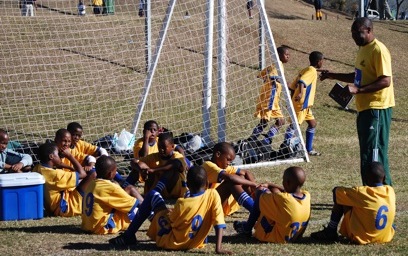
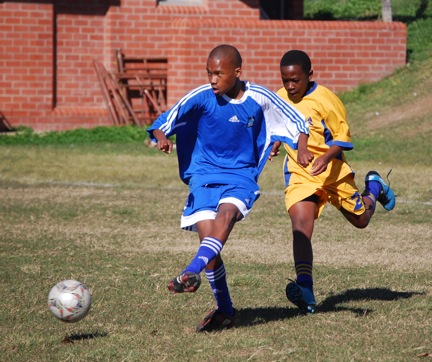
Coach Styles teaching future Bafana and PSL stars in Pietermaritzburg (Photo by Peter Alegi)


National football styles are intertwined with a country’s history and culture. Can Pitso Mosimane, Bafana Bafana’s new homegrown coach, develop a common ‘South African’ playing style? If the former SuperSport coach and Bafana assistant succeeds, he will have done better than his Brazilian, Romanian, English, Portuguese, and French predecessors.

‘South African football is a sort of United Nations,’ writes Izichwe Youth Football director Thabo Dladla in his ‘Talking Football’ column this week. ‘You have parts of the country like the Western Cape with their English influence, inland areas with diski [street style] influence, some German and Dutch influence in SAFA structures, [and more recently] Brazilian and Serbian influences.’

Clearly, Mosimane faces a daunting challenge in trying to craft a common style out of a melange of local and foreign influences. ‘South African football is more about ball retention and individual improvisation,’ Dladla notes.  ‘We grow up playing in small spaces, on hard, bumpy surfaces.  The small frame and short-to-medium height of the majority of our players make it logical to play mainly short passes on the ground.’

World champions Spain point the way forward for South Africa. It’s not a question of conveniently jumping on the winners’ bandwagon. Rather, Dladla notes that ‘Spanish football is based on technique, ball possession and nimble short-passing combination.’ That Spain’s 11 starters in the World Cup all play in La Liga further inspires many South Africans eager to raise the quality of the domestic Premier Soccer League.

Will South Africa’s performances improve under Mosimane? Will a new national style of play reflect the sharper sense of South Africanness left by the 2010 World Cup?  Perhaps, but until that time local fans will keep on blowing vuvuzelas in the stadiums: ‘They are bored,’ says Dladla, ‘There is nothing to entertain them between the lines.’
Categories
Video

Phillip is Here!


The Footsak exhibit at the Museum of Contemporary Art in Durban inspired me to make this 5-minute film about art + football. I shot it with a FlipVideo camera at the museum, World Cup matches, a tennis court in Joburg, a sports ground at UKZN Pietermaritzburg, and our veranda. Take a look.

Categories
Hosting

Podcast: Reflections on Africa’s First World Cup

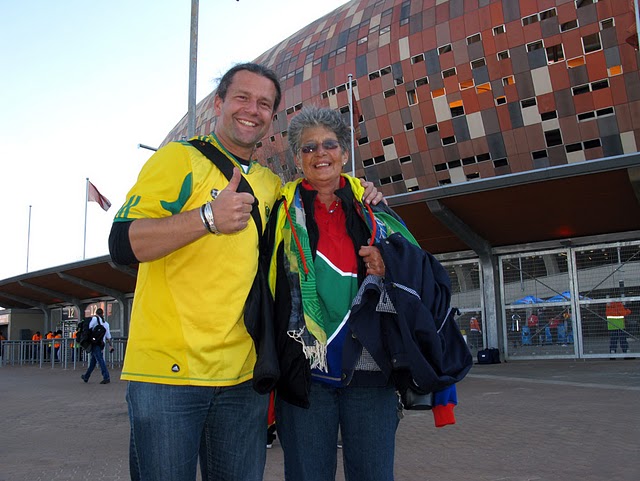
Chris Bolsmann and his mum at Soccer City, July 11, 2010 (Photo courtesy of Chris Bolsmann)


Chris Bolsmann (Sociology, Aston University) is the special guest in our latest episode of the Africa Past and Present podcast reflecting on the 2010 World Cup. Topics covered include experiences at stadiums and fan parks in South Africa; FIFA‘s Disney-fied World Cup; Pan-Africanism and the performance of African teams; and the political and economic impact of the tournament.

Click here to listen to the podcast. (mp3)

Categories
Hosting

After the World Cup: Football Again!


The 2010 World Cup in Disney-like FIFAland ended only seven days ago and since then South African columnists and cartoonists, corporate managers and car guards, compulsive fans and casuals alike have been vexed by the same post-World Cup question: what do we do now?

The immediate answer was stunningly simple. Back to the pitch! For me, that means training with the four dozen youngsters and the committed coaches of the Izichwe Youth Football program here in Pietermaritzburg. On Saturday, at the University of KwaZulu-Natal’s Peter Booysens sports ground, the teenagers played against the Durban (eThekwini) under-15 representative side due to compete in the ‘One Nation’ tournament in Bremen, Germany, in a few months.

Even though the visitors from the big city won, it was a glorious day for pure football. The illuminating pass, the righteous tackle, the crisp give-and-go, and the delicate chip shot over the keeper and into the back of the net. There will be time for improving team tactics and defensive organization. For now, let’s keep playing, learning, and giving Bafana Bafana hope for the future.

Categories
Hosting Players

World Cup All-Stars 2.0


Yesterday’s final ushered me into an emotional, existential Kalahari. Unable to resume life as usual here in South Africa, whatever that means, my therapy consists in part of playing everyone’s favorite fun game: World Cup All-Stars, version 2.0 (click here for 1.0).

Initially, the simple choice was to pick the entire Spain squad with just two changes: Fucile for Capdevila and Forlan for Torres/Pedro. But that wouldn’t be much fun. So here are my picks:

Neuer
Fucile, Juan, Pique, Sergio Ramos
Mueller, Schweinsteiger, Xavi, Sneijder
Villa, Forlan

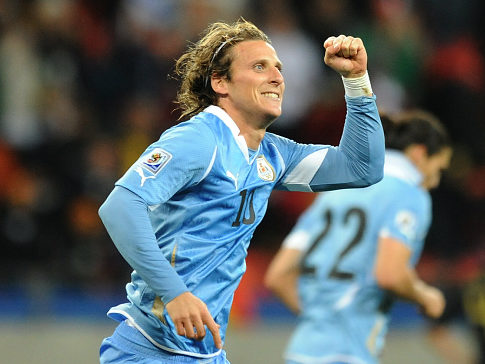
Best Players: Forlan and Sergio Ramos (because defenders are people too)

Goal of the Tournament: Van Bronckhorst in Netherlands v Uruguay (quality and importance)

Best Match of the Tournament: USA-Slovenia 2-2 (which should have gone down as one of the greatest comeback victories in World Cup history, right Mr. Coulibaly?)

Best Referee: Viktor Kassai of Hungary (This cool cat ref’d one of the cleanest World Cup semifinals ever: Spain-Germany)

Best Moments: Tshabalala’s goal for Bafana in the opener vs Mexico (when, for a few minutes, it seemed another World Cup was possible) and Buffon signing my daughters’ jersey and flag before Slovakia-Italy.

Categories
Hosting Players

Spain On Top of the World


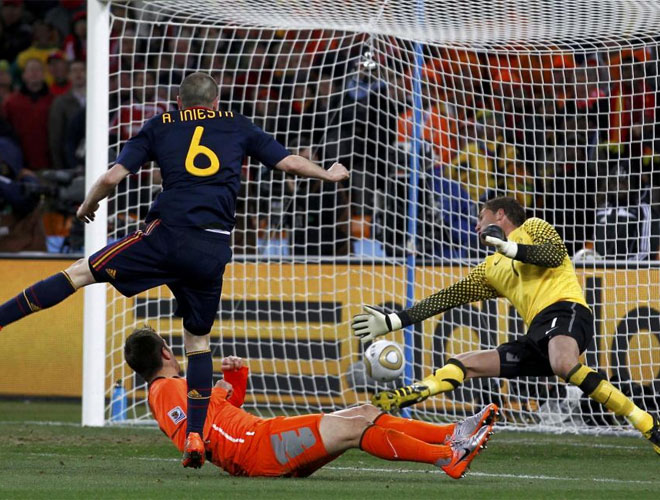
Spain are World Champions! Iniesta scores in the 116th minute to give La Roja a 1-0 victory over the Dutch at Soccer City.

Click here to read The New York Times match report, with a few words from yours truly.

Click here to read Johan Cruyff lambasting the anti-football of the Dutch and the refereeing of Howard Webb.

Categories
Video

Big Night at Soccer City


The Ukhamba (calabash in Zulu) at Soccer City. The center of attention for 3 billion people — half of humankind — on Sunday. A magnificent temple of football. A massive 95,000 seats and yet so intimate, near-perfect sight lines. What a stage for Netherlands-Spain! Click here to read the New York Times on who South Africans are supporting.