Frank Risorto of The Gentleman Ultra Podcast interviewed me about my futbological life. We began with the story of my Global Soccer history course at Michigan State, its origins and evolution. Then I explained the origin of my lifelong support of Juventus (as a Roman no less!) and moving to the United States as a teenager. There was even some time to highlight my academic work in South Africa, and how oscillating between continents has given me unusual outsider/insider perspectives on life and football. My love of Subbuteo—the table soccer game—snuck into the conversation, too!
Enjoy the conversation and, if inclined, share the link.
The Gentleman Ultra podcast on Italian calcio asked me three World Cup questions: Which was your favorite World Cup moment? Favorite game? Favorite team?
Hint: my stories have something to do with the Azzurri and Roberto Baggio. So let me take you back to Foxboro 1994 and Spain 1982. Listen here.
Curva Mundialis a podcast about the fans of the “The Beautiful Game.” In each episode, Sal Bono sets out to ask why folks from all walks of life love the teams they do and how football represents who they are and where they are from.
In Episode 24, I got to tell my story: How my love for Juventus was not an arranged marriage; calcio culture; moving to the United States; South African soccer experiences; and becoming a fútbologist. Listen here.
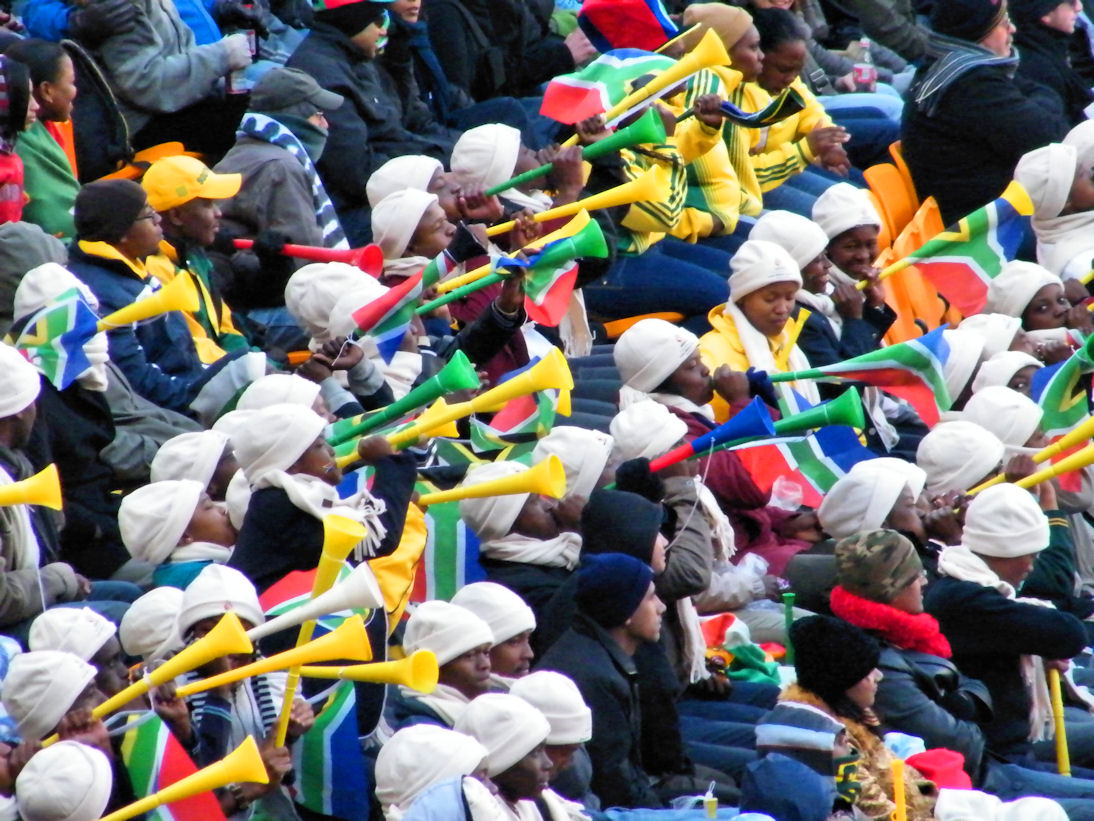
Episode 511 of the 99% Invisible podcast reconstructs the history of the vuvuzela, its cultural power at the 2010 World Cup, and its gradual downsizing in the football soundscape.
It was an honor to be interviewed for the project alongside Freddie “Saddam” Maake, the “inventor” of the plastic horn, Mark Gleeson, the legendary football broadcaster, and Duane Jethro, the leading scholar on the topic.
The episode was produced by reporter James Parkinson (@JamesRParkinson).
This Greens vs. Blues match between what appear to be 8-9 year olds is quintessential recreational soccer. They move in packs. The most daring among them dribble for dribbling sake. Technique is mostly an abstract concept. Goalkeeping resembles outfield play in Little League baseball. The ball ends up in the back of the net a few times, though the youngsters don’t seem to care about that as much as their parents do. The referee dad loves blowing his whistle. And just like today, coaches and parents shout “advice” and encouragement from the sidelines. It’s great to see gender integrated teams at play, though I did wonder why most players shunned shorts.
On March 21, 2022, SAfm—South Africa’s national news and talk radio station—did a live interview with me on the “Sport On” show about the connections between soccer, apartheid, and human rights.
March 21 is Human Rights Day in South Africa, a national holiday honoring the victims of the Sharpeville Massacre of 1960. That Monday morning, South African police shot peaceful protestors, killing 69—many of them in the back—and wounding nearly 200 outside a police station in Sharpeville township, near Vereeniging, a 45-minute drive south of Johannesburg. The police killings brought international condemnation and triggered Pretoria’s banning of the African National Congress (Nelson Mandela’s organization) and the Pan Africanist Congress (which had organized the Sharpeville demonstration). With the country suddenly under martial law, the liberation movements turned to armed struggle.
As I say at the start of the interview with Thabiso Mosia (after a few technical difficulties), the 1960 massacre and its aftermath informed FIFA’s decision the following year to suspend South Africa. The world governing body’s sanctions marked an important early victory in the increasingly global fight against apartheid and instilled hope among South Africans at a grim time. Isolation from world soccer accelerated the campaign to transform South Africa into a pariah of global sport. In 1970, the country of apartheid was expelled from the Olympics and by the 1980s few sporting bodies or competitions allowed South Africans to participate.
My conversation with Mosia went on to discuss a few other things, too, such as the remarkable life of Darius Dhlomo—one of the first Black South African pros in Europe—racial integration in South African soccer, and the country’s hosting of the 2010 FIFA World Cup.
Feel free to listen to the interview below and share it, too!
CGTN’s Mike Walter and Peter Alegi, Professor of history and global soccer studies at Michigan State University, discuss the legacy of Diego Maradona, both on and off the football pitch.