
By Mohlomi Maubane
The 2010 World Cup was heralded as the dawn of a new era in South African football. This new epoch was to be devoid of the old amateurish ways in the local game where officials “forget” to perform rudimentary tasks like erecting corner kick flags for an international match. But alas, as the events of the past week have shown, it’s not yet Uhuru.
A few weeks ago, the wise chaps at SAFA announced an upcoming friendly against Burkina Faso, 41st in the FIFA rankings. Problem is they seem to have forgotten to confirm this news with the intended opponents. When they did eventually contact the Burkinabe FA last week to “finalize” arrangements for the match, SAFA officials found out the West African country already had a fixture against Cape Verde on the same day. A scramble to find a “replacement” ensued. So now in preparation for a crucial AFCON qualifier against Egypt in March, on Wednesday (Feb. 9) at the Royal Bafokeng stadium outside Rustenburg Bafana Bafana will instead square up against mighty Kenya, ranked 127th by FIFA.
Speaking of the first World Cup host team to be eliminated in the first round, Bafana Bafana will soon be trading under a different name. Why? SAFA failed to register the team’s nickname. Instead, a shrewd businessman named Stanton Woodrush owns the copyright and is not playing ball, unless he is handsomely rewarded for being the first to register the Bafana name with the Department of Trade and Industry.
Simply put, SAFA are a disgraceful bunch. Despite the election of a new leadership in September 2009, the association failed to secure a training camp for Bafana Bafana in preparation for the 2010 World Cup; failed (again) to submit votes for the FIFA World Player of the Year awards; and failed to send a confirmation letter to CAF stating their intention to send the national Under 23 team to participate in the All-Africa games.
Perhaps, the overall state of the nation and its favourite pastime is best symbolized by the postponement of a Chiefs vs. Swallows game scheduled for February 5 at FNB Stadium – known as Soccer City during the World Cup – due to the theft of electric cables that left the stadium without power. Soccer City was a showpiece of South Africa’s technological sophistication and, with its calabash shell exterior, a monumental symbol of Africa’s first World Cup. The circumstances that led to a domestic league game being postponed there less than nine months after hosting the 2010 World Cup final, together with SAFA’s latest foibles, illustrate vividly how in South African football the more things change, the more they stay the same.
Month: February 2011
Categories
Blogging History: The Case of Isiah Stein
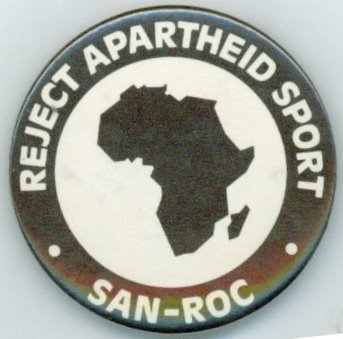
When Chris De Broglio told me the sad news of Isiah Stein’s passing I knew very little about this brave Capetonian activist. All I could remember was that he was an exiled South African, a former executive committee member of SANROC, the heart and soul of the anti-apartheid sport boycott, and that his sons had played professional football in Britain.
Then Omar Badsha, an ex-activist and founder of South African History Online, wrote a strange comment to my post. He asserted that Stein was white and could not have been incarcerated on Robben Island, a prison reserved for black political activists.
Based on the skin color of the Stein footballers, I had assumed their father was black (in the Black Consciousness sense of the word). In his comment to my post, Howard Holmes, director of the Sheffield-based Football Unites, Racism Divides (FURD), seemed bewildered by the confusion about Stein’s racial identity. After further research, I confirmed that the Cape Town-born Stein was classified “Coloured” (mixed race) under apartheid’s racial classification system. In other words, he was definitely not white.
But had he done time in the infamous apartheid prison with Nelson Mandela in the mid-1960s? This online list of Robben Island prisoners does not have Stein’s name. I consulted memoirs of prisoners and other published sources to no avail. I turned to colleagues intimately familiar with the Robben Island/Mayibuye Archives at the University of the Western Cape, but came up empty.
To resolve the matter, I sought the help of a former political prisoner who survived twelve years on the island. He sent a swift, courteous, and unambiguous reply: “Isiah was definitely not on Robben Island during the period [between] 1964 and 1975.”
I am struck by how a simple “hamba kahle” (Go Well, Rest in Peace) post in honor of a sport and human rights activist took on a life of its own. Blogging, memory, and the craft of history combined together to shed some new light on a not-so-ordinary South African and, at the same time, revealed how the history of the liberation struggle in South Africa is far from complete and seldom free of controversy and contestation.